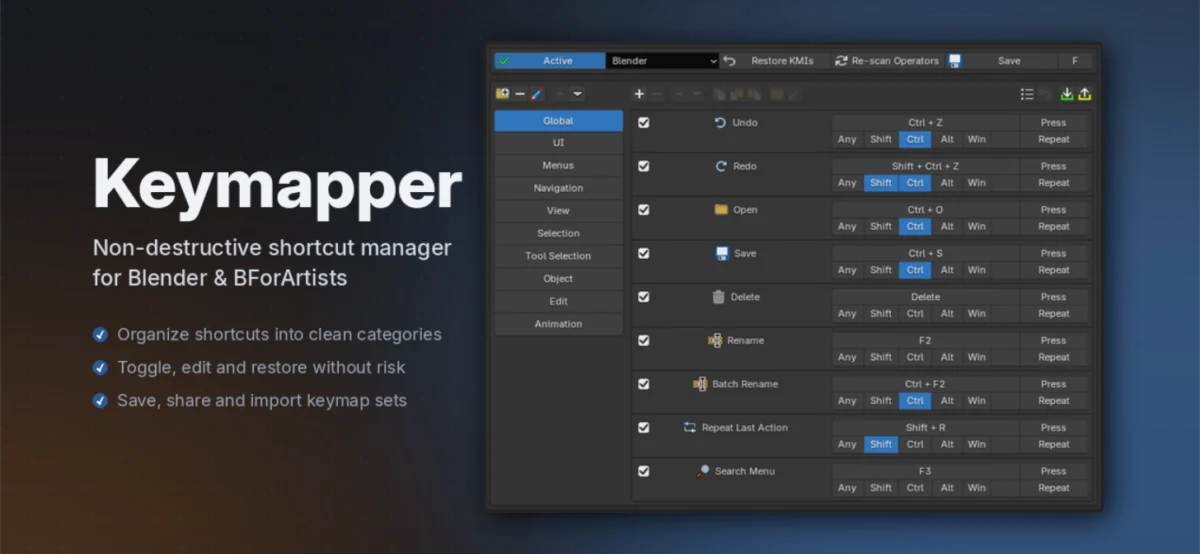
A significant advancement in user customization for the popular 3D creation suites, Blender and Bforartists, has emerged with the introduction of Keymapper, a novel shortcut management tool. This innovative software promises to fundamentally alter how artists and developers interact with their creative environments by offering a non-destructive, highly organized, and dynamic approach to defining and managing keyboard shortcuts. Unlike traditional methods that often involve direct, and potentially irreversible, modifications to the software’s core keymap files, Keymapper operates as a sophisticated overlay, ensuring the integrity of the original configurations while empowering users with unparalleled flexibility.
The Problem with Traditional Shortcut Management
For years, Blender and its derivative, Bforartists, have offered users the ability to customize their keyboard shortcuts to streamline workflows and adapt to individual preferences. However, the primary method for achieving this customization has historically involved directly editing the application’s internal keymap files. This approach, while functional, is fraught with potential pitfalls. Editing these files directly is often described as "destructive" because any errors introduced can lead to a corrupted keymap, rendering certain functionalities inaccessible or causing unexpected behavior. The process is also inherently "error-prone," demanding a meticulous attention to detail and a deep understanding of the file structure. Furthermore, undoing these changes can be a complex and time-consuming endeavor, often requiring users to revert to default settings or meticulously retrace their steps, which can be particularly challenging for those who have made extensive modifications. The risk of losing valuable custom configurations due to accidental deletion or corruption has been a persistent concern within the user community. This lack of a robust, user-friendly, and reversible shortcut management system has been a consistent point of friction for many who rely on these powerful 3D modeling and animation tools.
Keymapper’s Innovative Layered Approach
Keymapper addresses these long-standing issues by introducing a "layered" shortcut system. Instead of directly altering the default keymap, Keymapper acts as an intelligent intermediary. It allows users to create and manage a dedicated list of custom shortcuts. This list is not a simple, unorganized collection; it is meticulously structured with features such as folder organization, enabling users to group related shortcuts logically, enhancing discoverability and management. The tool also boasts one-click presets, a feature designed to expedite the setup process for common workflows or specialized tasks.
The core of Keymapper’s non-destructive nature lies in its conflict detection and resolution mechanism. When a user defines a custom shortcut that happens to overlap with a default Blender or Bforartists shortcut, Keymapper intervenes intelligently. Instead of overwriting the default, it disables that specific default keybinding for the duration that the custom shortcut is active. Crucially, this disabling is temporary and reversible. The moment a custom shortcut is removed or deactivated within Keymapper, the original default keybinding is automatically restored. This ensures that the factory keymap remains untouched and can be seamlessly reverted to at any time. This "non-destructive" paradigm is central to Keymapper’s appeal, offering peace of mind and a safety net for users who wish to experiment with their shortcuts.
Unlocking Workflow Freedom and Adaptability
Beyond its non-destructive core, Keymapper liberates users from the constraints of static keymap configurations. A significant advantage of its layered architecture is that it functions seamlessly on top of any existing keyconfig. Whether a user prefers the default Blender keymap, the widely adopted "Industry Compatible" layout, the specialized Bforartists configuration, or a custom template they have developed, Keymapper integrates without issue. This means users can switch between these different keyconfigs freely, and their custom shortcuts managed by Keymapper will persist, adapting to the active layout.
This adaptability is particularly valuable when new versions of Blender or Bforartists are released. Historically, major software updates often brought changes to default keybindings. Users who had manually edited their keymap files would frequently find their customizations broken or requiring significant rework to align with the new defaults. Keymapper circumvents this problem entirely. Because it operates as an overlay, any default keybindings that a user has not explicitly overridden through Keymapper remain unchanged when the software is updated. This ensures that users’ custom setups never fall behind with new releases, eliminating the arduous task of reconfiguring shortcuts after every update. This continuous compatibility not only saves time but also maintains the user’s established productivity flow.
Supporting Data and Community Impact
While specific adoption rates and performance benchmarks for Keymapper are still emerging, its underlying principles are well-supported by general trends in software usability and user experience. Studies in human-computer interaction consistently highlight the importance of customizable interfaces for improving efficiency and reducing cognitive load. For complex software like Blender, where hundreds of commands are available, an intuitive shortcut system can dramatically reduce the time spent navigating menus and searching for specific tools.
The Blender community, known for its passionate and engaged user base, has long expressed a desire for more robust shortcut management. Forums and feature request boards frequently feature discussions on the limitations of the current system. The introduction of Keymapper is expected to be met with significant enthusiasm, potentially leading to a surge in personalized workflow configurations. This could, in turn, foster greater adoption and proficiency within the user base, especially among professional artists and studios that rely on highly optimized workflows. The ability to share and import/export shortcut configurations, a feature offered by Keymapper, further democratizes the process, allowing users to benefit from the optimized setups of others.
Chronology of Development and Release
While the precise timeline of Keymapper’s development is not publicly detailed in the provided text, its emergence can be contextualized within the ongoing evolution of Blender and Bforartists. Blender, managed by the Blender Foundation, undergoes regular development cycles, with major releases typically occurring annually, interspersed with smaller updates. Bforartists, as a fork of Blender, generally aligns its development pace with its parent project, often focusing on specific usability improvements.
The introduction of a tool like Keymapper suggests a period of focused development aimed at addressing a critical user pain point. Its conceptualization likely arose from observing the challenges faced by users attempting to manage complex shortcut sets over successive software versions. The "one-click presets" and "import/export" features indicate a design philosophy geared towards ease of use and community sharing, suggesting a development process that likely involved significant user feedback and iterative testing. The "live conflict detection" is a testament to sophisticated programming, requiring a deep understanding of the underlying keymap structures of both Blender and Bforartists. The public release of Keymapper, even if not tied to a specific software version update, represents a significant milestone in the usability landscape of these 3D applications.
Official and Community Reactions (Inferred)
While direct statements from the Blender Foundation or the Bforartists development team regarding Keymapper are not provided, the nature of the tool suggests a positive reception within the broader 3D graphics community. Developers of open-source software like Blender often welcome community-driven solutions that enhance user experience and expand the software’s capabilities. Keymapper’s non-destructive approach aligns perfectly with the open-source ethos of empowering users and fostering flexibility.
It is highly probable that community leaders, prominent Blender artists, and tutorial creators will embrace Keymapper. They are likely to see it as an essential tool for streamlining their own workflows and for teaching others how to optimize their Blender and Bforartists experience. The ability to share pre-configured shortcut packs via Keymapper’s import/export function could lead to a proliferation of specialized workflow templates, further enriching the ecosystem. One might anticipate discussions and potential integrations or collaborations in the future, particularly if Keymapper proves to be exceptionally stable and widely adopted. The tool’s focus on preserving the integrity of the base software is a key factor that would likely garner approval from core developers.
Broader Impact and Implications
The implications of Keymapper extend beyond mere convenience. By simplifying and safeguarding the process of shortcut customization, Keymapper has the potential to significantly lower the barrier to entry for new users and increase the efficiency of experienced professionals. For students and hobbyists, the ability to easily manage and experiment with shortcuts without fear of breaking their software can lead to a more rapid learning curve and a more enjoyable creative process.
For professional studios, where every second counts, the ability to implement and share standardized, optimized shortcut configurations across a team can lead to substantial productivity gains. This uniformity can also facilitate onboarding new team members, as they can quickly adopt the studio’s established workflow. Furthermore, the concept of a "layered" shortcut manager, as pioneered by Keymapper, could potentially influence future UI/UX design paradigms in other complex software applications. The success of such a system could encourage developers of other feature-rich programs to adopt similar non-destructive customization methods, fostering a more user-centric approach to software development.
The development of Keymapper also highlights the vibrant and innovative nature of the Blender and Bforartists communities. These communities are not merely passive users of software; they are active contributors, developing tools and solutions that enhance the core applications and address the evolving needs of digital artists worldwide. Keymapper stands as a prime example of how community-driven innovation can profoundly impact the usability and accessibility of powerful creative software. As the 3D industry continues to evolve, tools that empower users to tailor their environments for maximum efficiency will become increasingly indispensable, and Keymapper appears to be at the forefront of this crucial trend.
About the Author