The landscape of Extended Reality (XR) hardware is undergoing a significant shift as startups move beyond traditional input methods toward more seamless, biological interfaces. At the recent VR/AR Expo China held in Shanghai, a Western startup named Immersix introduced a disruptive approach to eye-tracking technology that promises to solve many of the persistent challenges facing modern Mixed Reality (MR) and Virtual Reality (VR) headsets. While the majority of industry leaders, including Meta and Sony, rely on pupil-tracking mechanisms, Immersix has pivoted toward retina-tracking—a method that utilizes the internal structures of the eye as a fixed reference point for orientation and movement.
The Technological Shift: From Pupil to Retina Tracking
Traditional eye-tracking solutions typically utilize a ring of infrared (IR) LEDs to create "glints" on the cornea, which a camera then tracks in relation to the pupil. While effective, this method is susceptible to "calibration drift," where the system loses accuracy if the headset shifts slightly on the user’s face. Immersix’s innovation lies in its hardware efficiency and its algorithmic focus. Each eye module in the Immersix system consists of only a single camera and a single IR LED. Rather than focusing on the exterior surface of the eye, the camera is designed to look through the pupil to capture the unique vascular patterns and features of the retina.
According to technical specifications released by the company, this approach offers several distinct advantages. By using the retina as a "ground truth" or a biological fingerprint, the system can determine absolute eye rotation with sub-degree accuracy. Because the retina is a fixed internal structure that does not change significantly over a person’s adult life, the data gathered acts as a persistent map. This eliminates the need for the repetitive recalibration cycles that currently plague high-end headsets like the Apple Vision Pro or the Quest Pro, where even minor shifts in the device’s physical position can degrade tracking performance.

Context and Chronology of the Shanghai VR/AR Expo Demonstration
The VR/AR Expo China in Shanghai has long served as a critical venue for Western startups seeking to integrate with the massive Asian hardware supply chain. In May, Immersix utilized this platform to move its technology from the theoretical stage to a functional demonstration. The company provided a development kit to a select group of industry observers and evaluators to showcase the robustness of their retina-mapping algorithm.
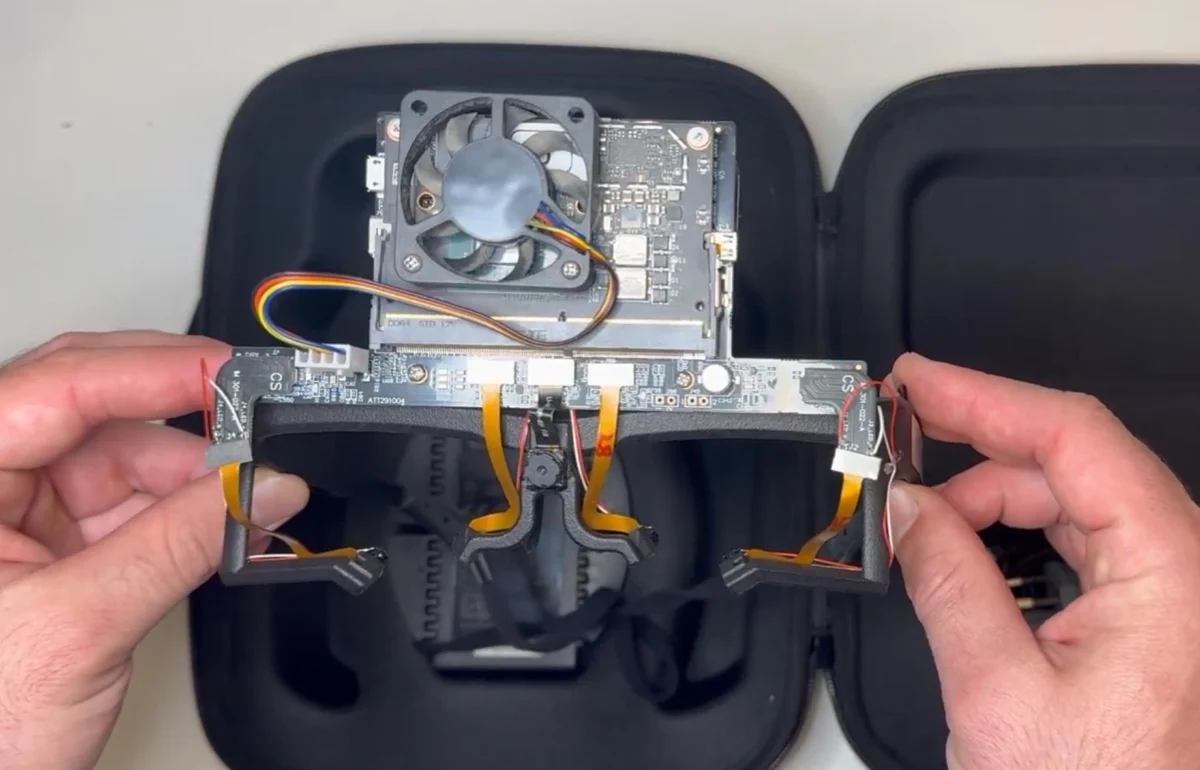
The demonstration began with a hardware evaluation of the Immersix prototype. Unlike a finished consumer product, the devkit consisted of standard eyeglass frames equipped with exposed circuitry, cameras, and IR sensors. This prototype was tethered to a high-performance laptop to handle the initial data processing. The chronology of the user experience was divided into two distinct phases: the "Mapping Phase" and the "Active Tracking Phase."
During the Mapping Phase, users were required to follow a digital pointer on a screen. This process was designed to be more comprehensive than standard five-point calibration. As the user moved their eyes, the software incrementally captured various regions of the retina, stitching them together into a high-resolution feature map. Evaluators noted that toward the end of this two-minute process, the software intentionally introduced a slight "lag" or resistance to the pointer, forcing the user to exert more lateral eye movement. This ensured that the camera could document the peripheral edges of the retina, completing the "fingerprint" necessary for long-term tracking.
Performance Benchmarks and Hands-On Results
Once the initial retina map was established, the system transitioned into Active Tracking. In this phase, the Immersix software matched the small, visible portion of the retina seen by the camera in real-time against the stored full-retina map. This "matching" algorithm allows the system to calculate the exact angle of the eye regardless of whether the headset has moved on the user’s nose or forehead.

Testing at the Shanghai expo confirmed that the system maintains high levels of precision even after the user removes and replaces the hardware. In a series of interface tests—where users were asked to select various UI elements on a grid simply by looking at them—the Immersix system demonstrated a 120Hz refresh rate and near-instantaneous response times. The accuracy remained consistent throughout the session, successfully avoiding the "jitter" often associated with pupil-based systems that struggle with light reflections or eyelid interference.
Furthermore, the hardware’s reduced footprint is a significant data point for the future of Augmented Reality (AR) glasses. By requiring only one LED per eye, Immersix reduces the power consumption and thermal output of the tracking module, two factors that are critical for the development of lightweight, all-day wearable smart glasses.
Industry Implications and the Problem of Calibration Drift
The broader implications for the XR industry are substantial. One of the primary barriers to the mass adoption of eye-tracking is the "friction" caused by setup. If a user must recalibrate their device every time they put it on, the "pick-up-and-play" appeal of the device vanishes. Immersix’s ability to treat the retina as a persistent coordinate system could potentially make eye-tracking a "set it and forget it" feature.
Moreover, high-accuracy eye-tracking is the foundational requirement for foveated rendering—a technique where the computer only renders the area the user is looking at in high resolution. If the tracking is even slightly off, the user perceives a blurry image, leading to eye strain and motion sickness. By providing sub-degree accuracy, Immersix could enable more aggressive foveated rendering, allowing mobile XR chips to produce graphics that rival high-end PCs by saving up to 60-80% of GPU processing power.

Addressing Biometric Privacy and Security
As with any technology that scans biological markers, the emergence of retina-tracking raises significant privacy concerns. The retina is one of the most secure biometric identifiers in existence, often used in high-security government and military installations. The prospect of a consumer electronics device maintaining a permanent scan of a user’s retina has drawn scrutiny from data privacy advocates.
In response to these concerns, the industry standard is shifting toward "On-Device Processing." Immersix has indicated that their solution is designed to store and process the retina map locally within the headset’s secure enclave. By ensuring that biometric data never reaches the cloud, the company aims to mitigate the risk of identity theft. Additionally, the retina map could serve a dual purpose: providing both the input mechanism for the UI and a biometric "login" for the device, similar to FaceID on smartphones but integrated directly into the optics of the glasses.
Future Outlook for Immersix
As of mid-2024, Immersix is positioning itself as a component supplier and licensing partner rather than a standalone headset manufacturer. The company has made evaluation kits available to major original equipment manufacturers (OEMs). Given the current trajectory of the market—where companies like Meta, ByteDance (Pico), and Samsung are racing to develop thinner, more capable MR devices—the demand for ultra-small, low-power tracking modules is at an all-time high.
While the initial calibration process is currently longer than existing solutions, the trade-off of never needing to calibrate again presents a compelling value proposition. If Immersix can successfully miniaturize its circuitry for mass production and continue to prove its robustness across diverse eye shapes and colors, retina-tracking may soon replace pupil-tracking as the gold standard for the next generation of spatial computing.
About the Author