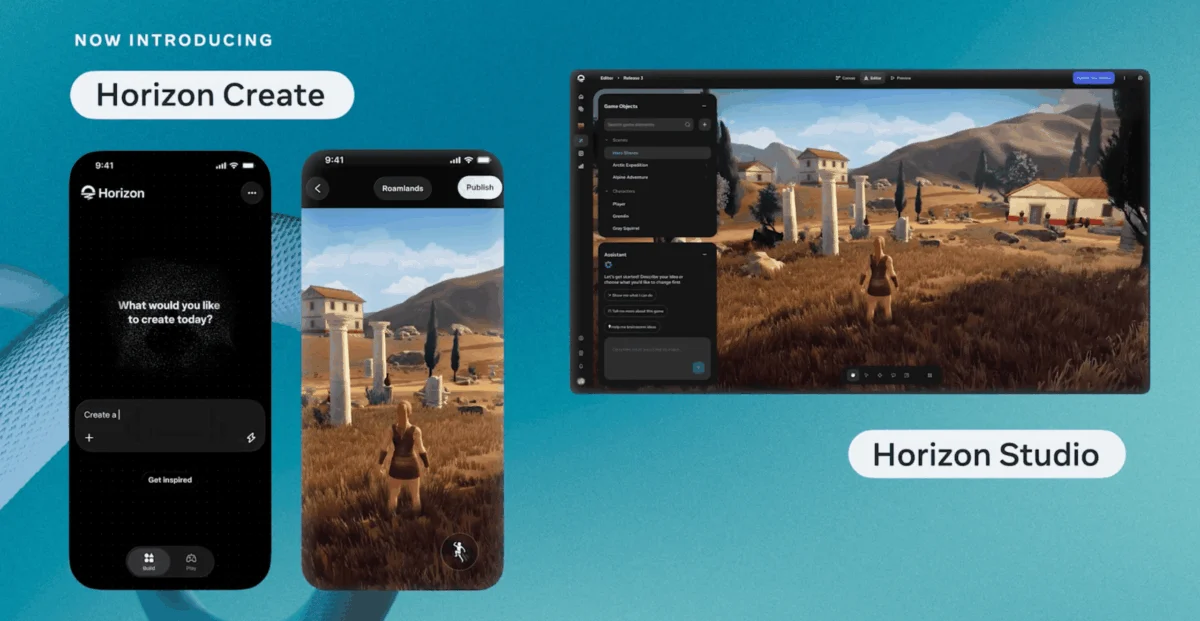
Meta has officially announced the launch of Horizon Create and Horizon Studio, a suite of advanced creative tools designed to democratize game development through generative artificial intelligence and seamless social media integration. Unveiled during the annual Meta Connect conference, these tools represent a significant strategic pivot for the company, moving away from a hardware-centric "metaverse" toward a more accessible, software-driven ecosystem that leverages the massive user bases of Facebook and Instagram. The new Horizon Create app allows users to generate complex 3D environments and interactive gameplay mechanics using natural language prompts, while the Horizon Studio toolset provides a more robust, browser-based environment for granular editing and professional-grade development.
The introduction of these tools marks Meta’s most aggressive attempt to date to lower the barrier to entry for digital content creation. By integrating generative AI directly into the creation pipeline, Meta aims to transform passive social media consumers into active creators. According to the company’s presentation, the Horizon Engine—the underlying technology powering these tools—can interpret text-based instructions to build assets, script behaviors, and arrange spatial layouts in real-time. This "prompt-to-game" capability is intended to compete with established user-generated content (UGC) platforms such as Roblox and Fortnite Creative, which have seen exponential growth in recent years.
Bridging the Gap Between Creation and Consumption
The Horizon Create app is designed primarily for mobile and VR headsets, offering an intuitive interface where users can experiment with "remixing" existing templates or starting from scratch with AI prompts. While the AI processes the request and builds the requested environment, users are encouraged to explore other player-created worlds, creating a continuous loop of engagement. This social aspect is a cornerstone of Meta’s strategy; the company envisions a future where game creation is as casual and collaborative as posting a "Reel" or a "Story."
Complementing the mobile-friendly Create app is Horizon Studio. This tool is accessible via standard web browsers, allowing for a level of precision that touchscreens or VR controllers often lack. Horizon Studio is aimed at more experienced developers who require fine-tuned control over game logic, physics, and aesthetic details. Crucially, the two platforms are fully interoperable. A creator can start a project using AI prompts on their phone via Horizon Create and later refine the mechanics using the more traditional interface of Horizon Studio on a desktop computer.
The Frictionless Distribution Model
Perhaps the most disruptive feature of the new Horizon suite is its integration with Meta’s existing social ecosystem. Historically, virtual reality and high-end gaming have been hindered by high "friction"—the need to purchase expensive hardware, download large files, or navigate complex digital storefronts. Meta’s new architecture bypasses these hurdles by making games "natively" playable within Facebook and Instagram feeds.
Using WebXR technology and cloud streaming, a user scrolling through their Instagram feed can click on a video clip of a game and be instantly transported into a multiplayer session. There is no requirement to download a separate application or leave the social media platform. This "instant play" functionality is designed to capitalize on the viral nature of social media, allowing creators to reach Meta’s billions of daily active users without the traditional marketing costs associated with game launches. Meta executives noted that this native placement ensures games live exactly where people are already discovering content and connecting with friends.
Historical Context and the Evolution of Meta’s Virtual Ecosystem
The announcement of Horizon Create and Studio comes at a critical juncture for Meta. Since rebranding from Facebook in 2021, the company has invested over $50 billion into its Reality Labs division, often facing skepticism from investors regarding the long-term viability of the metaverse. The initial iteration of Horizon Worlds, Meta’s flagship VR social platform, struggled with user retention and a perceived lack of high-quality content.
A chronological look at Meta’s development cycle reveals a steady shift toward accessibility:
- 2021: Rebrand to Meta and the launch of Horizon Worlds in the US and Canada.
- 2022: Expansion of Horizon Worlds to web and mobile browsers in beta, attempting to move beyond the Quest headset requirement.
- 2023: Integration of more sophisticated scripting tools and the introduction of "Super Rumble," a high-fidelity first-person shooter designed to showcase the platform’s improved graphical capabilities.
- 2024: The pivot to generative AI with Horizon Create, focusing on reducing "time-to-fun" for both creators and players.
By moving the focus from the hardware (VR headsets) to the content (AI-generated games) and the distribution (social feeds), Meta is attempting to replicate the success of the mobile gaming revolution but within its own walled garden.
Economic Incentives and the Horizon Creator Fund
To ensure a steady stream of high-quality content, Meta has reaffirmed its commitment to the Meta Horizon Creator Fund. This multi-million dollar initiative provides financial backing, technical support, and mentorship to selected developers. During the Connect event, Meta confirmed that the Horizon Create and Studio apps are already in the hands of a "select group" of early-adopters and professional creators who are stress-testing the AI capabilities.
Monetization remains a primary concern for the developer community. While specific details on revenue-sharing models were teased as "coming soon," Meta indicated that creators will have multiple avenues to earn income, including in-game purchases, subscriptions, and potentially ad-revenue sharing. This economic layer is essential for Meta to compete with Roblox, which paid out over $700 million to its creator community in 2023 alone.
Competitive Landscape: Challenging the Dominance of Roblox and Fortnite
Meta’s entry into the AI-powered UGC space places it in direct competition with industry titans. Roblox currently boasts over 70 million daily active users, many of whom are younger demographics that Meta has struggled to recapture on Facebook. Similarly, Epic Games’ Fortnite Creative (and the Unreal Editor for Fortnite) has turned a battle royale game into a massive platform for user-created experiences.
However, Meta holds a unique advantage: the social graph. Neither Roblox nor Epic Games possesses a social network with the reach of Instagram and Facebook. By embedding games into the social feed, Meta is banking on the idea that "social gaming" should be as easy to share as a photograph.
Industry analysts suggest that Meta’s use of AI could be the "great equalizer." While Roblox and Fortnite require a certain level of technical proficiency or time investment to build something compelling, Meta’s prompt-based system could theoretically allow anyone to create a functional game in minutes. This could lead to a massive influx of "hyper-casual" content, which has historically performed well on mobile platforms.
Technological Implications and Future Outlook
The reliance on generative AI for game development raises several technical and ethical questions that Meta will need to address as the tools roll out to the general public.
- Content Moderation: With the ability to generate entire worlds from a single prompt, the volume of content will likely outpace traditional human moderation. Meta will need to rely on automated AI safety layers to prevent the creation of inappropriate or harmful environments.
- Intellectual Property: As AI models are trained on existing data, the ownership of AI-generated assets remains a legal gray area. Meta has stated that creators will own the "experiences" they build, but the underlying assets generated by the Horizon Engine may remain part of the Meta ecosystem.
- Technical Fidelity: While "prompt-to-game" technology is revolutionary, the current state of AI-generated 3D environments often lacks the polish of hand-crafted assets. The success of Horizon Create will depend on how quickly Meta can improve the visual and mechanical quality of its AI outputs.
The rollout of these tools will be gradual. Early access is currently being expanded to a broader range of creators, with a general public release expected in the coming months. As Meta continues to integrate these features, the boundary between "social media" and "gaming platform" will likely continue to blur.
In summary, Horizon Create and Horizon Studio represent a holistic reimagining of Meta’s digital strategy. By combining the ease of generative AI with the massive distribution power of Facebook and Instagram, Meta is not just building a gaming platform; it is attempting to create a new medium of social expression. The success of this venture will depend on whether the company can foster a vibrant, self-sustaining economy of creators who can turn simple AI prompts into engaging, viral experiences for a global audience.
About the Author