The mobile gaming sector entered the second quarter of 2026 amidst a complex landscape of plateauing consumer spend, significant shifts in genre dominance, and a resurgence of high-value mergers and acquisitions. As publishers navigate the post-pandemic era, the industry is witnessing a consolidation of power among top-tier titles and a strategic pivot toward efficiency-driven technologies like artificial intelligence. Central to this narrative is the announcement from Playtika regarding a renewed search for strategic alternatives, alongside a global stabilization of in-app purchase (IAP) revenue at $20.5 billion. This report synthesizes the latest financial results, market data, and corporate movements to provide a comprehensive overview of the mobile gaming ecosystem in early 2026.

Playtika Reinitiates Strategic Review Amidst Valuation Volatility
Playtika, the Israel-based pioneer of the social casino genre, has officially announced a comprehensive review of strategic alternatives across its entire portfolio. By appointing Morgan Stanley as its financial advisor, the company has signaled to the market that it is once again open to a potential sale, merger, or significant restructuring. This marks the second time in four years that the company has sought such a path, following a similar, unsuccessful review initiated in February 2022.
The context for this review is a stark contrast between Playtika’s historical valuation and its current market standing. As of the first quarter of 2026, Playtika’s market capitalization has settled near $1 billion, representing a staggering 90.93% decline from its January 2021 valuation of $12.95 billion. Despite this contraction in equity value, the company’s enterprise value—incorporating debt and cash considerations—remains estimated between $2.7 billion and $2.9 billion.

Industry analysts suggest that Playtika’s move is a reaction to the cooling of the social casino market and the increasing difficulty of organic growth in a privacy-centric user acquisition environment. While the company failed to find a buyer in 2022, it has remained an active acquirer in the interim, absorbing fellow Israeli studios such as SuperPlay (developers of Dice Dreams) and InnPlay Labs (creators of Animals & Coins). These acquisitions were intended to diversify Playtika’s revenue streams beyond its core slots-based titles, but the continued pressure on its stock price suggests that investors are seeking a more radical shift in corporate structure or a complete exit.
Global IAP Revenue Stability and the Download Deficit
According to the latest data from M&A advisory firm Aream, global consumer spending on mobile game in-app purchases reached $20.5 billion in Q1 2026. This figure represents a plateau in the market, showing only a marginal increase from the $20.4 billion recorded in Q1 2025. Throughout 2025, quarterly revenues hovered consistently between $20.2 billion and $21 billion, suggesting that the industry has reached a point of maturity where growth is no longer driven by a rising tide of new spenders, but by the retention and monetization of existing high-value users.

While revenue remains stable, the volume of downloads tells a different story. Total installs for Q1 2026 fell to 11.8 billion, a 12% year-over-year decrease from the 13.4 billion recorded in the first quarter of 2025. This downward trend was persistent throughout the previous year, with downloads dropping from 12.8 billion in Q2 2025 to 11.7 billion in Q4 2025. The widening gap between stable revenue and declining downloads indicates a significant increase in the Average Revenue Per Download (ARPD), reflecting a market where "whales" and dedicated long-term players are more critical than ever to a game’s financial health.
Geographically, China remains the undisputed leader in mobile gaming revenue, with publishers headquartered there generating $26.5 billion over the 12-month period ending in March 2026, a slight 0.6% year-over-year increase. In contrast, U.S.-based publishers saw a significant 14% decline in revenue to $10.9 billion. Emerging markets showed the most aggressive growth, with Singapore-based publishers rising 22% to $4.5 billion and Türkiye-based firms surging 28% to reach $4.4 billion, solidifying Türkiye’s position as a premier global hub for mobile game development.

Top Performers: The Dominance of Honor of Kings and the Rise of Last War Survival
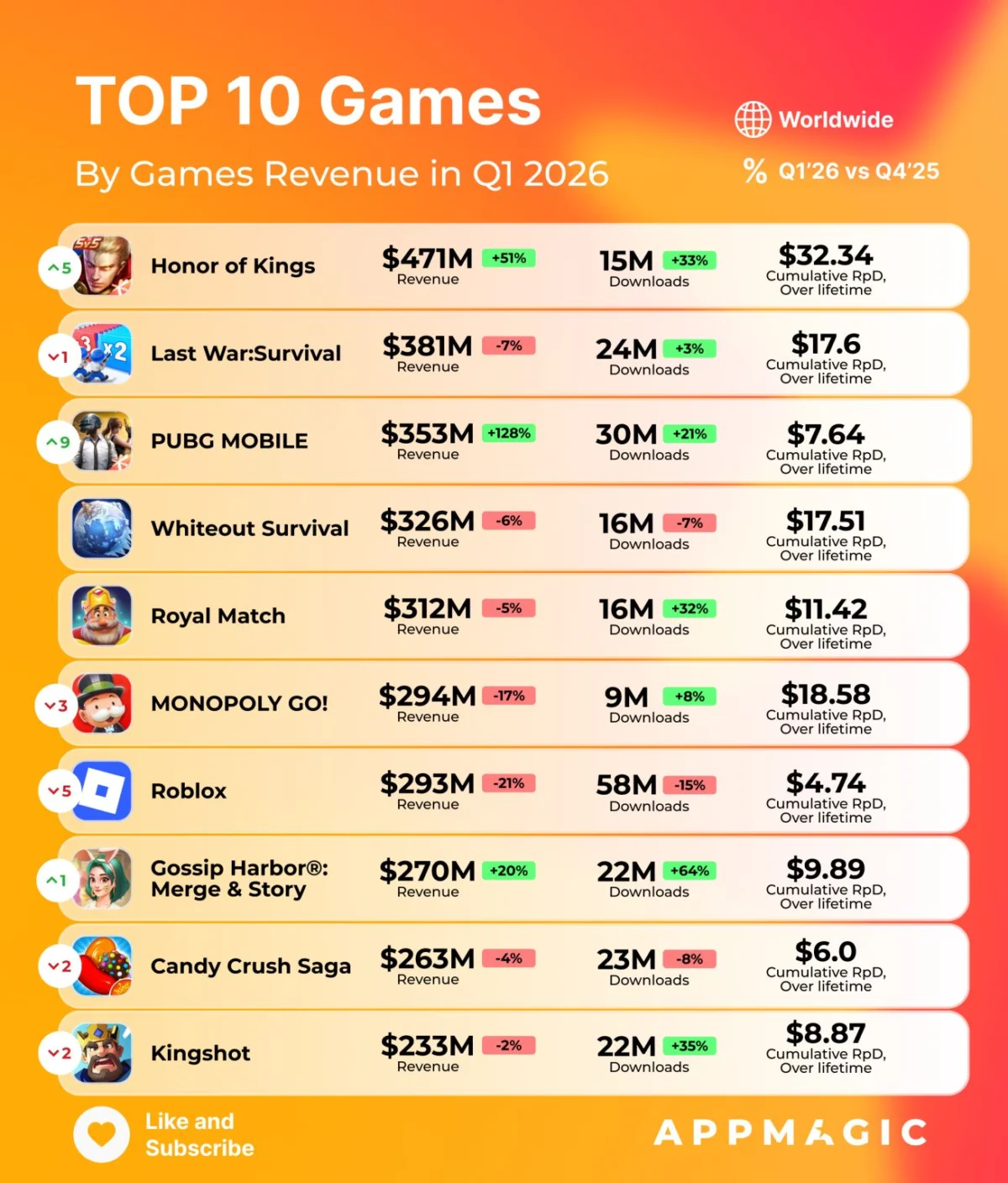
The competitive rankings for Q1 2026 highlight the continued dominance of established intellectual properties alongside the rapid ascent of new genre leaders. Tencent’s Honor of Kings reclaimed the top spot as the highest-earning mobile game worldwide, generating $471 million in IAP revenue during the first three months of the year. The title achieved a record-breaking monthly high of $188 million in January, bolstered by seasonal events and a loyal player base in Asia. Notably, Honor of Kings maintains the highest cumulative revenue per download among the top 10 titles at $32.34.
Slipping to second place was Last War: Survival, which nonetheless posted a formidable $381 million in quarterly revenue. The game’s success is emblematic of a broader trend in the 4X strategy genre, where aggressive marketing and hybrid-casual mechanics have successfully lowered the barrier to entry for high-monetization strategy games. PUBG Mobile secured the third position, notably achieving a 128% quarter-over-quarter earnings increase to reach $353 million, the largest growth spurt among the top tier.

The mid-table rankings featured a mix of puzzle and social titles, including Whiteout Survival ($326 million), Royal Match ($312 million), Monopoly Go, and Roblox. A standout performer was Gossip Harbor: Merge & Story, which reached new heights in both monthly downloads (8.9 million in January) and monthly earnings ($101 million in March), proving that the merge genre still possesses significant untapped potential for growth.
M&A Dynamics: Mega-Deals and Portfolio Expansion
The first quarter of 2026 was a landmark period for gaming M&A, with total deal value reaching $7.7 billion. This surge was primarily driven by Savvy Games Group’s $6 billion acquisition of Moonton, a move that significantly expands Saudi Arabia’s footprint in the competitive mobile esports and MOBA (Multiplayer Online Battle Arena) space. Additionally, Scopely’s $1 billion purchase of Loom Games underscored the ongoing consolidation of top-tier talent and technology.

This $7.7 billion figure represents the highest quarterly deal value in the post-pandemic era, excluding the massive outliers of the Activision Blizzard and Electronic Arts acquisitions. While public offerings saw a 68% decline to $1 billion, private investments rose by 42% year-over-year, reaching $800 million. This suggests that while the IPO market remains cautious, private equity and strategic corporate investors are still eager to fund high-potential startups and established private firms.
In the casual space, Easybrain, the puzzle specialist, announced it had surpassed 2.5 billion lifetime downloads ahead of its tenth anniversary. The studio’s trajectory—from its 2021 acquisition by Embracer Group for $765 million to its subsequent $1.2 billion sale to Miniclip (a Tencent subsidiary) in late 2024—serves as a case study in value creation within the puzzle genre. Easybrain’s ability to scale simple concepts like Sudoku.com and Blockudoku into billion-download powerhouses remains a benchmark for the industry.

Niche Successes and Genre Shifts: RPGs and 4X Strategy
The RPG (Role-Playing Game) landscape has seen a surprising shift with the launch of MapleStory: Idle RPG. Since its worldwide release in November, the title has earned $164 million in IAP revenue, making it the top-grossing RPG of 2026 thus far. It has outperformed heavyweights like Genshin Impact ($91.3 million) and Dragon Ball Z Dokkan Battle ($63.6 million). With a revenue per download of $21.35, the game demonstrates the massive profitability of the "idle" sub-genre when paired with a strong, nostalgic IP.
Similarly, 37Games has seen a "strongest start" for its new title, Last Asylum: Plague. Released in late February, the 4X strategy game earned $7.4 million in its first month. While it still trails behind genre leaders like Last War: Survival ($117 million in March) and Whiteout Survival ($109 million in March), its rapid ascent suggests that the market for post-apocalyptic strategy games is not yet saturated, provided publishers can maintain high daily revenue peaks through live-ops and effective user acquisition.

Technological Advents: The Role of AI in User Acquisition
As user acquisition (UA) becomes increasingly expensive and data-restricted, companies are turning to automated AI solutions to maintain margins. Sett, a UA creative performance platform based in Tel Aviv, recently closed a $30 million Series B funding round. Sett’s technology automates the "creative loop"—generating ad concepts, deploying them across various networks, and analyzing performance data in real-time.
The investment, led by Greenfield Partners, highlights a critical industry realization: the bottleneck for growth is no longer just the game’s quality, but the ability to produce and iterate on thousands of ad creatives to find the most cost-effective way to reach players. This technological pivot is essential for mid-sized publishers like Mag Interactive, whose Q2 net sales fell 4.1% to approximately $6.8 million. Despite the revenue dip, Mag Interactive saw a 35% year-over-year increase in ARPDAU (Average Revenue Per Daily Active User), suggesting that while their audience size may be shrinking, their ability to monetize remaining players is improving through more targeted and efficient operations.

Conclusion and Market Outlook
The mobile gaming industry at the start of 2026 is characterized by a "flight to quality" and a focus on operational efficiency. The plateauing of global IAP revenue at $20.5 billion indicates that the era of easy expansion is over, replaced by a highly competitive environment where market share must be wrestled away from incumbents.
Playtika’s strategic review is perhaps the most telling sign of the times, as even established giants must reconsider their structure to provide value in a market that has devalued traditional social casino models. However, the success of titles like MapleStory: Idle RPG and the massive M&A deals involving Savvy and Miniclip demonstrate that for those with the right IP and technological infrastructure, mobile gaming remains a highly lucrative frontier. As the year progresses, the industry will likely see further consolidation and an even heavier reliance on AI-driven marketing to offset the rising costs of player engagement.
About the Author