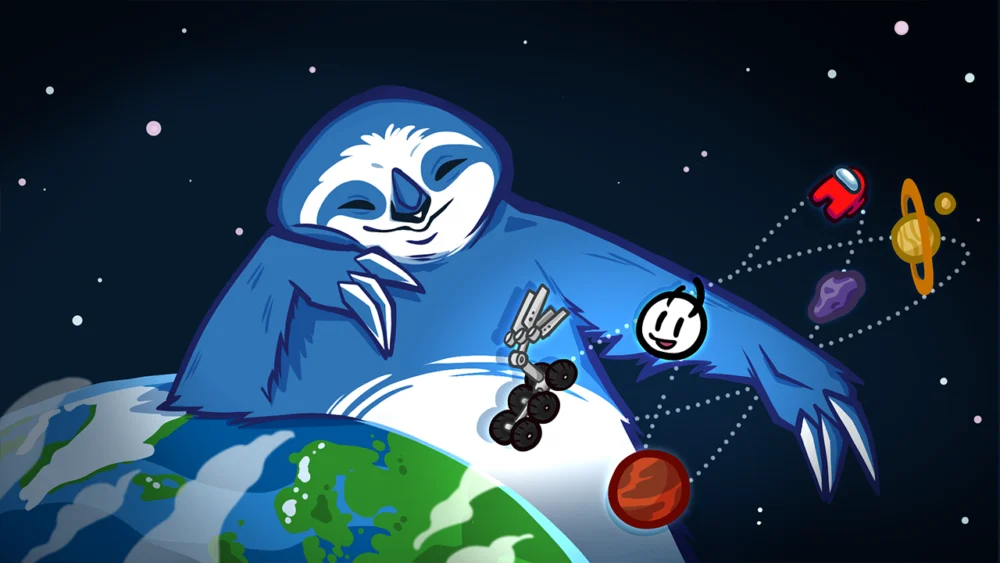
San Francisco, CA – The highly anticipated GDC Festival of Gaming recently became the stage for a candid revelation from Outersloth, the unique funding initiative born from the immense success of Among Us developer Innersloth. During a compelling session co-hosted by Outersloth CEO Forest Willard and Outersloth/Innersloth Community Director Victoria Tran, the company pulled back the curtain on its distinctive approach to game financing, offering an unprecedented look at its operational philosophy, financial terms, and the overarching goal of fostering a more sustainable indie game development ecosystem. Tran opened the talk with a characteristic blend of humor and directness, acknowledging the audience’s keen interest in the often-opaque world of game funding: "I know what you sickos are here for, and that’s insight into games funding—how we do it, and maybe how you might do it too." Her statement underscored the genuine hunger within the industry for greater transparency and more developer-friendly funding options, a need Outersloth explicitly aims to address.
A New Paradigm in Indie Funding Emerges from Global Phenomenon
The journey of Outersloth began quietly in 2022, though its public unveiling and active investment phase commenced just under two years ago, in 2024. This initiative was a direct response to the astronomical success of Among Us, the social deduction game that captivated millions globally during the pandemic. Innersloth, the studio behind the hit, found itself in an enviable position with substantial revenue, prompting a thoughtful decision to "pay it forward." Rather than simply reinvesting profits internally or pursuing aggressive expansion, the team sought to leverage its newfound financial stability to uplift other independent developers, creating Outersloth as a dedicated vehicle for this mission. It’s crucial to distinguish Outersloth from a traditional publisher; as Tran and Willard consistently emphasized, it does not offer comprehensive publishing services like marketing, PR, or extensive operational support. Its primary function is capital injection, coupled with a philosophy centered on sustainability rather than aggressive growth.
From its inception, Outersloth was designed with a clear, developer-centric mandate. The company committed a fixed budget of $25 million to be disbursed over five years, allocated quarterly to various video game projects. The core metric for success was refreshingly simple: enable recipient studios to achieve sustainability and successfully bring their games to market. Unlike many investment models that demand exponential returns or rapid scaling, Outersloth’s vision was anchored in the modest but crucial goal of breaking even for the funded projects. "Just break even. No need to chase infinite growth," Willard articulated, highlighting a fundamental divergence from conventional venture capital expectations that often place immense pressure on nascent studios. This focus on sustainability over unrestrained growth reflects a broader industry conversation about the mental and financial well-being of developers, particularly those operating within the often-volatile independent sector.
Operational Insights and Investment Milestones
Since its inception, Outersloth has made significant strides in deploying its allocated capital. As of the GDC presentation, the organization has invested a total of $19,161,040 across 24 distinct projects. This translates to an average investment of approximately $798,376 per project, a substantial sum for many indie studios that can make the difference between a project languishing in development hell and successfully reaching completion. The selection process is rigorous, as evidenced by a signing percentage of roughly 1.4 percent. While this figure might appear low, Willard noted that it is "slightly above average" for similar funding initiatives in the highly competitive indie game landscape, where thousands of pitches vie for limited investment opportunities. This statistic underscores both the high volume of submissions Outersloth receives and its selective approach to identifying projects that align with its mission and financial criteria.
The GDC talk marked a pivotal moment for Outersloth, as it publicly disclosed its partnership terms for the first time, a move designed to enhance transparency across the industry. Willard detailed a recoupment model where Outersloth takes a 50 percent share of revenue until its initial investment is recouped. He explained the rationale: "This is because we don’t offer services, so it doesn’t really make sense for us to tack on some margin. So when we say we’re taking a risk on you, both parties know what’s at stake. We can’t make the game without you. You can’t make the game without us. And so we are getting together and we should both want the same outcome." This 50/50 split during the recoupment phase emphasizes shared risk and mutual interest in a project’s initial success.
Following recoupment, Outersloth’s revenue share reduces significantly to 15 percent. This post-recoupment share is notably lower than many traditional publishing deals, which often see publishers retaining a much larger percentage (e.g., 30-50%) even after their investment is covered. Crucially, Willard stressed that Outersloth’s agreement includes a fixed seven-year term post-release, regardless of a game’s commercial performance. "Nobody really deserves unending rights to your money," he asserted, challenging the common industry practice of evergreen contracts that can bind developers to revenue shares for the entire lifespan of their game, even decades after release. This finite term provides developers with a clear pathway to regaining full control and ownership of their intellectual property and its associated revenue streams, a significant advantage for long-term sustainability and future projects.
Navigating the Nuances of Partnership
Beyond the core financial terms, Willard elaborated on several nuanced clauses in Outersloth’s contracts, details of which were shared via slides (and subsequently posted on Bluesky). One key aspect is Outersloth’s claim on all platforms. Even if the funding agreement specifies development for a limited number of platforms, Outersloth is entitled to a revenue share from any additional platforms a game may launch on. "You agree to ship X platforms to satisfy the deal, but if you also release on Y platforms we are entitled to rev share," one slide clarified. The justification for this, Willard explained, is that Outersloth’s initial investment makes the game’s existence possible, and therefore it’s reasonable to expect a share from subsequent opportunities, especially since many console releases are contingent on platform-specific funding that developers might pursue later. This ensures Outersloth benefits from the broader commercial reach of its funded projects.
Transparency and ongoing communication are also central to Outersloth’s operational model. The company requires monthly reports from its partners, a standard practice in most investment agreements but one that Outersloth frames as a collaborative tool. "You should definitely be keeping tabs on any game that you’ve signed, just to know whether things are going well or whether you can help out more," Willard stated, framing reporting as a means for Outersloth to identify opportunities to support its studios rather than simply monitor performance.
In what Willard enthusiastically described as "the best thing we have ever done," Outersloth has cultivated a vibrant, supportive community among its funded studios through a dedicated Slack channel. This digital hub allows developers to share knowledge, discuss challenges, exchange feedback on trailers and builds, and generally foster a sense of camaraderie that can be invaluable in the often-isolating world of indie development. "Everybody in there can learn from each other and talk to each other. They share their trailers and get feedback. It’s really, really nice. It’s extremely supportive and we love it," he added, emphasizing the organic, peer-to-peer support system that has emerged. While Outersloth explicitly states it doesn’t offer baked-in services, it does provide some ad-hoc support when feasible, including advice, industry connections, and access to IndieBI services, demonstrating a flexible commitment to developer success beyond just financial injection.
Defining Success and Addressing Challenges
For Outersloth, defining success has been an evolving process. Tran noted that a key indicator is the ability to consistently sign video games, which the company has achieved four years into its journey. A more profound success metric, however, is the demonstrable fact that the titles Outersloth has signed have actually made it to market. "Irrespective of how they perform from there on out (remember that seven-year term), that’s a huge win," Tran highlighted. This focus on project completion and market entry aligns perfectly with Outersloth’s mission of fostering sustainability and helping developers realize their creative visions, rather than chasing elusive blockbuster hits. The intent is clear: if Outersloth continues to break even and successfully deploy its capital, it fully intends to continue financing titles beyond its initial 2027 horizon, offering a beacon of hope for future indie developers.
Despite its innovative approach, Outersloth faces its own set of challenges. The company operates with a part-time team overseeing a portfolio of 24 active games, a significant undertaking that can sometimes lead to operational bottlenecks. Tran admitted that the team might "flounder on occasion" or take longer to review new submissions. This lean operational model also means Outersloth is inherently more hands-off than a full-service publisher, a reality that sometimes clashes with developers’ expectations. "We don’t provide as much marketing support as we can," Tran acknowledged. "Many of our submissions rely on this [and] mention wanting it—and that’s also because sometimes they might also think we’re a publisher—but we don’t do that. That means maybe you don’t get as much support as you want." This highlights a crucial educational gap, as many developers seeking funding are also implicitly looking for comprehensive publishing assistance.
Advice for Developers and a Call for Industry Change
The GDC talk also served as a valuable platform for Outersloth to share crucial advice for developers seeking funding. Tran stressed the paramount importance of well-crafted production and budget slides in a pitch deck. "These are the ones that will make or break, sometimes, a pitch deck for us—or a game signing if the production timeline doesn’t make sense," she emphasized, underscoring the need for realistic planning and clear financial projections. Beyond the numbers, the "vibe check" is equally vital. This informal assessment, often conducted through calls or face-to-face meetings, ensures that both parties are aligned on expectations, capabilities, and limits. Tran highlighted that this mutual understanding is critical, even to the point where a prospective partner might decide Outersloth isn’t the right fit for them, a decision that is "totally okay" up until the signing stage.
The overarching message from both Tran and Willard transcended Outersloth’s specific model, evolving into a broader call for industry-wide introspection on funding practices. Tran clarified, "This isn’t a talk to vilify publishers. Plenty have helped games launch to massive success and taken the burden off of developers. […] But this is a call for reconsidering that the status quo is for our contracts and how we can make a sustainable industry." This nuanced perspective acknowledges the valuable role traditional publishers play while advocating for more equitable and transparent contract terms across the board.
Willard further implored developers to become acutely aware of the true costs of game production. "You can go out and get quotes for QA and localization. Understand what those things cost and set price targets, marketing targets, and sales targets for your game," he advised. He stressed the importance of looking beyond the immediate project to consider long-term viability: "Understand whether you’ll be getting enough to survive after your first game. Because it really is not just about your first game, but the second game." He highlighted the inherent imbalance in risk between publishers and developers: "Understand while you are in this negotiation that the publisher can dilute risk across a portfolio but you only get that one game. It’s a meaningful thing. They should understand it too." This insight serves as a critical reminder for developers to negotiate terms that protect their long-term creative and financial independence.
Finally, Willard extended a polite but firm request to traditional publishers: to make their corner of the industry "a little bit friendlier." He acknowledged the inherent risks in publishing but argued against overly exploitative terms. "There are just some really bad terms out there and you really don’t have to go as far as we do. We don’t offer services. you should be a publisher, and publishers are great. But it’s going to be risky regardless, so you just have to be wise about your picks. It means so much more to the developer when the margins of success are so small. Everybody’s living on that first sales spike. If they don’t come away with what they need to make another game, they’e not growing. You’re not allowing the industry to grow." This powerful statement underscores Outersloth’s belief that more equitable partnerships are not just ethical but also essential for the overall health and growth of the game development industry.
In a crowning act of transparency, Outersloth announced that its full contract is now publicly accessible on the company’s website, providing an open-source template for other funders and a clear benchmark for developers. This unprecedented move is poised to empower developers with knowledge and encourage broader industry dialogue, solidifying Outersloth’s position not just as a funder, but as a catalyst for positive change in how indie games are brought to life.
About the Author