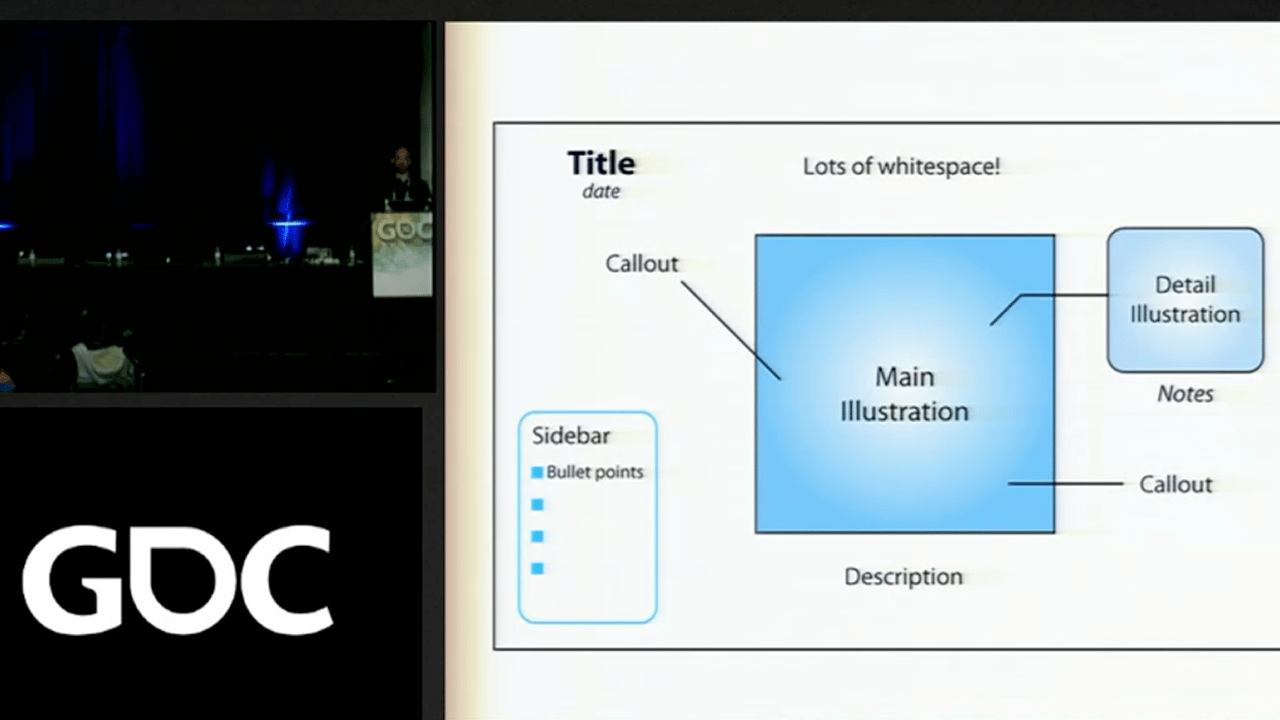
Stone Librande’s 2010 GDC talk, "One-Page Designs," continues to resonate profoundly within the game development community, nearly sixteen years after its initial presentation. Despite its vintage, featuring charming early 2010s references such as a fondness for raster-based Adobe Illustrator, the presentation remains a potent source of practical, actionable strategies for distilling complex design concepts into concise, impactful communications. Its principles are frequently revisited by seasoned professionals for personal inspiration and are a staple in game design curricula, underscoring its timeless value in an ever-evolving industry.
Addressing the Documentation Crisis in Game Development
At the turn of the decade, the game development landscape was grappling with significant challenges in design documentation. The industry often relied on sprawling "design bibles"—voluminous documents that, while comprehensive in theory, frequently became outdated, unwieldy, and inaccessible. These tomes, sometimes hundreds of pages long, were notorious for hindering rather than facilitating communication. Their sheer size made them difficult to update, share, and absorb, often leading to crucial information being overlooked or misunderstood by various team members.
Alongside design bibles, the rise of digital wikis offered an alternative, promising dynamic, interconnected repositories of information. However, these too presented their own set of problems. Without stringent curation and clear organizational principles, wikis could devolve into disconnected silos of data, lacking a cohesive narrative or a unified vision. Developers often found themselves sifting through fragmented entries, struggling to piece together a holistic understanding of game mechanics, narratives, or systems. This fragmented approach frequently led to misinterpretations, duplicated efforts, and a general disconnect across multidisciplinary teams, impacting project timelines and overall quality. The core issue, as Librande identified, was not a lack of information, but an overwhelming abundance of poorly organized information that failed to serve its primary purpose: effective communication.
The Genesis of One-Page Designs: Inspirations and Early Applications
Librande’s innovative approach was born from a desire to overcome these pervasive documentation failures. He drew inspiration from diverse fields renowned for their clear, information-dense visual communication. Architectural blueprints, with their precise layouts and standardized symbols, offered a model for conveying intricate structures succinctly. Children’s placemats, deceptively simple yet packed with engaging information and activities, demonstrated how to present complex ideas in an approachable, digestible format. Engineering schematics provided examples of how to diagram intricate systems with clarity and efficiency, while timeline graphics illustrated the power of sequential visual storytelling.
These disparate influences converged into the concept of the one-page design: a single, self-contained document capable of conveying the essence of a complex design idea. Librande vividly illustrated this power through several compelling examples from his own professional experience. He showcased a prototype project from Blizzard, demonstrating how the one-page format could capture the core mechanics and artistic vision of an unreleased title. A particularly "delightful" paper prototype for The Simpsons Hit and Run highlighted the format’s utility even in early-stage ideation and physical prototyping. Later, he applied the principles to system and build aspects of Spore, illustrating its scalability for conveying intricate game systems. These examples underscored the versatility of the one-page design, proving its efficacy across different stages of development and varying levels of conceptual complexity.
The Philosophy of Conciseness: Cognitive Benefits and Deeper Understanding

The power of the one-page design extends beyond mere brevity; it fundamentally transforms the design process itself. By imposing a strict spatial constraint, the method forces designers to engage in a rigorous intellectual exercise: to communicate an idea within a small space, one must possess a profound and complete understanding of the subject matter. This necessitates a deep dive into the core problem, a thorough consideration of multiple potential solutions, and the arduous task of identifying at least one optimal approach.
This process of distillation, of stripping away extraneous details to reveal the essential "juice" of an idea, provides immense cognitive benefits. It demands clarity of thought, precision in language, and an acute awareness of what truly matters. Designers are compelled to articulate their vision with unparalleled focus, eliminating ambiguity and fostering a coherent narrative. As a result, the hard work involved in crafting a concise one-page design benefits the designer as much as it aids external communication. It solidifies their own comprehension, allowing them to internalize the logic and implications of their design decisions, thereby making them more effective communicators and problem-solvers. This internal clarity then naturally translates into external clarity, facilitating smoother collaboration among team members.
Evolution of Collaboration: From Physical Boards to Digital Canvases
A particularly memorable anecdote from Librande’s talk highlights the tactile nature of early one-page design implementation. He recounted seeing a colleague print out a one-page design and prominently display it on their office wall. This simple act underscored the tangible, collaborative potential of the format. Librande himself championed the use of physical paper and pens for collaborative sessions, deliberately incorporating ample "white space" within the documents to encourage colleagues to add notes, sketches, and new ideas directly onto the design. This "old-school" approach, far from being a charming relic, fostered immediate, organic interaction and feedback.
The enduring appeal of this hands-on collaboration has transcended its original physical medium. While physical whiteboards remain a powerful tool for initial ideation—serving as an "early draft" space where ideas can be freely explored before refinement—digital whiteboard software like Miro has seamlessly adopted and expanded upon these principles. These platforms replicate the collaborative spirit of physical whiteboards, allowing distributed teams to simultaneously annotate, illustrate, and contribute to one-page designs in real-time. The emphasis on "white space" and iterative input carries over, ensuring that the core tenets of Librande’s philosophy remain relevant and actionable in contemporary, often remote, development environments. This adaptability ensures that the spirit of direct, visible collaboration continues to drive design refinement, regardless of geographical distance.
Implications for Cross-Disciplinary Team Dynamics and Project Efficiency
Perhaps one of the most significant contributions of the one-page design philosophy is its profound impact on cross-disciplinary communication within game development teams. In an industry characterized by its diverse specializations—programmers, level designers, systems designers, narrative designers, artists, animators, and many others—the ability to "translate" complex design ideas across different professional "languages" is paramount. A good, solid one-page design serves as an invaluable touchpoint, acting as a common ground for understanding and discussion.
It is not merely a summary, but a carefully curated synthesis that speaks to various types of "brains." For a programmer, it might highlight the core logic and technical implications; for an artist, the visual style and emotional tone; for a level designer, the spatial flow and player experience. By presenting the most critical information succinctly and visually, it reduces the cognitive load for each specialist, allowing them to quickly grasp the essence of an idea without getting bogged down in details irrelevant to their specific role. This clarity minimizes misinterpretations, accelerates feedback cycles, and fosters genuine collaboration. When teams can swiftly understand and align on core concepts, they can transition faster from ideation to testing, iteration, and refinement, thereby enhancing overall project efficiency and fostering a more cohesive development environment.
Educational Impact and the Cultivation of Future Designers
The enduring relevance of Librande’s talk is particularly evident in its integration into modern game design education. As Danielle Riendeau, Editor-in-Chief of GameDeveloper.com and a lecturer in game design at the Berklee College of Music, attests, the "One-Page Designs" talk is a foundational text she showcases to her students almost every quarter. This pedagogical application underscores the practical and theoretical importance of conciseness and clarity in design communication.
Teaching students to craft effective one-page designs instills critical skills beyond mere documentation. It forces them to develop a rigorous understanding of their own ideas, to prioritize information, and to think critically about how best to convey complex concepts to diverse audiences. This foundational training prepares aspiring designers for the collaborative realities of the professional world, equipping them with the tools to effectively articulate their visions, solicit constructive feedback, and contribute meaningfully to multidisciplinary teams. The ability to distill a sprawling concept into a compelling single page is a hallmark of a skilled designer, fostering both intellectual rigor and communicative prowess.
Librande’s Core Message: Engaging Communication as the Designer’s Primary Role
In summarizing his influential session, Librande unequivocally emphasized that the ultimate goal of design—and indeed, of any designer—is effective communication. "The goal of design—of any designer and their design that they make—is to communicate an idea," he stated. "Your job as a designer is to kind of come up with solutions to problems, figure out what’s going on, and giving that information back out to the team." This statement encapsulates the designer’s crucial role not just as a creator of concepts, but as a facilitator of understanding.
The intention behind the one-page design is not merely to provide information, but to actively engage the audience. It aims to spark interest, provoke questions, and excite team members about the underlying ideas, rather than simply dictating a set of instructions. Librande articulated this ambition directly: "I hope that even, you in the audience, as you looked at some of these things, said ‘man, I wish I could see some of that design, I want to see more of that,’ if you had that reaction, this was a success, because that’s the reaction that I’m going for. To draw people into your stuff, instead if you having to like, call a meeting and tell everybody what’s going on." This philosophy transforms design documentation from a passive reference into an active catalyst for collaboration and creative energy.
The Enduring Legacy in a Dynamic Industry
Sixteen years on, Stone Librande’s "One-Page Designs" talk remains a cornerstone of effective game design methodology. Its principles have transcended specific tools or technologies, proving adaptable to both traditional and contemporary development practices. In an industry that continues to grapple with the complexities of large-scale projects, distributed teams, and rapid iteration, the ability to communicate clearly, concisely, and engagingly is more critical than ever.
The talk’s lasting impact is a testament to its fundamental truth: that the clarity of a design directly correlates with its potential for successful execution. By providing a structured yet flexible framework for distilling complex ideas, Librande empowered designers to become more effective communicators, fostered deeper collaboration across disciplines, and ultimately, contributed to the creation of better games. Its continued adoption in professional studios and academic institutions worldwide solidifies its status not just as a memorable GDC presentation, but as an indispensable guide for navigating the intricate art of game design communication.
About the Author