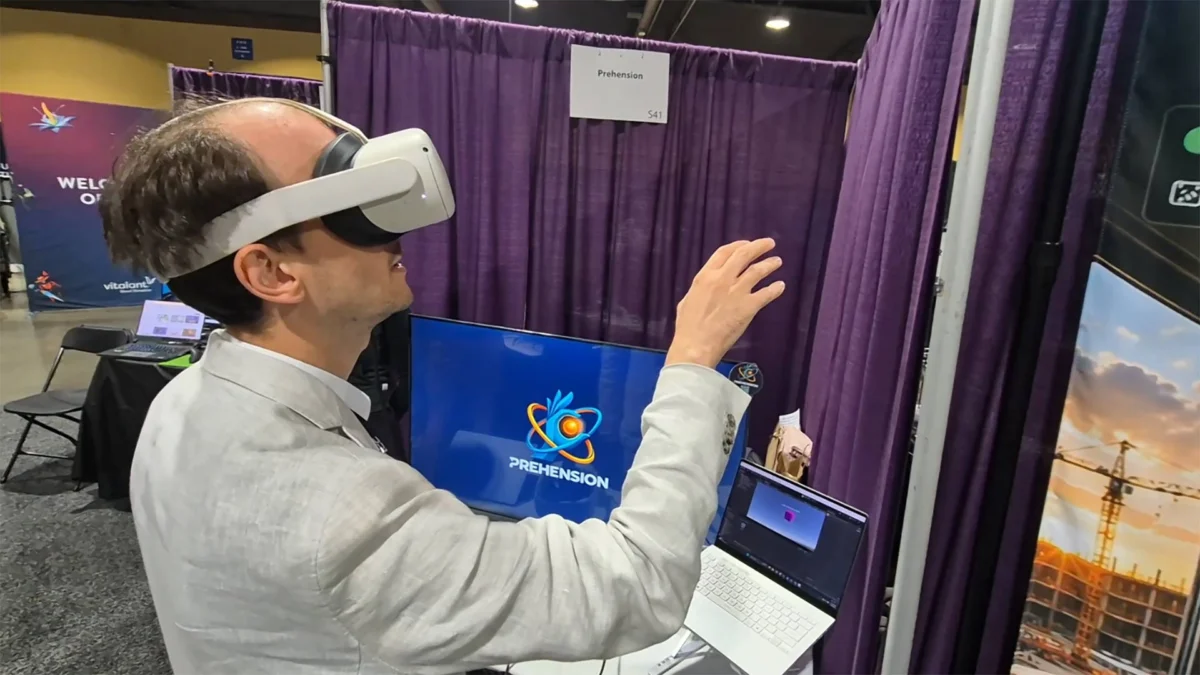
The landscape of spatial computing continues to evolve toward more intuitive, controller-less interfaces, a trend underscored by the recent demonstrations at the Augmented World Expo (AWE) USA 2026. Among the most notable technical advancements presented this year is a new software development kit (SDK) from Prehension AI, a startup specializing in machine learning-driven interaction models. The company’s Unity-based SDK is designed to streamline the implementation of complex, animated hand gestures in Mixed Reality (MR) and Virtual Reality (VR) environments, addressing a long-standing technical bottleneck for XR developers.
The Technical Challenge of Dynamic Gesture Recognition
In the current XR ecosystem, hand tracking has largely bifurcated into two categories: static poses and dynamic gestures. Static poses, such as a closed fist or a "pinch" gesture, are relatively simple to detect using standard skeletal tracking data. However, dynamic or "animated" gestures—those defined by movement over a specific temporal window—present significant hurdles for developers.
Traditionally, recognizing a movement such as a rhythmic wave, a circular motion, or culturally specific hand signals requires extensive manual programming. Developers often have to write complex logic involving vector math and trigonometry to track the position of joints over time. Furthermore, these manual systems frequently struggle with "noise" and variance; a gesture performed by one user may look fundamentally different when performed by another due to differences in hand size, speed, and range of motion. Prehension AI’s solution leverages a machine learning (ML) architecture to automate this classification, shifting the burden from manual coding to data-driven training.
Chronology of the Development Workflow
The Prehension AI SDK introduces a streamlined workflow within the Unity editor, designed to be accessible to developers without deep expertise in neural networks. The process, as demonstrated during the AWE 2026 technical sessions, follows a specific four-stage chronology:
- Environment Integration: Developers integrate the Prehension plugin into a Unity project. The SDK provides a dedicated "Recording Scene" where the developer connects a headset—such as a Meta Quest device via Link—to capture real-time hand-tracking data.
- Data Acquisition: During the recording phase, the developer performs the desired gesture multiple times. To ensure the robustness of the resulting model, the system encourages the collection of samples from different individuals. This variance helps the ML model account for the "human factor," recognizing the core pattern of the gesture regardless of the specific user’s physical nuances.
- Cloud-Based Training: Once the samples are recorded, the data is uploaded to Prehension AI’s cloud infrastructure. By clicking a single "Train" button within the Unity Editor, the system processes the temporal data points. At the AWE demonstration, a model trained on three distinct gestures with approximately five to six samples each reached completion in roughly 60 seconds.
- Local Implementation: After training is complete, the optimized model is downloaded back into the Unity project. Crucially, while the training occurs in the cloud to leverage high-performance computing, the inference—the actual detection of the gesture during app execution—happens locally on the device. This ensures that the end-user does not require a persistent internet connection for gesture recognition and minimizes latency.
Performance Analysis and Generalization
One of the critical metrics for any ML-based gesture system is its "generalization" capability—the ability to recognize a gesture from a user whose data was not part of the initial training set. Reports from the AWE hands-on sessions indicate that the Prehension SDK maintains high accuracy even when tested by new users. This suggests that the underlying architecture is effective at isolating the essential kinematic features of a movement from the incidental noise of individual performance.
The system also employs a probabilistic threshold for recognition. Unlike simpler systems that might "force" a movement to fit the nearest available category, the Prehension classifier is designed to return a "no gesture detected" result if the user’s movement does not sufficiently resemble the trained patterns. This reduces the frequency of accidental triggers, a common frustration in hand-tracked interfaces where "Midas Touch" problems—unintended activations—can break immersion.
Market Context and Industry Implications
The emergence of Prehension AI comes at a pivotal moment for the XR industry. As major hardware players like Meta and Apple push for "hands-first" operating systems, the demand for custom interaction sets has surged. While system-level gestures (like the Vision Pro’s tap) are standardized, game developers and enterprise training creators require unique movements specific to their software—such as a mechanic "turning" a virtual wrench or a surgeon performing a specific incision gesture.
By offering an "off-the-shelf" SDK for these custom interactions, Prehension AI is positioning itself to lower the barrier to entry for smaller studios. The current industry standard often requires hiring specialized computer vision engineers to build custom gesture recognizers. Prehension’s subscription-based model aims to democratize this capability, allowing indie developers to implement sophisticated controls that were previously the domain of high-budget AAA studios.
Business Sustainability and Future Outlook
Currently in private beta, Prehension AI is soliciting partnerships with enterprise and gaming firms to refine the SDK before a wider commercial release. The company has indicated that its eventual monetization strategy will revolve around a monthly subscription fee, a standard model for "SDK-as-a-Service" in the modern development landscape.
However, the startup faces a complex market. The sustainability of such a niche tool depends on the continued growth of the VR/MR market and the willingness of developers to pay for a third-party solution over building in-house tools or waiting for platform holders (like Meta or Google) to release their own advanced gesture APIs.
Industry analysts at AWE noted that while the SDK is technically proficient, its success will likely hinge on its pricing tiers. If priced competitively, it could become a staple in the Unity Asset Store ecosystem. If the cost is too high, it may remain a specialized tool for high-end enterprise simulations. Furthermore, while the current recording interface is described as functional but unpolished, the core technology’s ability to operate in "messy" real-world environments—such as the crowded, signal-heavy floor of a major convention—serves as a strong proof of concept for its reliability.
As spatial computing moves away from the abstractions of plastic controllers and toward the natural mechanics of human movement, tools like the Prehension AI SDK represent the necessary infrastructure for the next generation of user interfaces. The ability to "teach" a computer to understand human intent through motion, without writing a single line of complex math, marks a significant step toward more invisible and intuitive technology.
About the Author