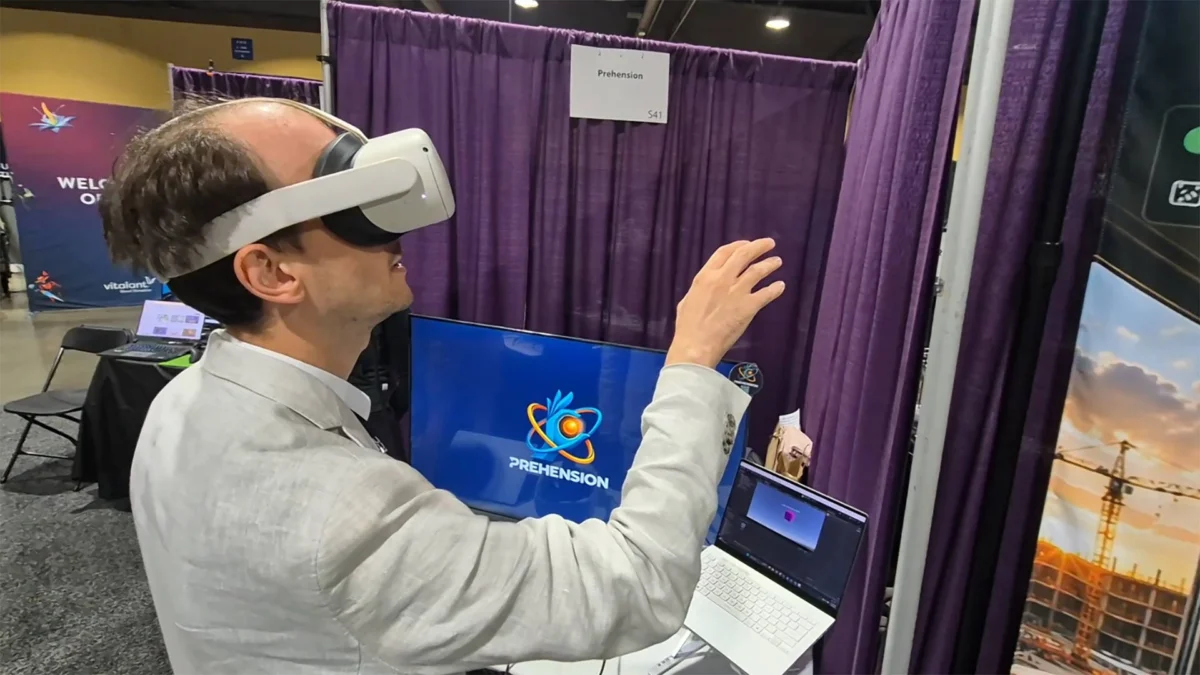
The landscape of spatial computing and immersive technology continues to evolve toward more natural user interfaces, a trend underscored by the recent demonstration from Prehension AI at the Augmented World Expo (AWE) USA 2026. The startup has introduced a specialized Software Development Kit (SDK) for the Unity engine, designed specifically to bridge the technical gap in hand-tracking capabilities. While major hardware manufacturers have mastered static pose detection, Prehension AI focuses on the more complex challenge of animated gestures—movements that occur over a temporal sequence rather than a single frame.
The debut of this technology comes at a critical juncture for the Extended Reality (XR) industry. As headsets become lighter and more powerful, the reliance on physical controllers is diminishing in favor of direct hand interaction. However, developers have historically faced significant hurdles when attempting to implement custom gestures beyond standard pinches or pokes. Prehension AI’s solution aims to automate the machine learning (ML) pipeline required to recognize these intricate movements, potentially reducing development cycles from weeks to minutes.
The Evolution of Hand Interaction in Spatial Computing
To understand the significance of Prehension AI’s entry into the market, it is necessary to examine the current state of hand tracking. Standard SDKs provided by industry leaders like Meta and Apple are highly optimized for "discrete poses"—fixed hand shapes such as a fist, an open palm, or a pointing finger. While these are sufficient for basic menu navigation, they fail to capture the nuance of human communication and complex tool manipulation.
Animated gestures, such as waving, rotating a virtual dial, or performing specific cultural signs, require the system to track the velocity, trajectory, and changing orientation of the hand over time. Traditionally, implementing these features required a deep understanding of mathematical heuristics or the manual training of bespoke neural networks. Prehension AI addresses these two primary pain points: the difficulty of manual coding for temporal data and the high barrier to entry for machine learning integration in game design.
Technical Workflow and Machine Learning Integration
The Prehension AI SDK operates through a streamlined three-phase process: recording, training, and deployment. During the demonstration at AWE USA 2026, the company showcased how a developer can integrate these capabilities directly within the Unity Editor environment.
The recording phase utilizes a dedicated Unity scene provided by the plugin. Developers wear a supported headset—such as the Meta Quest series connected via Link—and perform the desired gesture multiple times. The system records the skeletal data of the hand as it moves through space. Technical experts at the event noted that the quality of the resulting model is highly dependent on the variance of the input data. To ensure robust recognition, developers are encouraged to record samples from multiple individuals, accounting for differences in hand size, movement speed, and idiosyncratic styles.
Once the data is captured, the training phase begins with the press of a button within the Unity editor. Unlike traditional ML workflows that require external environments, Prehension AI utilizes a cloud-based training system. The recorded data is uploaded to the company’s servers, where a classification model is generated and subsequently downloaded back to the local project.
Observations during the live demonstration indicated that the training time is remarkably efficient. For a set of three distinct gestures with approximately five to six samples each, the cloud processing was completed in roughly 60 seconds. Notably, the final model functions locally on the device after the initial download, ensuring that end-user applications do not require a constant internet connection for gesture recognition—a vital feature for privacy and performance.
Performance Analysis and Generalization Capabilities
A critical metric for any gesture recognition system is its ability to "generalize"—meaning it can recognize a gesture performed by a user whose hands were not part of the initial training set. During field testing at AWE, the Prehension AI SDK demonstrated a high degree of reliability in this area. Even when the gestures were performed by new users with varying degrees of precision, the system successfully triggered the intended digital responses.
The SDK also includes logic to prevent "false positives." In many gesture recognition systems, the classifier may force a movement into the nearest available category, leading to unintended actions. Prehension’s architecture appears to utilize a confidence threshold; if a movement does not sufficiently resemble the trained gestures, the system returns a null result rather than an incorrect classification. This level of accuracy is essential for industrial and medical XR applications where accidental inputs can have significant consequences.
Market Context and Industry Implications
The emergence of specialized middleware like Prehension AI reflects a broader trend of "democratization" in XR development. As the industry moves away from the "walled garden" approach of early VR, third-party tools are becoming essential for creating cross-platform experiences that feel consistent.
Industry analysts suggest that the demand for such tools is driven by the rise of enterprise XR. In sectors such as manufacturing and logistics, workers often need to perform specific, repetitive hand motions that are unique to their trade. A tool that allows a non-expert to "teach" a headset to recognize these motions could revolutionize training simulations.
However, the startup faces a challenging economic environment. The XR industry in 2026 is characterized by a "flight to quality," where only the most functional and cost-effective tools survive. Prehension AI has announced that the SDK will eventually move to a monthly subscription model, though it is currently in a private beta phase. The sustainability of this business model will depend on its adoption rate among indie developers and small-to-medium enterprises (SMEs) who may lack the resources to build proprietary ML models.
Comparison with Existing Frameworks
While Meta’s Interaction SDK and Microsoft’s Mixed Reality Toolkit (MRTK) offer robust libraries for hand interactions, they are often perceived as "heavyweight" or overly complex for developers who only need a specific set of custom gestures. Prehension AI positions itself as a surgical tool—a lightweight plugin that does one thing exceptionally well.
Furthermore, the "no-code" or "low-code" nature of the SDK aligns with the current industry shift toward making 3D content creation more accessible. By abstracting the complexities of neural network weights and temporal data structures, Prehension AI allows creative leads and technical artists to iterate on interaction design without waiting for specialized ML engineers.
Conclusion and Future Outlook
The presentation at AWE USA 2026 confirmed that Prehension AI has developed a functional and user-friendly solution for a long-standing problem in the XR space. While the user interface of the recording environment remains in a beta state, the underlying technology demonstrates the precision required for professional applications.
As the company moves toward a public release, the primary questions remaining involve pricing and long-term support. If positioned correctly, Prehension AI could become a standard component of the Unity developer’s toolkit, particularly for those working on gesture-heavy applications in education, social VR, and industrial training. For now, the startup represents a significant step forward in making our digital interactions as fluid and expressive as our real-world movements. The success of such ventures will ultimately determine how quickly the industry reaches the goal of truly "invisible" and natural user interfaces.
About the Author