In a significant demonstration of the democratizing power of generative artificial intelligence in software development, retired professional tennis player Iain Atkinson has successfully developed and released a comprehensive sports management simulator, Tennis Tycoon, using Anthropic’s Claude Code. The launch marks a pivotal moment in the intersection of professional sports expertise and amateur software engineering, as Atkinson—who possessed no prior coding experience—joins a growing cohort of "non-technical" creators successfully navigating the complexities of the Apple App Store. By utilizing large language models (LLMs) to bridge the gap between conceptual design and executable code, Atkinson has transformed his firsthand experience on the professional circuit into a digital product that emphasizes the logistical and financial rigors of the sport over traditional arcade-style gameplay.
The Genesis of Tennis Tycoon and the Shift to Management Simulation
The development of Tennis Tycoon was born out of a perceived void in the sports gaming market. While high-fidelity tennis titles often focus on the physics of the racket-ball interaction, Atkinson noted that these games frequently fail to capture the strategic and grueling administrative realities of a tennis career. Drawing inspiration from the seminal management simulations of the 1990s and early 2000s—most notably Championship Manager (the precursor to Football Manager), SimCity, and the Civilization series—Atkinson sought to create a title that prioritized resource management, long-term planning, and the "unseen" side of the professional circuit.
According to Atkinson, the decision to focus on management rather than action was a deliberate choice rooted in his professional background. He observed that action-oriented tennis games often struggle with the nuances of player movement and ball physics, which can lead to a disconnect for those who have played the sport at a high level. Conversely, the management aspect—navigating the financial constraints of travel, managing injuries in foreign countries, and selecting the right coaching staff—offered a fertile ground for a deep, data-driven simulation that could be accurately rendered through a text-and-menu-based interface.
The Technical Evolution: From Amateur to App Developer via Claude Code
The technical backbone of Tennis Tycoon is Claude Code, a specialized interface for Anthropic’s Claude AI designed to assist with complex programming tasks. Atkinson’s success follows in the footsteps of other recent amateur developers who have utilized the same platform to achieve viral success. Most notably, Deniz Sancar recently released 38-0-0, a football drafting game that reached the top of the UK iOS charts despite Sancar having no formal background in computer science. Similarly, developer Josh Pavey released a successful variation titled 38-0.
The trend highlights a shift in the "barrier to entry" for the gaming industry. Historically, developing a robust management simulator would require a multidisciplinary team, including software engineers, UI/UX designers, and quality assurance testers. For a solo "passion project," the financial burden of hiring such a team is often insurmountable. Atkinson noted that the economics of traditional development would have rendered Tennis Tycoon impossible, stating that much of the game’s specific nuance—the "tiny tennis-specific details"—would likely have been lost if he had tried to explain them to a third-party developer who had not lived the life of a traveling professional.
The development process was not instantaneous. Atkinson engaged in a rigorous period of trial and error, building several smaller, non-commercial applications to understand the logic of software architecture. This iterative learning process was crucial in overcoming what he describes as the "production gap"—the massive distance between a functional prototype that works on a local machine and a polished, production-ready application capable of meeting Apple’s stringent App Store requirements.
Deep Simulation Mechanics: Integrating Professional Experience
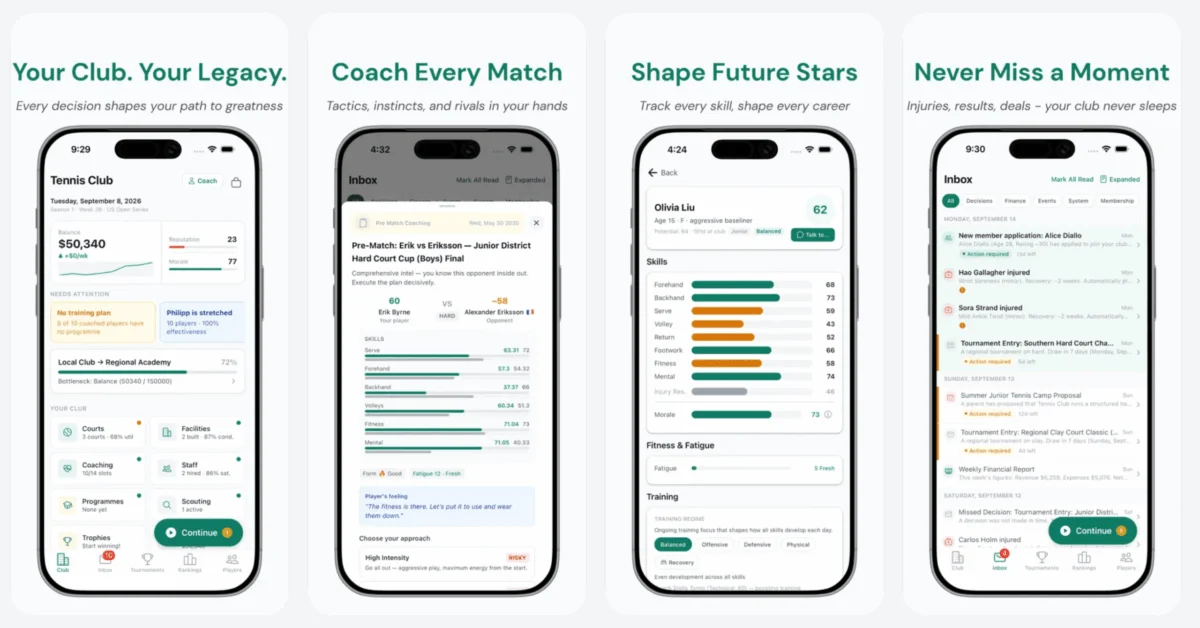
Tennis Tycoon distinguishes itself through its granular approach to the sport’s administrative side. Players assume the role of a club manager or player agent, tasked with making high-stakes decisions that mirror the real-world trade-offs Atkinson faced during his career. Key gameplay mechanics include:
- Staff and Coaching Recruitment: Players must vet and hire coaches based on their compatibility with specific player personalities. This reflects the real-world importance of the "coach-player fit," which can often dictate a season’s success more than raw talent.
- Infrastructure Management: Managers must decide how to allocate limited funds—for instance, choosing between repairing aging court surfaces or investing in a scouting network to find young talent.
- Surface Specialization: The game incorporates the strategic necessity of training on specific surfaces (clay, grass, hard court) ahead of major tournaments, a factor that significantly impacts player performance and injury risk.
- Financial Survival: Modeled on the tight budgets of lower-tier professional circuits, the game forces players to manage hotel costs, travel logistics, and tournament entry fees, providing a realistic look at the "grind" of professional tennis.
Market Positioning and Monetization Strategy
In an era where mobile gaming is dominated by "freemium" models—characterized by intrusive advertisements, pay-to-win mechanics, and artificial time-gating—Atkinson has opted for a "premium" entry price of $2.99. The game includes optional in-app purchases, but Atkinson has stated that these are not required for progression.
This decision was driven by a desire to maintain the integrity of the simulation. By avoiding "pay-to-progress" timers, Tennis Tycoon positions itself as a serious tool for fans of the genre rather than a casual "time-waster." The $2.99 price point serves as a filter, attracting a dedicated audience of management sim enthusiasts while providing a modest revenue stream to support future updates and an eventual Android port.
The Broader Impact: AI and the Democratization of Creativity
The emergence of games like Tennis Tycoon and 38-0-0 suggests a structural change in the mobile gaming landscape. As AI tools become more adept at handling the "syntax" of coding, the value of "domain expertise"—the deep, specialized knowledge of a subject like professional tennis—is increasing.
Industry analysts suggest that we are entering an era of "Expert-Led Development." In this model, the primary creator is not a coder, but a subject matter expert (SME). The AI acts as a translator, turning the SME’s nuanced understanding of a field into functional software. This allows for the creation of highly niche, hyper-realistic simulators that might otherwise be ignored by major gaming studios looking for broad, mass-market appeal.
However, this shift also presents new challenges for the App Store and Google Play Store. The ease of production could lead to a "content explosion," making discoverability even more difficult for independent developers. Atkinson’s strategy for overcoming this has been community-led marketing, focusing on tennis forums, social media groups dedicated to sports management, and word-of-mouth within the professional tennis community.
Chronology of Development and Future Outlook
- Phase 1: Conceptualization: Atkinson identifies the lack of realistic management simulators in the tennis gaming market based on his professional experience.
- Phase 2: Skill Acquisition: Atkinson begins experimenting with Claude and other LLMs, building basic utility apps to understand logic and state management.
- Phase 3: Prototyping: The core mechanics of Tennis Tycoon are developed. Atkinson focuses on the financial and logistical algorithms that define the player experience.
- Phase 4: Refinement: A period of "closing the gap" where Atkinson uses AI to debug, optimize performance, and design a user interface suitable for mobile devices.
- Phase 5: Launch: Tennis Tycoon is released on the iOS App Store for $2.99.
- Future Plans: Atkinson is currently evaluating the integration of social features, such as global leaderboards and the ability for players to share their club statistics. A version for Android devices is also in the planning stages, though no specific release date has been confirmed.
Conclusion: A New Paradigm for Indie Developers
The story of Iain Atkinson and Tennis Tycoon serves as a case study for the potential of AI to empower individuals with unique life experiences to become creators. By bypassing the traditional requirement for years of technical training, Atkinson has demonstrated that the most important element of game design remains the "idea" and the "authenticity" of the experience being simulated.
As Claude Code and similar tools continue to evolve, the gaming industry likely will see a surge in titles that explore niche hobbies, professional industries, and complex simulations driven by those who know them best. For the tennis world, Tennis Tycoon represents a rare opportunity to see the sport through the eyes of a professional, highlighting the struggle, the strategy, and the thin margins between success and failure on the global circuit.
About the Author