The creation of a compelling modular environment in 3D modeling often presents a significant challenge, particularly when transitioning from individual, impressive assets to a cohesive and scalable street scene. Neil Bettison, operating under the alias 3D Tudor, has recently detailed his comprehensive workflow for developing a "Stylized Haunted Street Modular Kit," offering an in-depth, practical guide for aspiring environment artists. This breakdown, spanning from initial asset creation in Blender 5 to the final atmospheric polish in Unreal Engine 5.7, emphasizes the critical importance of a robust system design from the outset, rather than retrofitting modularity onto pre-existing, disparate elements.
Bettison’s core thesis highlights a common pitfall in environment art: the tendency to prioritize "cool pieces" over the fundamental principles of modularity. He argues that a successful modular kit is not merely a collection of aesthetically pleasing meshes, but a sophisticated system designed to withstand duplication, maintain visual consistency, and integrate seamlessly within a larger scene. This fundamental understanding forms the bedrock of his approach, aiming to create a kit that functions effectively at a street scale and can be rigorously tested within a game engine environment under realistic lighting and atmospheric conditions.
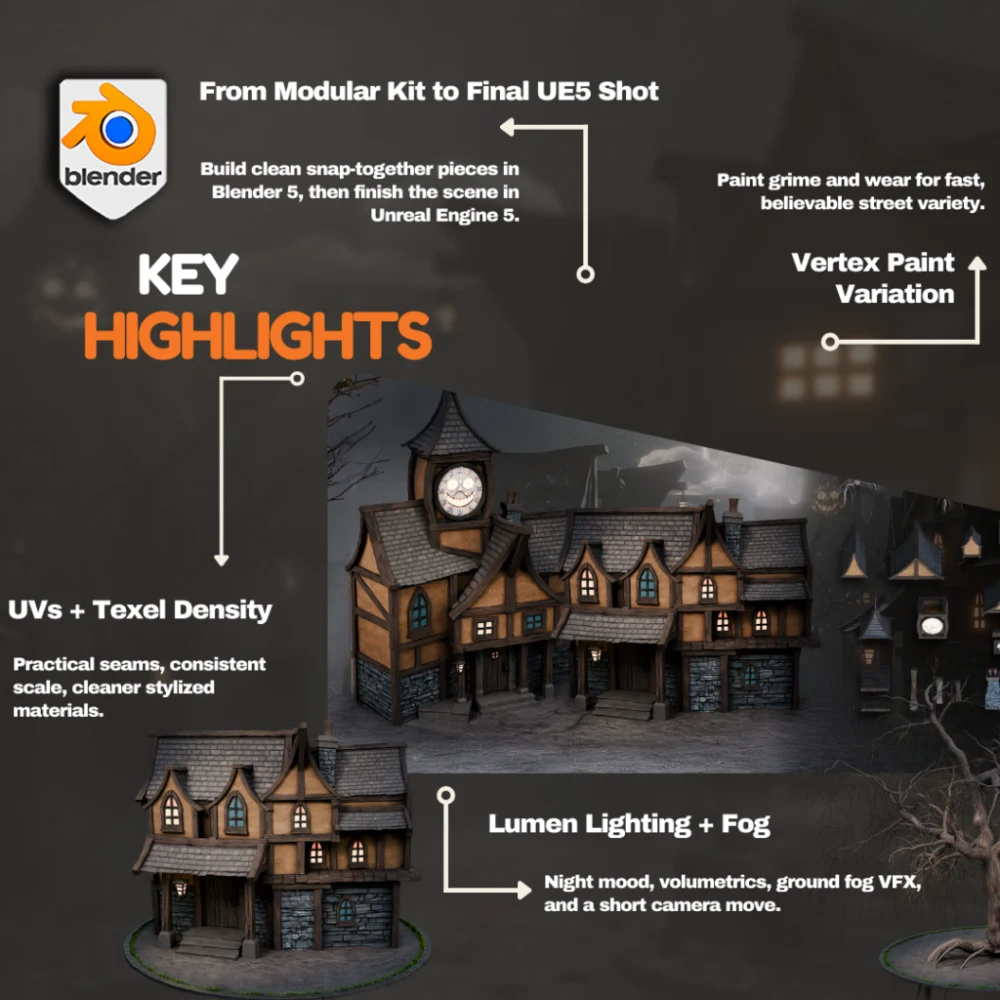
The project’s objective was twofold: to deliver a functional modular kit and to demonstrate its application in a complete environment. This dual deliverable ensures that the kit’s viability is not just theoretical but has been practically validated. The process began in Blender 5, where Bettison meticulously established foundational rules before delving into intricate detailing. These crucial pre-production steps included defining precise unit measurements, establishing grid-based snapping systems, and standardizing connection points. These seemingly unglamorous, yet essential, protocols are presented as the linchpin for preventing significant rework later in the pipeline.
Establishing the Foundation: Blender 5 Workflow
Bettison’s approach in Blender 5 is characterized by a deliberate focus on building stability and reusability. The process commenced with the creation of the smallest repeatable units, such as individual wall segments, window frames, and roof eaves. This granular approach allowed for the validation of each component’s functionality and aesthetic before scaling up to more complex structures. By ensuring these basic building blocks performed as intended, the kit began to coalesce into a cohesive toolkit rather than a disparate collection of individual models.
Stylization, a key characteristic of the "Haunted Street" theme, was intentionally managed to avoid inconsistency. Bettison emphasizes that while a degree of "wonkiness" can contribute to a stylized aesthetic, uncontrolled deviations can lead to a visually chaotic and disjointed environment. To counteract this, stylization was approached as a deliberate artistic choice, with specific parameters set for shape language, silhouette, and color palettes to ensure a unified look across all modular assets.
A critical aspect of modular kit development, often cited as a point of failure, is the management of UV layouts. Bettison treated UVs as a systematic component of the workflow, aiming for consistent texel density and efficient material application across numerous assets. This discipline in UV unwrapping is crucial for ensuring that textures tile seamlessly and materials appear uniform when different modular pieces are combined, preventing visual seams or jarring inconsistencies in the final render.
Furthermore, export preparation was integrated into the modeling process itself, rather than being an afterthought. This foresight in considering how assets would be imported and utilized in Unreal Engine 5.7 prevented potential issues related to scale, orientation, and pivot points, streamlining the transition between software.
Proving the System: Unreal Engine 5.7 Implementation

The second phase of the project shifted to Unreal Engine 5.7, where the modular kit was put to the test in constructing a tangible environment. This stage is critical for validating the kit’s practical application and transforming it from a set of digital components into an atmospheric narrative space. Collaborating with artist Luke, the process focused on integrating the modular pieces to create a believable and immersive "haunted street."
The initial step involved shaping the terrain to accommodate the street, ensuring a natural integration rather than a sterile placement on a flat plane. This foundational step grounds the environment and influences how the modular buildings interact with their surroundings. The inclusion of water features, such as a river, served as an additional, rigorous test for the kit. Water is particularly adept at revealing scale discrepancies, compositional weaknesses, and lighting challenges that might otherwise go unnoticed.
Achieving variation within the environment without compromising material consistency was another key objective. Practical techniques were employed to introduce wear, damage, and subtle differences across the modular assets. The aim was to avoid creating overly complex or fragile shaders that would hinder future modifications or optimization efforts.
Procedural Content Generation (PCG) was judiciously applied where it offered genuine advantages in saving time and maintaining consistency. Bettison highlights that PCG can be a powerful tool, but it also presents a risk of introducing unpredictability if not managed carefully. Its implementation was therefore focused on specific areas where it could enhance the scene without compromising the integrity of the modular system.
The final stage involved a meticulous lighting and atmospheric pass. This is where the "haunted" aspect of the street truly comes to life. The strategic use of lighting, fog, and post-processing effects was essential in establishing the desired mood and narrative. A haunted street, Bettison notes, is fundamentally defined by its atmosphere; without it, even well-constructed buildings can appear lifeless.
Challenges and Deliverables
During the development process, several unforeseen challenges emerged, providing valuable lessons. For instance, issues encountered during the Unreal Engine integration often traced back to fundamental design decisions made earlier in Blender. This reinforced the adage that problems discovered in the engine frequently indicate that the asset preparation was not yet complete within the modeling software.
The project’s deliverables were designed to be tangible and immediately useful for learners. These included the complete modular kit itself, enabling users to replicate the process and experiment with their own scene designs. Additionally, a comprehensive tutorial series was produced, offering a step-by-step walkthrough of the entire pipeline. This educational component is intended to empower users by demystifying the workflow and providing actionable knowledge. The resource pack also contains essential props and elements that facilitate immediate application, reducing the need for users to recreate basic assets and allowing them to focus on learning the core principles of environment creation.
Bettison explicitly identifies the target audience for this workflow. It is primarily aimed at aspiring environment artists, game developers, and 3D modelers seeking to elevate their skills in creating scalable and reusable assets. Those transitioning from architectural visualization to game development, or individuals looking to refine their modular workflow, are particularly likely to benefit from this detailed breakdown.
The "Stylized Haunted Street Modular Kit" project, as presented by 3D Tudor, represents a significant contribution to the field of environment art education. By meticulously dissecting the process, from the foundational principles of modular design in Blender to the atmospheric finalization in Unreal Engine, Bettison provides a blueprint for creating robust and visually compelling game environments. The emphasis on system design, deliberate stylization, and integrated preparation underscores a professional approach that prioritizes long-term usability and scalability, offering a valuable resource for artists at various stages of their careers.
About the Author