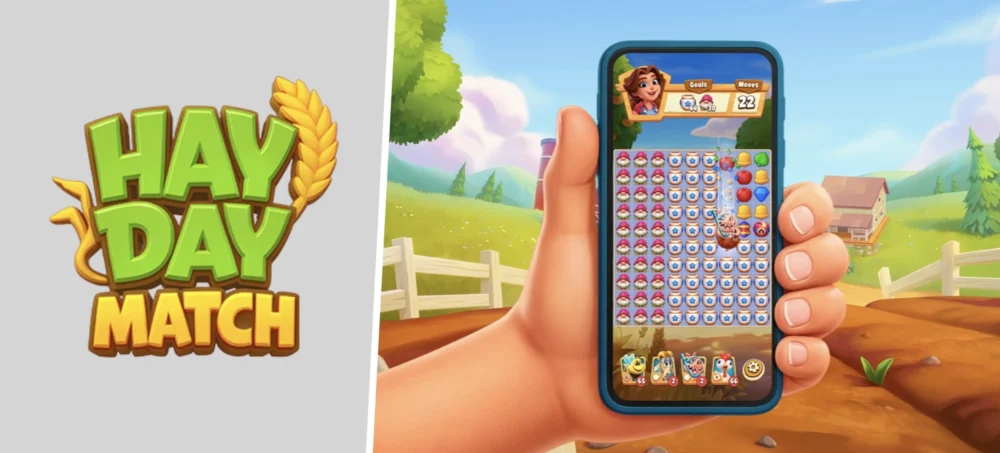
Supercell, the Finnish mobile gaming giant behind global hits such as Clash of Clans and Brawl Stars, has officially announced a new expansion of its intellectual property through a partnership with the London-based developer Playabit. The upcoming title, Hay Day Match, represents a strategic return to the Hay Day universe, the farming simulator that originally put Supercell on the map in 2012. Unlike its predecessor, Hay Day Match is a match-3 puzzle game, a genre that continues to dominate the mobile gaming revenue charts. According to official communications from the development team, the game is scheduled for a soft launch later this month, targeting three key growth markets: India, Indonesia, and the Philippines.
The project is being spearheaded by Playabit, a studio with a significant pedigree in the puzzle genre. Founded in 2021 with initial support from Wildlife Studios, Playabit was established by industry veterans Tugrul Atak, Ayhan Sahin, and Ant Sengelli. This trio is widely recognized for their pivotal roles at Peak Games, where they were instrumental in the development and massive success of Toy Blast and Toon Blast—two titles that redefined the "blast" and match-3 subgenres. As of 2024, Playabit has transitioned into an independent entity, a move facilitated by a strategic partnership and investment from Supercell. This collaboration marks a shift in Supercell’s broader operational strategy, focusing on empowering specialized external teams to iterate on its established intellectual properties.
A Strategic Pivot into the Match-3 Genre
The mobile gaming landscape has seen a significant consolidation of the match-3 genre over the last decade. With the success of titles like Candy Crush Saga, Royal Match, and Gardenscapes, the genre has proven to be one of the most resilient and profitable segments of the mobile market. By bringing the Hay Day IP into this space, Supercell is attempting to leverage a decade of brand equity to capture a broader, more casual demographic.
The official description of Hay Day Match suggests a focus on accessibility and narrative progression. Players are invited to engage in a "relaxing yet rewarding puzzle adventure" where they match colors to solve challenges. A central character, Mavis, serves as the narrative anchor, guiding players through a journey that involves uncovering the "secrets of the countryside." This narrative-driven approach mirrors successful trends in modern puzzle games where gameplay is supplemented by world-building and character interaction, moving beyond the simple high-score mechanics of early mobile titles.
The Evolution of the Hay Day Franchise: A Chronology
The announcement of Hay Day Match is not Supercell’s first attempt to diversify the Hay Day brand. To understand the significance of this new release, it is essential to look at the franchise’s history and Supercell’s rigorous approach to game development and cancellation.
- June 2012 – Hay Day Launch: Supercell releases Hay Day on iOS, followed by Android in 2013. The game becomes a foundational success for the company, establishing a "freemium" model that balances deep simulation with social interaction.
- March 2020 – Hay Day Pop Soft Launch: In an attempt to modernize the IP, Supercell soft-launched Hay Day Pop, a puzzle-based game that utilized a "tap-to-blast" mechanic rather than traditional swiping. The game integrated farming elements with puzzle levels.
- January 2021 – Hay Day Pop Cancellation: Despite a loyal initial following, Supercell announced the termination of Hay Day Pop. The company cited that the game did not meet the "high standards" required for a global launch, a hallmark of Supercell’s "quality over quantity" philosophy.
- 2021 – Playabit Formation: Tugrul Atak, Ayhan Sahin, and Ant Sengelli found Playabit in London. The studio begins developing puzzle-centric technology with the goal of creating the next generation of casual hits.
- October 2021 – Boom Beach Frontlines: While not related to Hay Day, Supercell partnered with Space Ape Games to launch a spin-off of Boom Beach. This demonstrated Supercell’s growing interest in external development partnerships.
- November 2022 – Boom Beach Frontlines Cancellation: Following the trend of Hay Day Pop, Frontlines was cancelled after failing to reach the necessary engagement metrics during its soft launch phase.
- 2024 – Playabit Independence and Hay Day Match: Playabit emerges as an independent studio under Supercell’s wing, announcing Hay Day Match as its flagship project.
Market Analysis: Why India, Indonesia, and the Philippines?
The choice of soft launch markets—India, Indonesia, and the Philippines—reflects a calculated move to test the game’s scalability and monetization in regions with high mobile density and a rapidly growing middle class. Industry data suggests that these regions are ideal for "tuning" a game’s economy before a global rollout.
In India, the mobile gaming market has seen an explosion in users following the widespread availability of low-cost data and smartphones. Similarly, Indonesia and the Philippines represent some of the highest engagement rates for casual social games in Southeast Asia. By testing in these markets, Playabit and Supercell can gather vast amounts of data on user retention, difficulty curves, and in-app purchase behavior without the high cost-per-install (CPI) typically associated with Tier-1 markets like the United States or the United Kingdom.
Furthermore, these markets have historically shown a strong affinity for the original Hay Day. By reintroducing the brand in a new format, the developers can gauge if the brand’s nostalgia carries over into the puzzle genre.
The Playabit Pedigree: The "Toon Blast" Effect
The involvement of the former Peak Games leads is perhaps the most significant indicator of the game’s potential. Toy Blast and Toon Blast were revolutionary because they simplified the match-3 formula into a "tap" mechanic that felt more tactile and responsive than previous iterations. They also mastered the "team" and "tournament" social layers that kept players engaged for years.
By bringing this expertise to Hay Day Match, Playabit is likely aiming to solve the retention issues that plagued Hay Day Pop. While Hay Day Pop was well-received for its aesthetics, many critics felt the gameplay loop lacked the "snappiness" found in Peak Games’ titles. With the original architects of the "blast" phenomenon at the helm, Hay Day Match is expected to feature a highly polished core engine and sophisticated social features.
Supercell’s Investment Strategy and the External Studio Model
For years, Supercell was known for its small, autonomous internal "cells." However, the company has increasingly moved toward a model of investing in external talent to expand its reach. This strategy allows Supercell to maintain its internal focus on groundbreaking new genres while ensuring its established IPs remain relevant through spin-offs.
Supercell’s investment in Playabit is part of a broader portfolio that includes stakes in studios like Metacore (developers of Merge Mansion) and Space Ape Games. This "publisher-investor" hybrid model allows Supercell to diversify its revenue streams. If Hay Day Match succeeds, it provides a steady stream of casual gaming revenue that can offset the more volatile performance of mid-core titles like Clash Royale.
Implications for the Mobile Gaming Industry
The launch of Hay Day Match comes at a time of transition for the mobile gaming industry. Apple’s App Tracking Transparency (ATT) and changes in Google’s privacy policies have made user acquisition significantly more expensive. In this environment, established IP is more valuable than ever. A known brand like Hay Day lowers the barrier to entry, as players are more likely to download a game featuring characters and art styles they already recognize.
However, the match-3 market is notoriously difficult to break into. The "Big Three"—Playrix, King, and Dream Games—hold a dominant share of the market. For Hay Day Match to succeed where Hay Day Pop failed, it will need to offer more than just a familiar skin; it will need to innovate on the social and meta-progression layers that define modern puzzle gaming.
Official Expectations and Future Outlook
While Supercell and Playabit have not released specific revenue targets, the expectations for any project associated with the Hay Day name are high. The original game has generated over $1 billion in lifetime revenue, and Supercell is keen to see the brand reach a new generation of players.
If the soft launch in India, Indonesia, and the Philippines yields positive data regarding Day-30 retention and average revenue per user (ARPU), a global rollout could be expected in early to mid-2025. Conversely, if the game fails to meet Supercell’s stringent KPIs, it may face the same fate as its predecessor. In the competitive world of mobile gaming, even the most beloved franchises must prove their worth through data-driven performance.
As the industry watches the soft launch later this month, Hay Day Match stands as a testament to Supercell’s willingness to iterate and its belief that with the right team—in this case, the veterans at Playabit—even the most crowded genres can be disrupted. For the millions of fans of the original farming sim, it represents a new way to interact with a familiar world, while for the industry, it is a litmus test for the power of IP-led puzzle games in a post-privacy mobile market.
About the Author