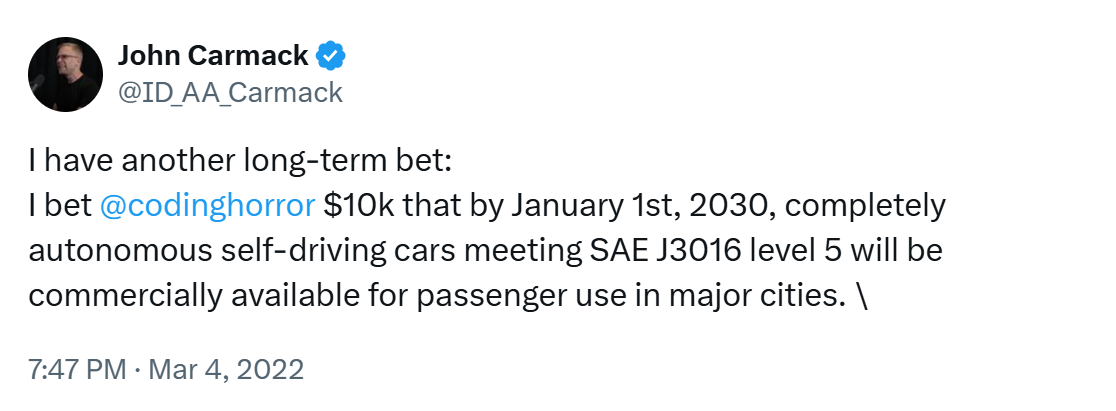
A high-stakes intellectual wager has been struck between two titans of the technology world, Jeff Atwood, co-founder of Stack Overflow and Discourse, and John Carmack, legendary programmer behind Doom and Quake, focusing on one of the most ambitious technological frontiers of our era: fully autonomous vehicles. The friendly bet, set at $10,000 to be donated to a 501(c)(3) charity of the winner’s choice, hinges on whether truly Level 5 self-driving cars will be commercially available for passenger use in major U.S. cities by January 1st, 2030. Atwood is betting against this ambitious timeline, while Carmack champions the belief that the technology will reach this pinnacle within the decade. The agreement also includes a provision for adjusting the prize amount for inflation to ensure its intended impact in 2030.
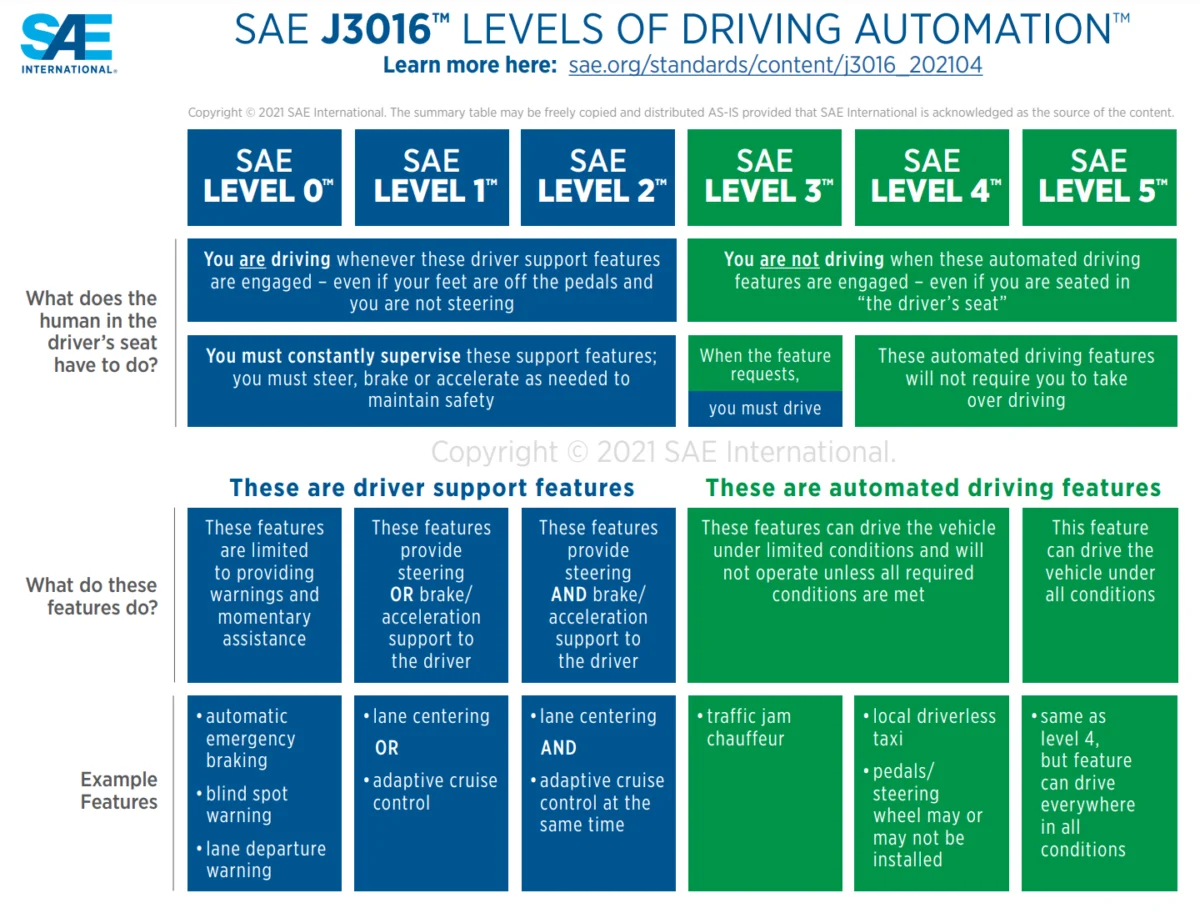
The core of the wager centers on the precise definition of "completely autonomous" as outlined by the Society of Automotive Engineers (SAE) J3016 standard for vehicle automation levels. Specifically, the bet refers to Level 5 autonomy, the highest classification, meaning the vehicle is capable of performing all driving tasks under all conditions. This implies a scenario where a human passenger merely enters the vehicle, selects a destination, and requires zero attention or interaction throughout the journey. The only exceptions would be in cases of natural disasters or emergencies, which fall outside the scope of typical driving scenarios. Furthermore, "major cities" are defined as any of the top 10 most populous cities in the United States, adding a significant layer of environmental complexity to the challenge.
Understanding SAE J3016 Levels of Automation
To fully grasp the magnitude of the bet, it is crucial to understand the SAE J3016 standard, which categorizes driving automation into six distinct levels, from Level 0 (no automation) to Level 5 (full automation). This framework provides a standardized vocabulary for discussing the capabilities of autonomous vehicles.
- Level 0: No Driving Automation. The human driver performs all driving tasks.
- Level 1: Driver Assistance. The vehicle features a single automated system for either steering or acceleration/deceleration, such as adaptive cruise control or lane-keeping assist. The human driver remains fully responsible for all other aspects of driving.
- Level 2: Partial Driving Automation. The vehicle can control both steering and acceleration/deceleration simultaneously in specific scenarios, but the human driver must constantly supervise the driving environment and be prepared to intervene at any moment. Examples include Tesla’s Autopilot and GM’s Super Cruise.
- Level 3: Conditional Driving Automation. The vehicle can perform all aspects of driving under specific conditions, but the human driver must be ready to take over if prompted. The driver is not required to monitor the environment constantly but must be available to intervene when the system requests it. Traffic Jam Pilot systems are an emerging example.
- Level 4: High Driving Automation. The vehicle can perform all driving tasks and monitor the driving environment under specific conditions, within a defined operational design domain (ODD). In a Level 4 system, if the system encounters a situation it cannot handle, it will safely bring the vehicle to a minimal risk condition (e.g., pulling over) without human intervention. Many current robotaxi trials operate at this level within geofenced areas.
- Level 5: Full Driving Automation. This is the holy grail of autonomous driving. The vehicle can perform all driving tasks and monitor the driving environment under all conditions, equivalent to a human driver. There are no geofencing or environmental limitations, and no human intervention is ever required. This means the vehicle could theoretically operate anywhere a human driver could, from complex urban centers to rural roads, in all weather conditions.
The wager specifically targets Level 5, which represents a quantum leap beyond even Level 4. While Level 4 systems are already being tested in limited capacities in select cities, transitioning from highly constrained environments to truly universal, all-condition operation presents an exponential increase in technical and regulatory challenges.
A Historical Perspective: The Elusive Promise of Full Autonomy
The dream of self-driving cars is not new, tracing its roots back to early 20th-century science fiction and futuristic exhibitions like the 1939 New York World’s Fair "Futurama" exhibit. However, serious technological development began accelerating in the late 20th and early 21st centuries. Carnegie Mellon University’s "Navlab" projects in the 1980s and 90s demonstrated early capabilities, but it was the DARPA Grand Challenges in the mid-2000s that truly ignited public and private sector interest. These competitions pushed the boundaries of robotic vehicle navigation, culminating in Stanford University’s "Stanley" winning the 2005 Grand Challenge by autonomously traversing 132 miles of desert terrain.
Following these successes, Google (now Waymo) launched its self-driving car project in 2009, with early prototypes generating significant optimism. Initial predictions from industry leaders and tech evangelists often placed Level 5 autonomy within a five-to-ten-year timeframe, a projection that has repeatedly been pushed back. In 2012, Google co-founder Sergey Brin famously stated that self-driving cars would be "available to a large part of the population" within five years. Similar optimistic timelines have been voiced by various CEOs and researchers throughout the 2010s, creating a consistent pattern of overestimation regarding the speed of autonomous vehicle development.
This pattern highlights a phenomenon often observed in complex technological advancements: the initial stages of development show rapid progress, but the final stages, particularly the transition from "most cases" to "all cases," prove exponentially more challenging. This "long tail" of unforeseen circumstances and "edge cases" has proven to be a significant hurdle for Level 5 autonomy.
The Current Landscape: Progress and Persistent Challenges
As of the mid-2020s, the autonomous vehicle industry has made substantial strides, primarily in Level 2 and Level 4 capabilities. Level 2 systems, offering advanced driver assistance, are widely available in consumer vehicles, providing features like adaptive cruise control, lane-keeping, and automatic emergency braking. These systems enhance safety and convenience but require constant human supervision.
Level 4 autonomy has seen the most significant advancements in controlled environments. Companies like Waymo (Alphabet’s self-driving unit) and Cruise (majority-owned by GM) operate robotaxi services in select cities like Phoenix, San Francisco, and Austin. These services run within carefully mapped and monitored operational design domains (ODDs), often restricted by weather conditions, time of day, and specific routes. While impressive, these systems are still far from Level 5. They demonstrate the capability to navigate complex urban scenarios without human intervention under specific, favorable conditions, but cannot yet handle any condition or environment.

The challenges in achieving Level 5 are multifaceted and profound:
- Perception and Prediction in Unpredictable Environments: Human drivers rely on intuition, cultural context, and nuanced understanding of human behavior to navigate complex scenarios. Replicating this in AI requires perfect sensor fusion (lidar, radar, cameras), robust object detection in all weather conditions (heavy rain, snow, fog, bright sun glare), and predictive models for highly unpredictable agents like pedestrians, cyclists, and other drivers. Edge cases – rare but critical events – such as unusual road debris, erratic human behavior, or novel construction zones, pose immense difficulty.
- Decision-Making and "Common Sense": Beyond perception, an L5 system must make safe, legally compliant, and socially acceptable decisions in real-time. This includes navigating ethical dilemmas (e.g., unavoidable accidents), understanding implied social rules of the road (e.g., yielding in ambiguous situations), and adapting to unforeseen circumstances that defy pre-programmed rules. The concept of "common sense AI" remains a significant research hurdle across the entire field of artificial intelligence.
- Regulatory and Legal Frameworks: There is no unified federal regulatory framework for autonomous vehicles in the United States. Instead, a patchwork of state laws and guidelines creates a complex environment for deployment. For Level 5 vehicles to be "commercially available for passenger use in major cities," clear national standards for testing, deployment, liability, and safety certification would likely be necessary. The public’s trust and acceptance also heavily depend on clear regulatory oversight.
- Infrastructure Requirements: While Level 5 theoretically operates without specific infrastructure, dense urban environments present unique challenges. Smart city infrastructure, vehicle-to-everything (V2X) communication, and high-definition mapping require continuous updates and maintenance, adding to the complexity of universal deployment.
- Cost and Scalability: The sophisticated sensor suites, powerful onboard computers, and extensive testing required for Level 5 vehicles make them incredibly expensive to develop and produce. Achieving commercial availability implies affordability and widespread access, which is a major hurdle for such cutting-edge technology.
The Stances: Carmack’s Optimism vs. Atwood’s Pragmatism
John Carmack, a visionary known for pushing the boundaries of computing and graphics, represents the optimistic camp. His career has been defined by overcoming seemingly insurmountable technical challenges, from pioneering 3D game engines to his more recent work in virtual reality and AI. His bet "for" Level 5 by 2030 likely stems from a belief in the relentless pace of technological progress, particularly in AI, machine learning, and computational power. He may foresee breakthroughs in neural networks, simulation environments, and data collection that could accelerate the development curve in the latter half of the decade. The sheer amount of investment pouring into the AV space from companies like Google, Amazon, General Motors, Ford, Tesla, NVIDIA, and Mobileye also fuels this optimism, suggesting that a collective effort could surmount the remaining obstacles.
Jeff Atwood, known for his pragmatic and often skeptical view on nascent technologies, is betting "against." His publicly stated reason is that he believes everyone is "underestimating how difficult fully autonomous driving really is." This perspective aligns with the industry’s historical pattern of overpromising and underdelivering on AV timelines. Atwood’s skepticism isn’t rooted in opposition to the technology itself; he expresses a desire for autonomous vehicles and views it as a fascinating computer science problem. Rather, his position reflects an understanding of the immense gap between near-perfect automation (Level 4) and absolute, universal perfection (Level 5). The "last mile" problem in AI, where the final few percentage points of accuracy or capability prove exponentially harder to achieve, is a common theme in his analysis of emerging tech. He previously voiced a similar, even more pessimistic view on the widespread adoption of virtual reality, suggesting that augmented reality and projection technologies might offer more practical advancements sooner.
Broader Implications and Societal Impact
The outcome of this wager, irrespective of the financial stakes, carries significant implications for society. If Level 5 autonomy becomes commercially available in major U.S. cities by 2030, it would herald a transportation revolution with profound impacts:
- Safety: The vast majority of traffic accidents are caused by human error. Level 5 AVs could drastically reduce accidents, injuries, and fatalities, potentially saving millions of lives globally over decades.
- Mobility and Accessibility: It could offer unprecedented mobility for the elderly, disabled, and those unable to drive, dramatically enhancing their independence and access to services.
- Urban Planning and Infrastructure: With fewer personally owned vehicles and a shift towards ride-sharing autonomous fleets, cities could reimagine parking spaces, reduce traffic congestion, and reallocate urban land.
- Economic Transformation: Industries such as logistics, trucking, and delivery services would be fundamentally reshaped. New business models would emerge, while existing ones would need to adapt. However, this could also lead to significant job displacement in the transportation sector.
- Personal Productivity: Commuters could reclaim hours currently spent driving, converting travel time into productive work, relaxation, or leisure.
- Environmental Benefits: Optimized driving patterns, reduced congestion, and potential shifts towards electric autonomous fleets could lead to lower emissions and improved air quality in urban centers.
Conversely, if Level 5 autonomy remains elusive by 2030, it would underscore the immense complexity of replicating human-level intelligence in unpredictable, real-world environments. It would force a re-evaluation of AI development strategies and likely lead to continued focus on Level 4 solutions within defined operational domains, with human oversight remaining a critical component for the foreseeable future. This would not negate the value of autonomous vehicle research but would temper expectations for universal, unconstrained autonomy.
The Challenge Ahead
The bet between John Carmack and Jeff Atwood serves as more than just a friendly competition; it’s a public declaration of a critical technological frontier and a challenge to the entire industry. Atwood explicitly frames his "against" bet as an invitation: "Prove me wrong! Make it happen by 2030, and I’ll be popping champagne along with you and everyone else!" This sentiment encapsulates the spirit of innovation that drives the tech community.
The journey to Level 5 autonomy is one of the most ambitious engineering and AI challenges ever undertaken. It requires not only technical breakthroughs but also robust regulatory frameworks, public acceptance, and solutions to complex ethical dilemmas. As the calendar pages turn towards 2030, the world will be watching to see whether the collective ingenuity of the tech industry can bridge the gap from impressive automation to true, universal autonomy. The outcome of this $10,000 wager will signify a pivotal moment in the history of artificial intelligence and transportation, marking either a triumph of rapid innovation or a testament to the enduring complexity of the real world.
About the Author