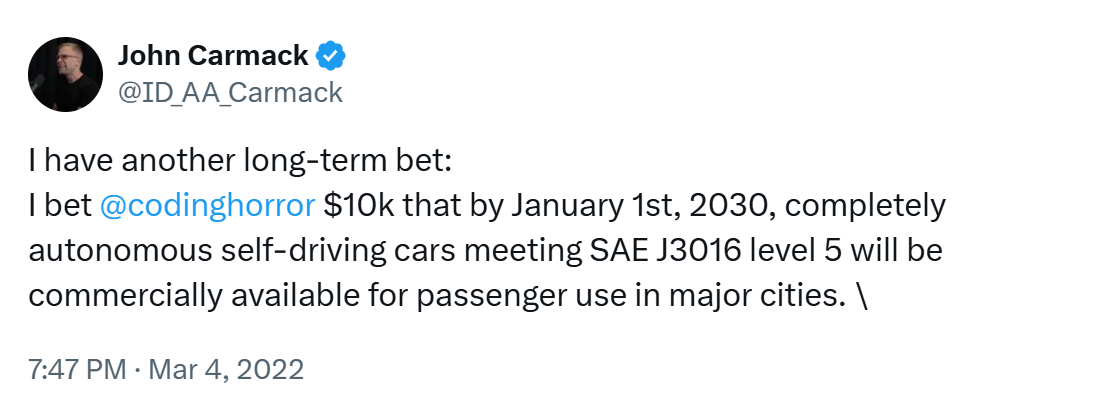
In a challenge that has captivated the technology community, two titans of the software world, legendary programmer John Carmack and influential developer Jeff Atwood, have initiated a friendly, high-stakes wager of $10,000, payable to a 501(c)(3) charity of the winner’s choice. The focal point of this public intellectual sparring match is the ambitious prediction that by January 1st, 2030, completely autonomous self-driving cars, meeting the rigorous SAE J3016 Level 5 standard, will be commercially available for passenger use in major U.S. cities. Carmack champions the optimistic view, betting "for" the realization of this technological milestone, while Atwood adopts the more cautious stance, betting "against."
The Core Proposition: Unpacking Level 5 Autonomy
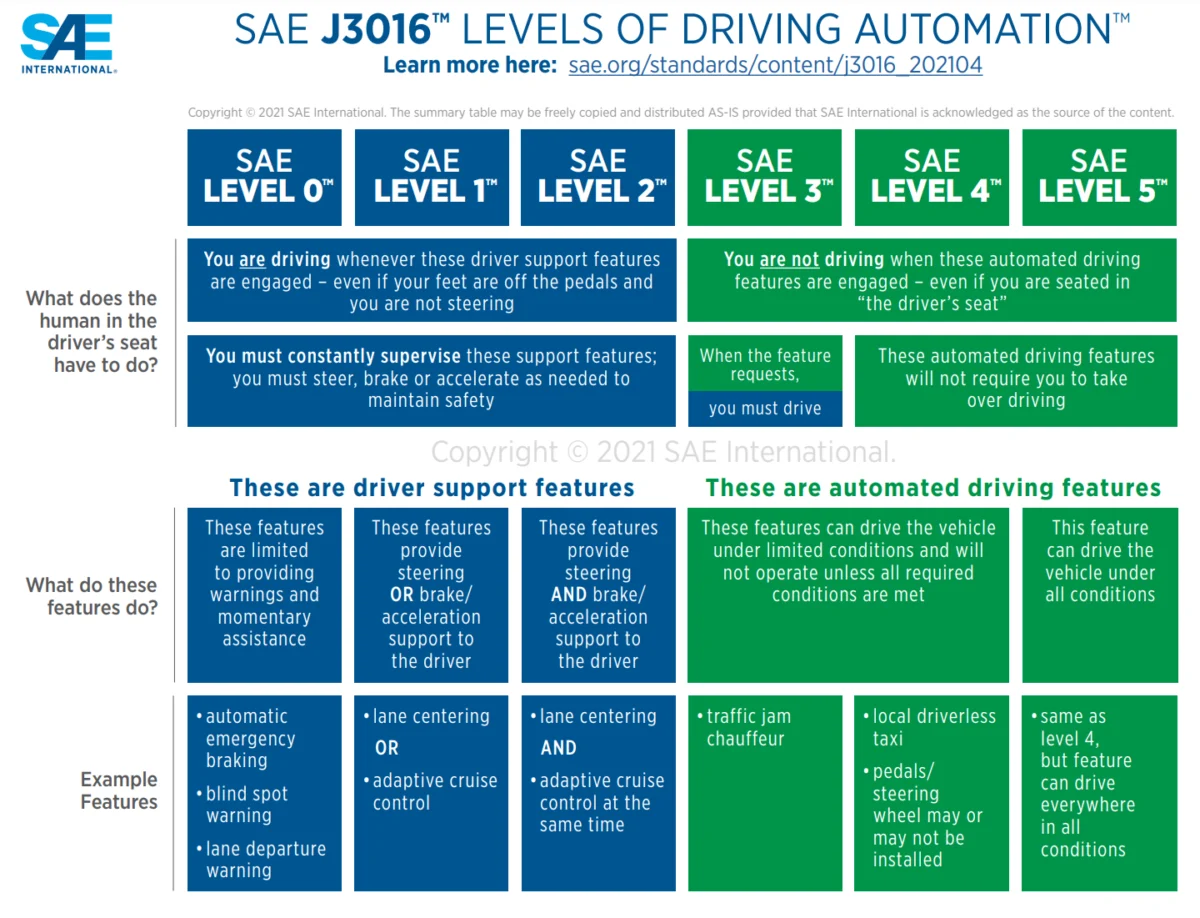
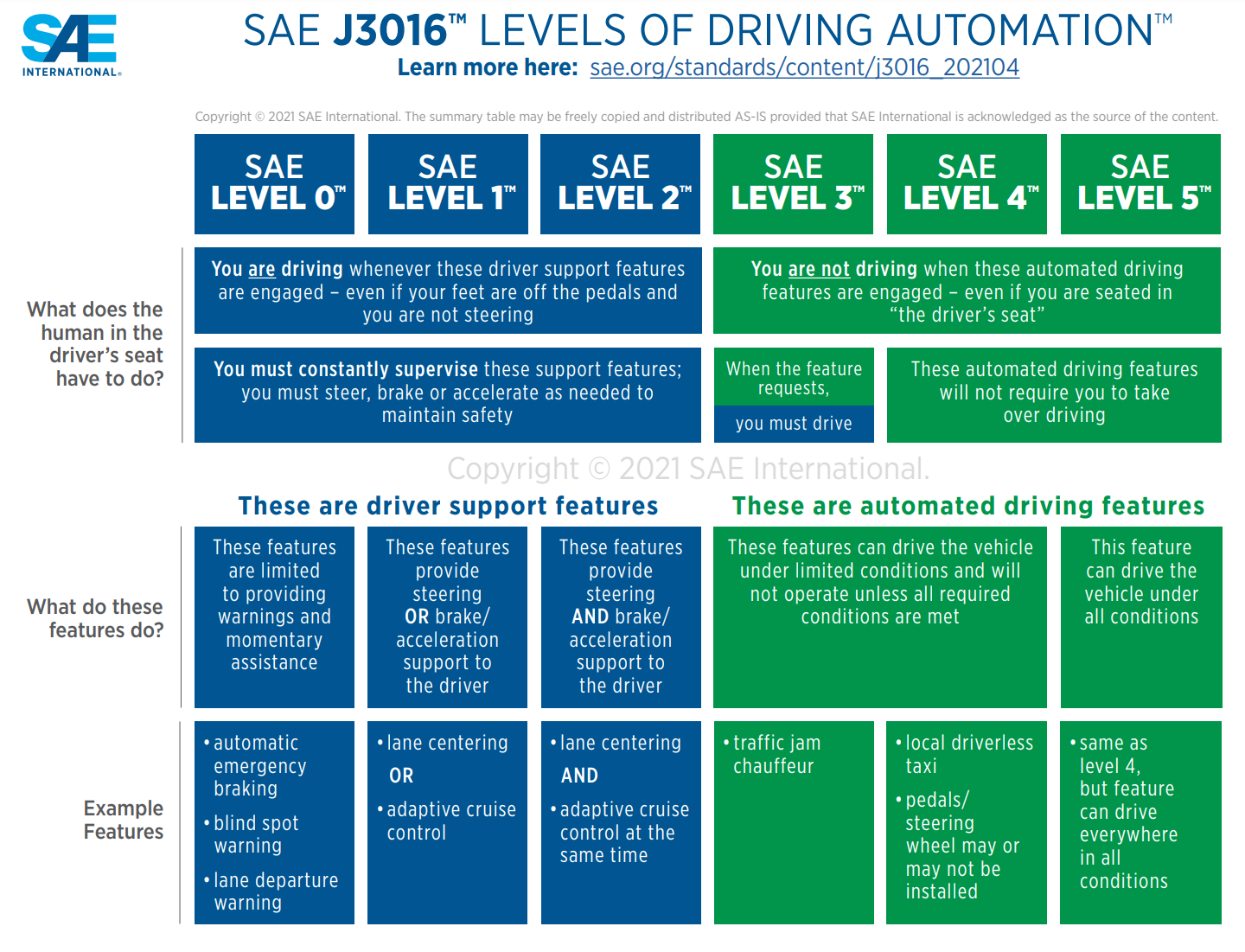
At the heart of the wager lies the precise definition of "completely autonomous" as outlined by the Society of Automotive Engineers (SAE) J3016 standard for vehicle automation. SAE Level 5 represents the pinnacle of autonomous capability, signifying a vehicle that can perform all driving tasks under all conditions, without any human attention or interaction whatsoever. The only exceptions are extreme natural disasters or emergencies that render even human-driven vehicles immobile. This means a passenger would simply enter the vehicle, select a destination, and the vehicle would handle every aspect of the journey from start to finish. There would be no steering wheel, pedals, or human-facing controls necessary, as the vehicle is designed to operate entirely independently of human input.
The bet further stipulates that this Level 5 capability must be "commercially available for passenger use," implying widespread deployment and accessibility, not merely experimental prototypes or limited pilot programs. Furthermore, this availability must extend to "major cities," specifically defined as any of the top 10 most populous cities in the United States. These cities, according to recent census data, include New York City, Los Angeles, Chicago, Houston, Phoenix, Philadelphia, San Antonio, San Diego, Dallas, and Austin. The urban complexities of these metropolitan areas, ranging from dense traffic and unpredictable pedestrian behavior to varied infrastructure and dynamic road conditions, present an enormous challenge for even advanced autonomous systems. The potential for the $10,000 prize to be adjusted for inflation by mutual agreement in 2030 underscores the long-term perspective of this friendly rivalry, emphasizing the desired charitable impact rather than merely the monetary value.
The Proponents: Carmack’s Optimism and Atwood’s Skepticism
John Carmack, co-founder of id Software and a pioneer in 3D graphics and virtual reality, is renowned for his visionary outlook and relentless pursuit of technological frontiers. His career is marked by breakthroughs that many once deemed impossible, from developing groundbreaking game engines to his significant contributions to Oculus VR. Carmack’s wager reflects a deep-seated belief in the power of sustained engineering effort, exponential technological progress, and the eventual triumph of advanced AI and robotics over complex real-world problems. His willingness to take the "for" side of such a challenging bet aligns with his history of pushing boundaries and his often-optimistic view of future technological capabilities. The bet, he suggested, serves as a "fun way to generate STEM publicity," encouraging innovation and engagement in science, technology, engineering, and mathematics.
Conversely, Jeff Atwood, celebrated for founding Stack Overflow and his influential "Coding Horror" blog, has positioned himself as the skeptic in this wager. Atwood is known for his incisive analysis of software development and technology trends, often tempering enthusiasm with pragmatic assessments of practical difficulties. His decision to bet "against" Level 5 autonomy by 2030 stems from a profound conviction that the industry is "underestimating how difficult fully autonomous driving really is." While acknowledging the allure of self-driving cars – expressing a personal desire to spend travel time on activities other than driving – Atwood views Level 5 autonomy as an "incredibly challenging computer science problem." His stance is not one of opposition to the technology itself, but rather a realistic appraisal of the immense complexities involved in achieving truly universal, human-level driving intelligence in machines within the specified timeframe. Atwood’s previous public skepticism regarding the transformative potential of virtual reality, which he described as "just okay" and unlikely to "change the world" in our lifetimes, provides a consistent through-line for his cautious approach to emerging technologies with significant hype.
A Deeper Dive into Autonomous Driving Levels and Current State
To fully appreciate the scope of the Carmack-Atwood wager, it is essential to understand the SAE J3016 levels of driving automation:
- Level 0 (No Automation): The human driver does everything.
- Level 1 (Driver Assistance): A single automated system provides assistance, such as adaptive cruise control or lane keeping. The human driver remains fully responsible.
- Level 2 (Partial Automation): The vehicle can control both steering and acceleration/deceleration under specific conditions (e.g., highway driving). The human driver must constantly monitor the environment and be ready to intervene immediately. Most advanced driver-assistance systems (ADAS) on the market today, including Tesla’s Autopilot and General Motors’ Super Cruise, fall into this category.
- Level 3 (Conditional Automation): The vehicle can perform all driving tasks under specific conditions, and the human driver does not need to monitor the environment constantly. However, the system will request human intervention when it encounters situations it cannot handle, and the driver must be ready to take over within a few seconds. Deployments of Level 3 systems are extremely limited globally.
- Level 4 (High Automation): The vehicle can perform all driving tasks and monitor the driving environment under specific conditions (an "Operational Design Domain" or ODD). In these ODDs, the vehicle can handle unexpected situations and safely come to a minimal risk condition (e.g., pulling over) if the driver fails to respond to a takeover request. Human intervention is not required within the ODD. Companies like Waymo and Cruise operate Level 4 autonomous ride-hailing services in geo-fenced areas of cities like Phoenix, San Francisco, and Austin.
- Level 5 (Full Automation): This is the target of the bet. The vehicle can perform all driving tasks and monitor the driving environment under all conditions, in all scenarios, equivalent to a human driver. There are no ODD limitations, and no human intervention is ever expected or required.
Currently, no company has achieved commercially available Level 5 autonomous vehicles. Even leading Level 4 systems, such as Waymo and Cruise, operate within carefully mapped and monitored geographical boundaries and often have restrictions on weather conditions or times of day. The leap from Level 4, which still has defined operational limits, to Level 5, which demands universal capability, represents an exponential increase in complexity and technical challenge.
Technological and Regulatory Hurdles to Level 5

Achieving Level 5 autonomy by 2030 faces a gauntlet of formidable technical, regulatory, and societal obstacles:
Technical Challenges:
- Edge Cases and Unpredictability: While autonomous systems excel at common driving scenarios, the "long tail" of rare, unpredictable, or ambiguous situations presents an enormous hurdle. This includes navigating complex, unmapped construction zones, understanding nuanced human gestures (e.g., a flagger’s signals), responding to unexpected debris, or operating flawlessly in extreme weather (heavy snow, torrential rain, thick fog) that obscure sensors.
- Perception and Sensor Fusion: Reliably perceiving the environment in all conditions requires robust sensor fusion (Lidar, radar, cameras, ultrasonic) that can overcome individual sensor limitations. Distinguishing between a shadow and a pothole, or a plastic bag and a child, at high speeds and varying light conditions, remains a significant challenge.
- Prediction and Intent: Predicting the behavior of other human drivers, pedestrians, and cyclists – who often act irrationally or unpredictably – is immensely difficult. Human drivers rely on intuition and contextual cues that AI struggles to replicate.
- Real-time Decision Making: Autonomous systems must make instantaneous, complex decisions in dynamic environments, often weighing safety, efficiency, and legal compliance. The computational demands for such real-time, global awareness and planning are immense.
- Robustness and Redundancy: Level 5 systems require multiple layers of redundancy for all critical components to ensure safety in case of hardware or software failure, adding to cost and complexity.
Regulatory and Legal Challenges:
- Standardization Across Jurisdictions: The lack of a unified national regulatory framework in the U.S. (with states enacting their own laws) creates a patchwork of rules that hinders widespread deployment.
- Liability: Determining fault in an accident involving a fully autonomous vehicle remains a complex legal question, with implications for manufacturers, software developers, and even passengers.
- Certification and Testing: How to certify a Level 5 system as safe enough for universal deployment is an unsolved problem. Traditional testing methods are insufficient to cover the infinite number of real-world scenarios.
- Public Acceptance and Trust: High-profile accidents involving autonomous vehicles, even those with human drivers in control, have eroded public trust. Overcoming this skepticism requires a flawless safety record, which Level 5 aims to deliver.
Timeline and Industry Perspectives
The journey toward autonomous vehicles began in earnest with projects like the DARPA Grand Challenge in the early 2000s, demonstrating the feasibility of robotic vehicles navigating desert terrain. Google’s self-driving car project (later Waymo) significantly advanced the field in the late 2000s and early 2010s. Over the past decade, numerous startups and established automakers have poured billions into research and development.
Despite significant progress in Level 2 and Level 4 deployments, the industry remains divided on the timeline for Level 5.
- Skeptics (echoing Atwood): Many prominent experts, including those at established automotive companies and research institutions, believe Level 5 is still decades away. They point to the "long tail" problem of rare but critical scenarios, the limitations of current AI in handling truly novel situations, and the regulatory hurdles. They argue that the last 1% of the problem is exponentially harder than the first 99%. "The challenge isn’t just about driving, it’s about understanding the entire human context of driving, which is incredibly nuanced," an automotive AI researcher might contend.
- Optimists (aligning with Carmack): A smaller but vocal group, often from cutting-edge AI and robotics firms, holds that breakthroughs in machine learning, particularly deep reinforcement learning and vastly improved sensor technology, could accelerate progress. They believe that with enough data and computational power, AI can eventually surpass human driving capabilities in all conditions. "The rate of AI improvement is accelerating, and what seems impossible today could be commonplace in a few years with continued investment and innovation," a tech entrepreneur specializing in AI might argue. Tesla CEO Elon Musk has famously, and repeatedly, predicted full autonomy "next year" for several years running, reflecting an aggressive, though as yet unrealized, timeline.
For Level 5 to be commercially available in major U.S. cities by 2030, a confluence of unprecedented technological breakthroughs, harmonized regulatory frameworks, and widespread public acceptance would need to occur. This includes not just technical prowess but also a societal shift in how we interact with transportation.
Broader Impact and Implications
Should Level 5 autonomous vehicles become a reality by 2030, the implications would be profound and far-reaching, transforming virtually every aspect of society:
- Urban Planning and Infrastructure: Cities could be redesigned with less parking, more green spaces, and optimized traffic flow. Road infrastructure might adapt to accommodate vehicle-to-everything (V2X) communication, enhancing safety and efficiency.
- Transportation and Mobility: Personal car ownership might decline in favor of subscription-based or on-demand autonomous ride-sharing services. This could offer unprecedented mobility for the elderly, disabled, and those unable to drive. Public transit systems could be integrated with autonomous fleets, providing seamless last-mile solutions.
- Safety: The vast majority of traffic accidents are caused by human error. Level 5 autonomy promises a dramatic reduction in fatalities and injuries, potentially saving millions of lives globally over decades.
- Economic Shifts: The trucking and taxi industries would face massive disruption, leading to job displacement for professional drivers. However, new industries would emerge, focusing on maintenance, fleet management, software development, and in-vehicle services. Insurance models would fundamentally change, shifting liability from individual drivers to manufacturers and software providers.
- Environmental Benefits: Optimized driving patterns, reduced congestion, and a potential shift towards electric autonomous vehicles could significantly lower carbon emissions and fuel consumption.
- Societal Change: Commute times could become productive or leisure time, enhancing quality of life. The psychological experience of travel would be redefined, allowing passengers to work, socialize, or relax while in transit. Ethical considerations, such as programming vehicles to make difficult moral choices in unavoidable accident scenarios, would become paramount.
The wager between John Carmack and Jeff Atwood is more than just a friendly bet; it is a public challenge that encapsulates one of the most compelling and complex technological debates of our era. It forces a critical examination of what constitutes true artificial intelligence, the limits of current technological capabilities, and the pace at which humanity can solve seemingly intractable problems. Whether the champagne flows in 2030 for Carmack’s optimism or Atwood’s pragmatism, the conversation ignited by this $10,000 bet serves to underscore the monumental effort required to bring a truly autonomous future into existence. This philanthropic wager, alongside Atwood’s ongoing project to update "the single most influential book of the BASIC era" with proceeds also benefiting charity, highlights the deep commitment of these tech leaders to using their influence for the greater good, even amidst their intellectual sparring.
About the Author