The Terms of the Wager: Defining Level 5 Autonomy and Market Availability
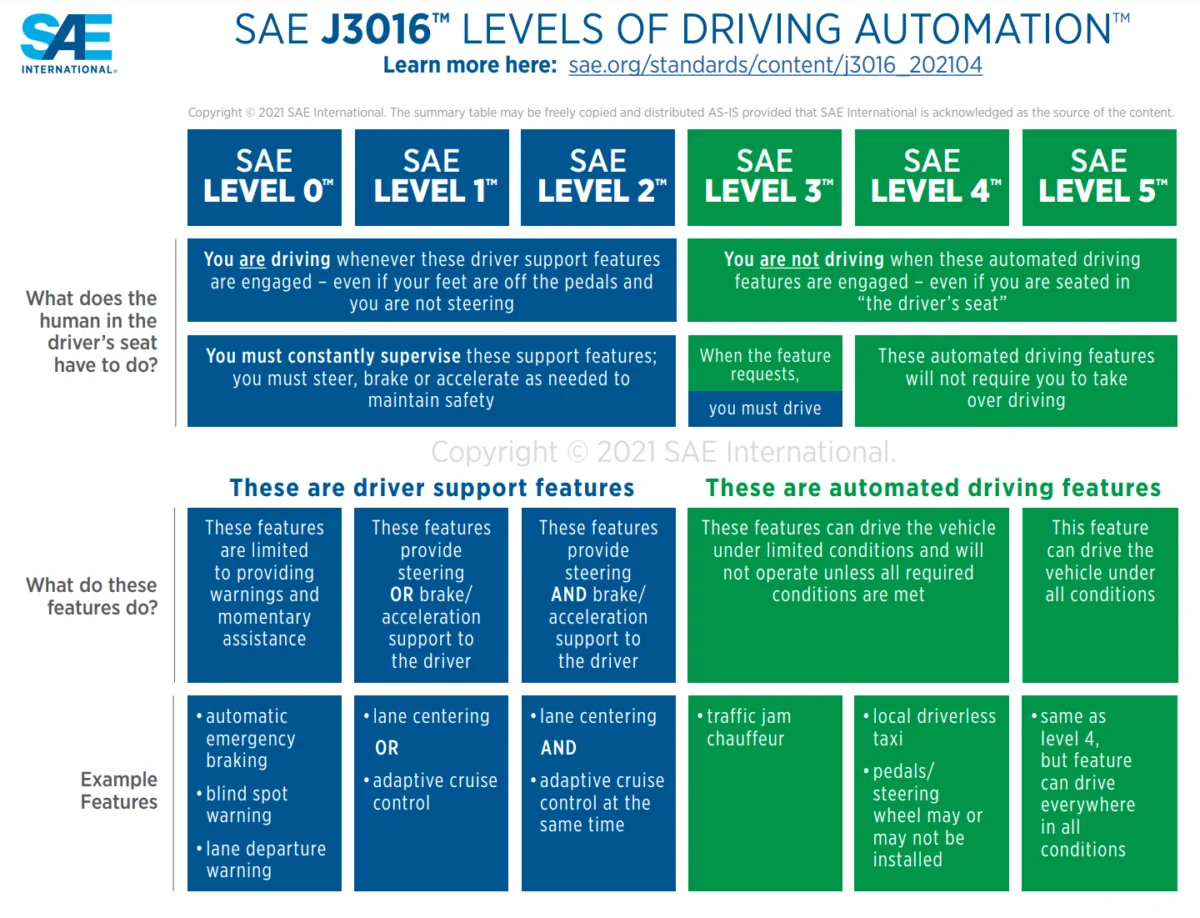
The core of the bet rests on a precise definition of "completely autonomous" as outlined by the Society of Automotive Engineers (SAE) J3016 standard for Levels of Driving Automation. SAE Level 5, the highest classification, signifies full automation where the vehicle performs all driving tasks under all conditions, without any human attention or interaction required during the journey. This means a passenger would simply enter the vehicle, select a destination, and the car would handle every aspect of driving, barring natural disasters or extreme emergencies beyond typical operational design domains. There is no expectation for a human driver to intervene or even monitor the system. This distinguishes Level 5 significantly from lower levels of automation, which still require varying degrees of human oversight.
Furthermore, the bet specifies "commercially available for passenger use in major cities." For the purposes of this wager, "major cities" refers to any of the top 10 most populous cities in the United States of America, which currently include New York City, Los Angeles, Chicago, Houston, Phoenix, Philadelphia, San Antonio, San Diego, Dallas, and Austin. Commercial availability implies that these vehicles are not merely prototypes or limited pilot programs, but rather systems accessible to the general public for transportation services, such as ride-hailing, or for private ownership within these specified urban environments. The $10,000 prize amount, intended for charity, may also be adjusted for inflation by mutual agreement in 2030 to ensure its intended impact.
The Stances: Skepticism vs. Optimism
Jeff Atwood, known for his incisive analysis of software development and technology trends, articulates his position against the 2030 deadline with a clear rationale: "I think everyone is underestimating how difficult fully autonomous driving really is." While acknowledging his personal desire for such technology – expressing a preference to read, watch videos, or socialize instead of driving – Atwood views Level 5 autonomy as an "incredibly challenging computer science problem." His stance is not one of opposition to the technology itself, but rather a realistic assessment of the immense technical and regulatory hurdles that must be overcome within the next six years. He frames his bet as a challenge, urging innovators to "prove me wrong! Make it happen by 2030, and I’ll be popping champagne along with you and everyone else!" This perspective aligns with his past cautious assessments of emerging technologies, notably his more pessimistic view on the widespread adoption of Virtual Reality (VR), which he believes will not "change the world" in our lifetimes.
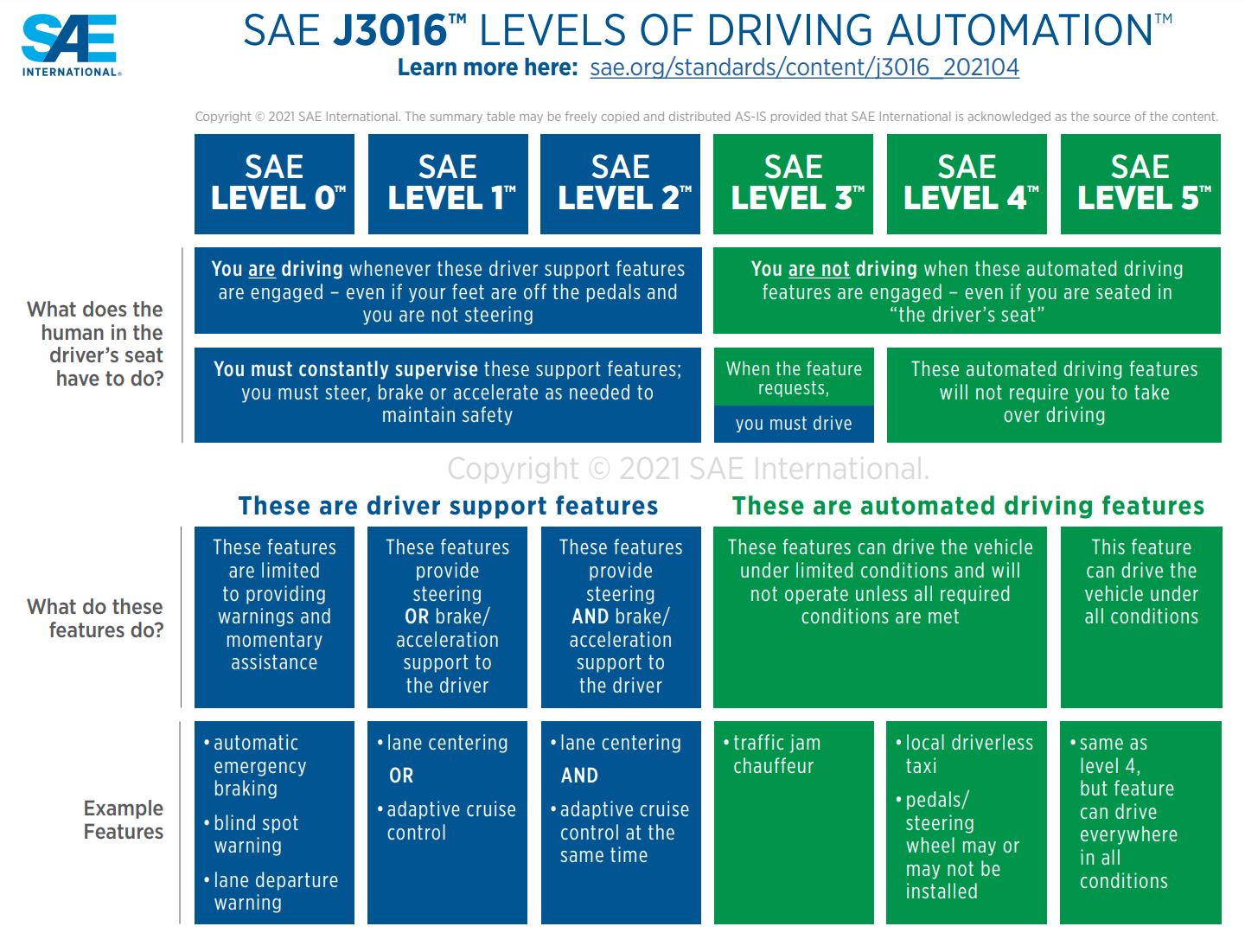
John Carmack, a visionary whose career has consistently pushed the boundaries of computing, holds the optimistic view. While his direct statement regarding the bet is captured in an image shared by Atwood, his long-standing track record of solving complex problems and his involvement in cutting-edge fields like VR and AI suggest a deep faith in technological progress. Carmack’s participation in the wager, described as a "friendly wager as a fun way to generate STEM publicity," underscores his belief that the necessary advancements are achievable within the stipulated timeframe. His optimism reflects a segment of the tech industry that believes rapid innovation in AI, sensor technology, and data processing will accelerate the path to full autonomy. Carmack is celebrated as one of Atwood’s personal heroes, a testament to his profound influence on the industry.
Understanding the SAE J3016 Levels of Driving Automation
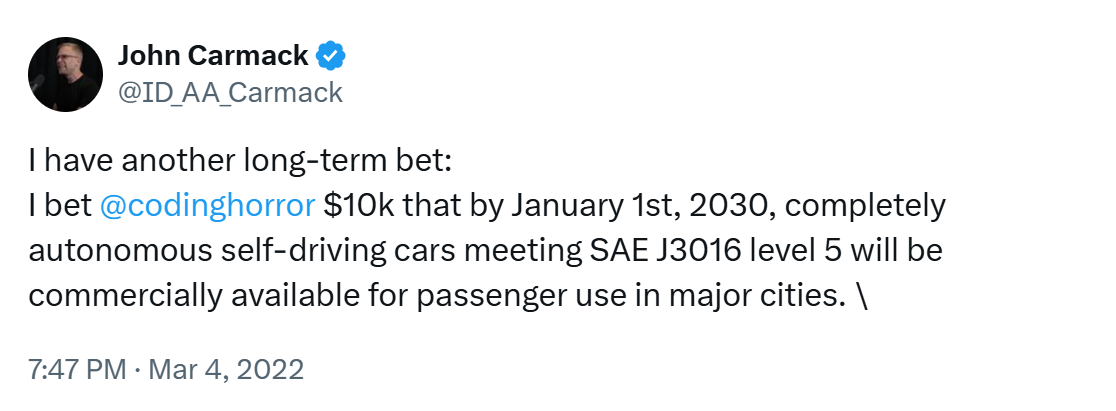
To fully appreciate the scope of the Atwood-Carmack wager, it is essential to understand the SAE J3016 standard, which categorizes driving automation into six distinct levels, ranging from no automation to full automation. This framework provides a common language for discussing and regulating autonomous vehicle technology.
- Level 0: No Driving Automation. The human driver performs all driving tasks.
- Level 1: Driver Assistance. The vehicle features a single automated system, such as adaptive cruise control or lane-keeping assist, that aids the human driver. The driver is still responsible for monitoring the driving environment.
- Level 2: Partial Driving Automation. The vehicle can automate at least two driving tasks simultaneously, like adaptive cruise control combined with lane centering. The driver must remain engaged, monitor the environment, and be ready to take control at any moment. Systems like Tesla’s Autopilot and GM’s Super Cruise fall into this category.
- Level 3: Conditional Driving Automation. The vehicle can perform all driving tasks under specific conditions, allowing the driver to disengage from monitoring the driving environment. However, the system will issue a request for the driver to intervene if it encounters a situation it cannot handle. The driver must be ready to take over within a few seconds. Mercedes-Benz DRIVE PILOT is an example of a Level 3 system approved for use in certain conditions in Germany and parts of the U.S.
- Level 4: High Driving Automation. The vehicle can perform all driving tasks and monitor the driving environment within a specific operational design domain (ODD), such as geofenced areas or specific weather conditions. In a Level 4 system, if the vehicle encounters a situation it cannot handle, it will safely pull over or come to a stop without requiring human intervention. Commercial robotaxi services like Waymo and Cruise operate at this level in limited areas.
- Level 5: Full Driving Automation. This is the ultimate goal: the vehicle can perform all driving tasks under all conditions, human-operable or not, and in all operational design domains. No human intervention is ever required. The vehicle functions completely autonomously from start to finish, akin to a human driver capable of driving anywhere, anytime.
The jump from Level 4 to Level 5 represents a monumental leap in complexity and capability. While Level 4 systems are already deployed in controlled environments, Level 5 demands a robustness and versatility that can navigate unpredictable real-world scenarios across diverse geographies and weather conditions, without any human safety net.
The Current Landscape of Autonomous Driving: Progress and Hurdles
As of the current date, the autonomous vehicle industry is primarily operating within Level 2 and, in limited instances, Level 3 and Level 4 capabilities. Companies like Waymo (an Alphabet subsidiary) and Cruise (majority-owned by GM) have deployed Level 4 robotaxi services in select cities like Phoenix, San Francisco, and Austin. These services, while impressive, are typically confined to specific operational design domains (ODDs) – predetermined geographical areas, certain weather conditions, and often limited hours of operation. They still face challenges, including public skepticism, regulatory scrutiny, and incidents that highlight the inherent difficulties of navigating complex urban environments.

Tesla, a prominent player, offers its "Full Self-Driving" (FSD) beta software, which operates as an advanced Level 2 system. Despite its name, FSD still requires active driver supervision and intervention, especially in complex scenarios. The company’s approach relies heavily on camera vision and neural networks, contrasting with the lidar-heavy strategies of many other AV developers.
The global investment in autonomous driving technology has been immense, with billions of dollars poured into research, development, and deployment by major automotive manufacturers, tech giants, and startups. Market intelligence firms project the autonomous vehicle market to grow substantially, with some estimates reaching hundreds of billions of dollars within the next decade. However, these projections often encompass various levels of autonomy, not exclusively Level 5.
Technological and Regulatory Challenges on the Road to 2030
Achieving Level 5 autonomy by 2030 requires overcoming a confluence of significant technological and regulatory challenges:
- Edge Cases: The most formidable technological hurdle is handling "edge cases" – rare, unusual, or unforeseen scenarios that confound even advanced AI systems. These can range from unexpected road debris, erratic human behavior, ambiguous signage, to adverse weather conditions (heavy rain, snow, fog) that obscure sensors. Programming for every conceivable edge case is an exponentially difficult problem.
- Sensor Fusion and Redundancy: Level 5 vehicles will require highly sophisticated sensor arrays (Lidar, Radar, Cameras, Ultrasonic) and robust sensor fusion algorithms to create a comprehensive and accurate real-time model of the environment. Redundancy across these systems is crucial for safety, ensuring that if one sensor fails, others can compensate.
- AI and Machine Learning Advancement: The AI systems driving Level 5 vehicles must be capable of human-like perception, prediction, and decision-making, even in novel situations. This demands continued breakthroughs in deep learning, reinforcement learning, and explainable AI.
- Hardware Reliability and Durability: The hardware components, from sensors to processors, must operate flawlessly and reliably for extended periods in diverse environmental conditions.
- Cybersecurity: Autonomous vehicles are essentially computers on wheels, making them vulnerable to cyberattacks. Robust cybersecurity measures are paramount to prevent malicious actors from hijacking or disabling vehicles.
- Mapping and Localization: High-definition 3D maps are critical for AV navigation, but maintaining these maps in real-time, especially in constantly changing urban environments, presents a significant data management challenge.
- Regulatory Frameworks: Governments worldwide are grappling with how to regulate autonomous vehicles. Establishing consistent safety standards, liability laws, and operational guidelines for Level 5 systems across multiple jurisdictions, especially within the top 10 U.S. cities, is a complex undertaking that requires significant legislative and administrative effort.
- Public Acceptance and Trust: Beyond technical feasibility, widespread public trust and acceptance are crucial for commercial viability. High-profile incidents involving autonomous or semi-autonomous vehicles can erode public confidence and slow adoption.
- Infrastructure: While Level 5 aims for operation in all conditions, dedicated smart city infrastructure (e.g., vehicle-to-everything communication, intelligent traffic lights) could accelerate deployment, but requires massive investment and coordination.
Industry Perspectives and the Road Ahead to 2030
Industry analysts and experts hold diverse opinions on the 2030 timeline for Level 5 autonomy. Some, aligning with Carmack’s optimism, point to the rapid pace of AI development and the concentrated efforts of well-funded companies as reasons for accelerated progress. They argue that breakthroughs in neural networks, coupled with massive data collection from existing semi-autonomous fleets, could lead to unforeseen advancements. The "software 2.0" paradigm, where complex behaviors are learned rather than explicitly programmed, might hold the key.
Conversely, many experts echo Atwood’s caution, emphasizing that the final percentage points of autonomy, particularly the transition from Level 4’s geofenced capabilities to Level 5’s universal operation, are exponentially harder to achieve. They highlight that human driving involves subtle social cues, intuition, and common sense that are incredibly difficult to replicate in algorithms. The ethical implications of AI decision-making in unavoidable accident scenarios also remain a significant societal and philosophical challenge that could impede rapid deployment.
For Carmack to win the bet, several critical milestones must be met by January 1st, 2030:
- At least one company must have successfully developed and validated a truly Level 5 autonomous vehicle system.
- This system must be approved by relevant regulatory bodies (e.g., NHTSA, state DMVs) for commercial operation without human supervision.
- The vehicles must be available for passenger use (e.g., via ride-hailing fleets or direct sales) in a commercially viable manner within at least one of the top 10 most populous U.S. cities.
- The system must demonstrate consistent, reliable operation across a wide range of typical urban driving conditions, truly requiring "zero human attention or interaction."
Broader Implications of Level 5 Autonomous Vehicles
Should Level 5 autonomy become a reality by 2030, the implications would be profound and far-reaching:
- Safety: A significant reduction in traffic accidents, injuries, and fatalities, as human error is eliminated. This could save millions of lives globally over decades.
- Mobility and Accessibility: Enhanced mobility for the elderly, disabled, and those unable to drive, dramatically increasing independence and access to services.
- Urban Planning: Redesigned cities with less need for parking spaces, potentially freeing up vast areas for green spaces, housing, or other developments.
- Transportation Efficiency: Reduced traffic congestion through optimized routing and platooning, leading to faster travel times and lower fuel consumption.
- Economic Impact: A complete restructuring of the transportation sector, affecting jobs in trucking, ride-sharing, and vehicle maintenance. New industries centered around in-car services and autonomous fleet management would emerge.
- Personal Productivity and Leisure: Commute times could transform into productive work hours or leisure time, significantly impacting daily routines.
- Logistics and Supply Chain: Revolutionized goods delivery, potentially lowering costs and increasing efficiency in supply chains.
The bet between Jeff Atwood and John Carmack is more than a simple wager; it encapsulates the ongoing debate within the tech community about the pace and feasibility of achieving truly transformative technological goals. It serves as a public barometer for the industry’s confidence and the formidable challenges that lie ahead. Whether Level 5 autonomous vehicles become a commercial reality in major cities by 2030 remains to be seen, but the outcome will undoubtedly mark a pivotal moment in the history of transportation and artificial intelligence. The next six years will be critical in determining whether Carmack’s optimism or Atwood’s caution proves to be the more accurate prediction.
About the Author