The universe, an expanse of unimaginable scale and antiquity, presents one of humanity’s most profound scientific and philosophical conundrums: if life is common, why have we not yet encountered any evidence of extraterrestrial civilizations? This central question forms the crux of the Fermi Paradox, a contradiction that challenges our understanding of life’s prevalence and destiny. With a cosmic head start of approximately 13 billion years on evolutionary processes, the expectation that other intelligent life forms should have emerged and made their presence known seems logical, yet our telescopes and detectors register only an eerie silence.
The Genesis of the Paradox: "Where Is Everybody?"
The Fermi Paradox, named after Nobel laureate physicist Enrico Fermi, originated from a casual lunch conversation in 1950. While discussing recent UFO sightings and the possibility of faster-than-light travel, Fermi reportedly posed a simple yet devastating question: "Where is everybody?" Given the immense size and age of the universe, coupled with the sheer number of stars and potential planets, Fermi reasoned that even if intelligent life were rare, it should have had ample time to develop, expand, and colonize significant portions of the galaxy. The absence of any compelling evidence—no alien probes, no interstellar transmissions, no signs of mega-engineering projects—stands in stark contrast to the high probability estimates for extraterrestrial civilizations. This stark discrepancy has since fueled decades of scientific inquiry, philosophical debate, and imaginative speculation.
The Cosmic Timeline and the Opportunity for Life
To fully appreciate the weight of the Fermi Paradox, one must consider the vast cosmic timeline. The universe is estimated to be approximately 13.8 billion years old. The first stars, known as Population III stars, formed hundreds of millions of years after the Big Bang, initiating the cosmic alchemy that forged heavier elements like carbon, oxygen, and iron—the building blocks of planets and life. Our own solar system, including Earth, formed roughly 4.6 billion years ago, with the earliest evidence of life appearing on Earth around 3.8 billion years ago. This suggests that life, once conditions are right, can emerge relatively quickly.
Given this chronology, countless star systems and their planets would have formed billions of years before our own. For instance, stars older than our sun, formed perhaps 8 to 10 billion years ago, would have had a multi-billion-year advantage in allowing life to evolve, potentially giving rise to intelligent, technologically advanced civilizations long before Earth was even a molten sphere. Such civilizations, with a head start of billions of years, might have had sufficient time to develop interstellar travel, construct vast Dyson spheres to harness stellar energy, or broadcast powerful signals across the galaxy. The lack of any such observable phenomena becomes increasingly perplexing when viewed against this immense temporal backdrop.
The Drake Equation: A Framework for Possibility
The probability of extraterrestrial intelligence gained a more structured framework with the introduction of the Drake Equation in 1961 by astronomer Frank Drake. This probabilistic argument attempts to estimate the number of active, communicative extraterrestrial civilizations in the Milky Way galaxy. The equation comprises several variables, each representing a factor crucial to the emergence and detectability of intelligent life:
- *R:** The rate of star formation in our galaxy.
- fp: The fraction of those stars that have planets.
- ne: The average number of planets that can potentially support life per star that has planets.
- fl: The fraction of those planets where life actually emerges.
- fi: The fraction of planets with life where intelligent life emerges.
- fc: The fraction of civilizations that develop a technology that releases detectable signs of their existence into space.
- L: The length of time such civilizations release detectable signals into space.
While many of these variables remain highly speculative, particularly fl, fi, fc, and L, recent astronomical discoveries have significantly refined our understanding of the initial terms. Missions like NASA’s Kepler Space Telescope and the Transiting Exoplanet Survey Satellite (TESS) have revealed that planets are ubiquitous. It is now estimated that nearly every star in the galaxy hosts at least one planet, and a significant fraction of these planets reside within their star’s habitable zone, where conditions might allow for liquid water. This surge in exoplanet discoveries pushes up the initial estimates in the Drake Equation, making the "Great Silence" of the universe even more pronounced. If the first few factors are high, then N (the number of detectable civilizations) should be a very large number, far greater than one.

The Great Filter: A Universal Bottleneck?
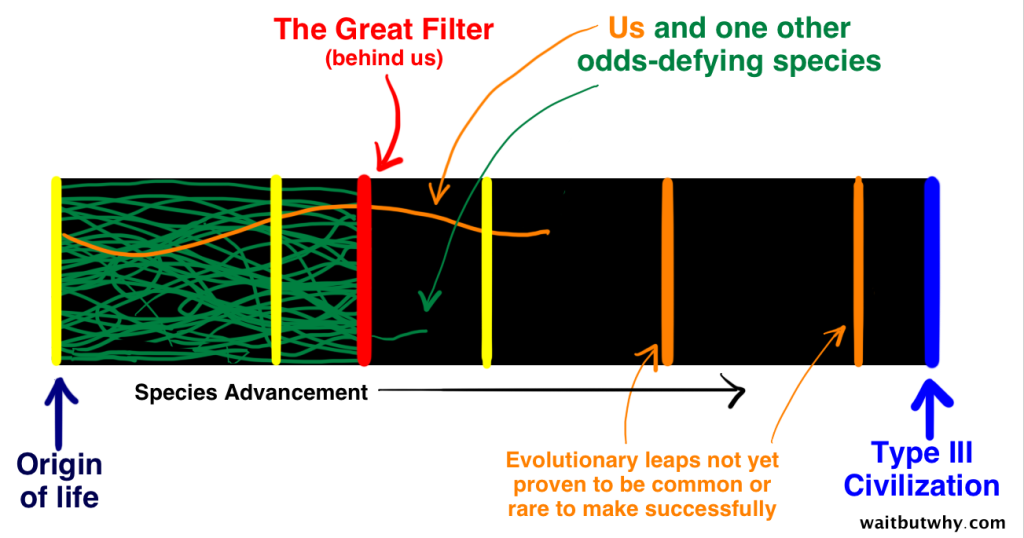
One of the most compelling explanations for the Fermi Paradox is the "Great Filter" hypothesis, proposed by economist Robin Hanson. This theory suggests that at some critical juncture between abiogenesis (the origin of life) and the emergence of a Type III civilization (a civilization capable of harnessing the energy of an entire galaxy), there exists an evolutionary "wall" or bottleneck that nearly all life forms fail to overcome. This filter represents an extremely unlikely or impossible stage for life to get beyond, thus explaining why intelligent, communicative civilizations are so rare.
The Great Filter can be broadly categorized into three possibilities:
-
Early Filters (We are Exceptionally Lucky): This scenario posits that the filter lies in our past, meaning humanity has already overcome a stage that is incredibly difficult for most life. Potential early filters include:
- The origin of life (abiogenesis): The spontaneous emergence of self-replicating molecules from non-living matter might be an exceedingly rare event.
- The evolution of complex multicellular life: The transition from simple single-celled organisms to complex multicellularity, involving cellular differentiation and specialized tissues, is a colossal leap.
- The emergence of intelligent life: Even with complex life, the development of tool-making intelligence, self-awareness, and problem-solving abilities might be an infrequent occurrence.
- The development of technological civilization: The ability to manipulate the environment, create advanced tools, and develop complex communication systems could be another significant hurdle.
If any of these stages are the Great Filter, it implies that humanity has, against immense odds, navigated a series of biological and cognitive bottlenecks that most other life forms in the universe cannot.
-
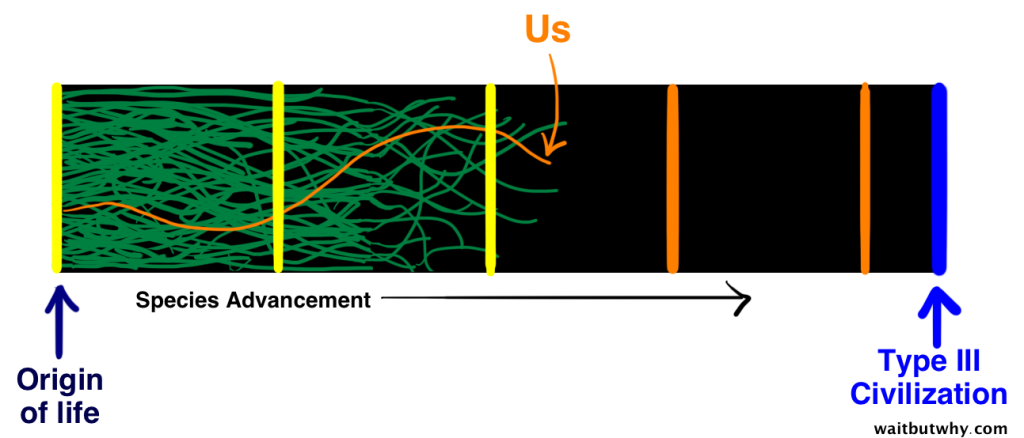
Late Filters (We Are Likely Doomed): This more pessimistic scenario suggests that the Great Filter lies in our future. It implies that civilizations tend to destroy themselves before achieving interstellar communication or colonization. Potential late filters include:
- Self-destruction through technology: This could manifest as nuclear warfare, catastrophic biological weapons, uncontrolled artificial intelligence, or runaway climate change. The development of technologies powerful enough to transform a planet also carries the inherent risk of its destruction.
- Resource depletion and environmental collapse: Advanced civilizations might deplete their home planet’s resources, leading to societal collapse and inability to expand further.
- Existential risks from cosmic events: While less common, civilizations could be wiped out by gamma-ray bursts, asteroid impacts, or supernova explosions before they can escape their home system.
If the filter is in our future, then the current silence of the universe serves as a chilling warning about the likely fate of any advanced civilization, including our own.
-
External Filters (The Universe is Hostile): This category suggests that some external, universal phenomenon acts as a recurring filter. Examples include:
- Recurring natural catastrophes: Frequent asteroid impacts, supervolcano eruptions, or even periodic cosmic radiation events could reset evolutionary progress on many planets.
- Self-replicating destructive probes: A hypothetical "berserker" probe or Von Neumann machine, designed to destroy emerging intelligent life, could sweep through the galaxy, eliminating any civilization that reaches a detectable threshold.
Alternative Hypotheses for the Great Silence
Beyond the Great Filter, numerous other hypotheses attempt to explain the cosmic silence, each offering a distinct perspective on the problem:
-
The Rare Earth Hypothesis: This theory, championed by paleontologist Peter Ward and astronomer Donald Brownlee, argues that while microbial life might be common, the conditions necessary for the emergence and sustained evolution of complex, intelligent life are exceedingly rare. These conditions include a stable star in a galactic habitable zone, a large moon to stabilize the planet’s axial tilt, plate tectonics for long-term climate regulation and nutrient cycling, a gas giant like Jupiter to clear out destructive asteroids, and specific atmospheric compositions. The Rare Earth hypothesis suggests that Earth is not merely lucky, but uniquely fortunate, making us one of the very few, if not the only, complex civilizations in the galaxy.
-
The Zoo Hypothesis: This intriguing idea posits that extraterrestrial civilizations are aware of humanity but deliberately choose not to interfere, observing us from a distance as if we were part of a cosmic preserve or zoo. This non-intervention policy, often referred to as the "Prime Directive" in science fiction, would explain the lack of contact. It suggests that advanced civilizations might have a common ethical code against disturbing less developed species, waiting until we reach a certain level of technological or societal maturity.
-
The Dark Forest Theory: Popularized by Chinese science fiction author Liu Cixin, this theory offers a grim explanation. It proposes that the universe is a "dark forest" where every civilization is a hunter. Because the true intentions of another civilization cannot be known, and because interstellar distances make communication slow and prone to misunderstanding, the safest course of action upon detecting another civilization is to immediately destroy it before it can pose a threat. This leads to a pervasive atmosphere of fear and paranoia, compelling all intelligent life to remain silent and hidden, lest they invite their own destruction.
-
The Transcension Hypothesis / "Small is Advanced": This perspective, articulated by SETI astronomer Seth Shostak, suggests that highly advanced civilizations may evolve beyond large-scale physical existence, perhaps migrating into digital realms or becoming incredibly small and efficient. Just as computers have evolved from room-sized behemoths to microscopic chips, advanced intelligence might shed its macroscopic, inefficient physical forms. Shostak argues that large structures are inefficient due to inertia and the speed of light limits on internal communication. Instead, advanced societies might focus on building nanobots or developing purely informational existences, becoming effectively undetectable to our current macroscopic observation methods. If the ultimate destination of intelligence is to transcend physical limitations into vast, complex computational structures that exist in miniature or purely in data, then their presence would be profoundly difficult, if not impossible, for us to detect using traditional astronomical means. They would not build Dyson spheres or vast interstellar empires, but rather occupy the "infinite spaces between" matter, time, and information.
-
The Vastness of Space and Time: Even without filters or deliberate silence, the sheer scale of the universe and the limitations imposed by the speed of light could explain the paradox. The Milky Way galaxy alone is 100,000 light-years across. A signal sent from a distant star system would take tens of thousands of years to reach us, and a reply would take just as long. Interstellar travel, even at speeds approaching light, would require immense energy and time, making galactic-scale colonization an undertaking spanning millions of years. It’s plausible that civilizations are simply too far apart, or their periods of technological visibility are too short, for their signals or presence to overlap with our brief window of observation.
Implications for Humanity and the Search for Extraterrestrial Intelligence
The Fermi Paradox carries profound implications for humanity’s understanding of its place in the cosmos. If the Great Filter lies in our past, it elevates our perceived uniqueness, suggesting we have overcome hurdles that almost all other life forms fail to clear. This would make Earth a truly rare jewel in the universe. If the filter lies in our future, it serves as a stark warning, urging us to address global challenges like climate change, nuclear proliferation, and the ethical development of artificial intelligence, as these could represent the very bottlenecks that doom civilizations.
The ongoing Search for Extraterrestrial Intelligence (SETI) programs continue to scan the skies, listening for radio signals or optical pulses that might betray the presence of intelligent life. Astrobiology, a rapidly growing field, explores the conditions necessary for life and its potential distribution across the universe, analyzing exoplanet atmospheres and searching for biosignatures. The prospect of active Messaging Extraterrestrial Intelligence (METI)—deliberately sending signals from Earth—remains a contentious issue, with some scientists advocating for caution, citing the "Dark Forest" theory as a potential danger.
Ultimately, the Fermi Paradox remains an open question, one of the most compelling mysteries in science. Whether the silence is due to the extreme rarity of complex life, an insurmountable challenge awaiting all advanced civilizations, or simply our inability to perceive life that has evolved beyond our current understanding, the quest to answer "Where is everybody?" continues to drive our exploration of the universe and our introspection about the fate of our own civilization. The answer, whenever it comes, will undoubtedly reshape our perception of life, intelligence, and our singular, perhaps solitary, journey through the cosmos.
About the Author