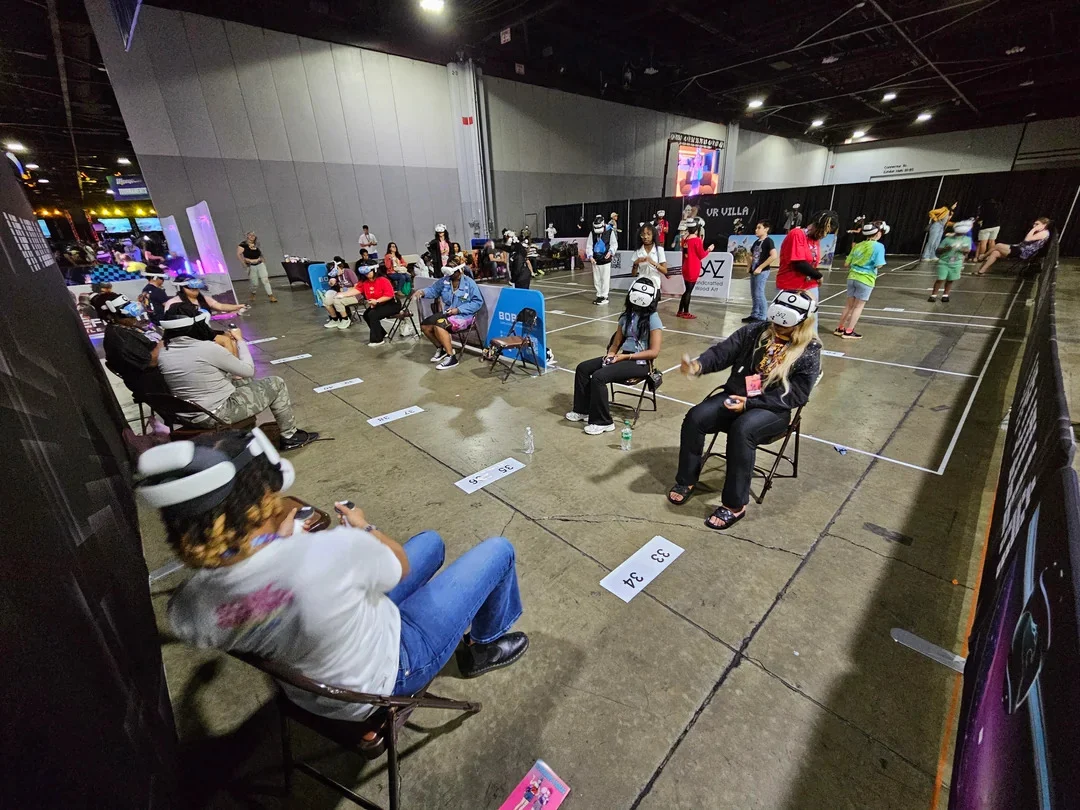
The landscape of virtual reality (VR) adoption is undergoing a significant transformation, driven not by multi-billion dollar advertising campaigns from Silicon Valley, but by a grassroots movement led by an unlikely figure: an exotic woodcraft entrepreneur. Jeff Basladynski, known within the digital community as “Bazitron,” has emerged as a pivotal force in the VR industry through his organization, VR Villa. By leveraging the logistics of his primary business, Baz LLC—a company specialized in the manufacture of high-end customized chopsticks—Basladynski has successfully introduced tens of thousands of individuals to immersive technology through large-scale, free-to-play VR installations at major conventions across the United States.
The Genesis of VR Villa and the Logistic Synergy
The origins of VR Villa trace back to 2014, when Basladynski established Baz LLC to produce artisanal chopsticks from exotic woods. However, his personal interest in gaming took a professional turn in 2016 with the commercial release of the HTC Vive and Oculus Rift. Recognizing a gap between the potential of the technology and public access to it, Basladynski began integrating VR demonstrations into his retail presence at comic-cons and anime festivals.

What began as a personal hobby involving one or two headsets has evolved into a sophisticated logistical operation. Basladynski utilizes the existing infrastructure of his woodcraft business—vans, shipping pallets, and travel schedules—to transport an arsenal of VR hardware to events ranging from Hawaii to Washington, D.C. This "piggyback" model allows VR Villa to operate with a level of efficiency that traditional corporate marketing teams often struggle to replicate. At its peak, the organization managed a fleet of over 200 headsets, recently transitioning its inventory to focus on the Meta Quest 3 and 3S models to ensure a high-quality user experience.
Statistical Analysis of Public Engagement
Data collected by VR Villa over the past four years provides a rare, empirical look at how the general public interacts with VR outside of a retail or home environment. Basladynski reports that the organization has serviced approximately 80,000 players in the last four years alone. In the previous calendar year, the group facilitated between 25,000 and 30,000 individual sessions.
One of the most compelling metrics identified by VR Villa is the average session duration. In 2022, play sessions averaged approximately 22 minutes. By the end of the last festival cycle, this figure increased to 32 minutes per session. This growth is attributed to a shift in strategy from "demos" to "experiences." Unlike traditional retail demos that often limit users to five-minute snippets, VR Villa encourages extended play. The organization has recorded sessions for cooperative games like Demeo lasting up to four and a half hours, demonstrating that when comfort and content are optimized, user fatigue is significantly mitigated.

Furthermore, the data reveals a persistent "newcomer" demographic. Despite the technology being commercially available for nearly a decade, approximately 30% of VR Villa’s participants are first-time VR users. This suggests a significant "access gap" where a large portion of the population remains "VR-curious" but lacks a low-friction entry point to test the hardware.
Content Strategy and the "Cook-Out" Phenomenon
The success of these installations is largely dependent on software selection. Basladynski emphasizes a curated approach, favoring titles that offer immediate intuitive gameplay and social interaction. For five consecutive years, the most popular title in the VR Villa repertoire has been Cook-Out: A Sandwich Tale, developed by Resolution Games. According to internal statistics, one in every four sessions involves Cook-Out, highlighting the public’s preference for collaborative, multiplayer experiences over solitary, narrative-driven content.
Other top-performing titles include Fruit Ninja VR, Space Pirate Trainer, Blaston, and Walkabout Mini Golf. These games share common traits: they are easy to teach, require minimal movement to avoid motion sickness, and provide instant feedback. Basladynski’s team of trained volunteers—many of whom were recruited from the player base at previous events—focuses on one-on-one instruction, teaching users not just how to play a specific game, but how to navigate the VR operating system and adjust hardware for maximum comfort.

A Critique of Traditional Retail and Marketing Models
The success of VR Villa’s grassroots approach serves as a counterpoint to the struggling retail demo programs of major hardware manufacturers. Basladynski notes that traditional retail environments, such as those in Best Buy or Target, often fail because they lack dedicated, knowledgeable staff and sufficient play space. Retail demos frequently require users to hold the headset to their faces rather than wearing it properly, leading to a subpar experience that fails to demonstrate the medium’s true potential.
Moreover, Basladynski identifies a "marketing impasse" within the industry. Current advertising strategies often target existing VR users, leaving the general public unaware of the current state of the technology. Many attendees at VR Villa events still associate the medium with "Google Cardboard"—the low-tech, smartphone-based shells of the early 2010s. By providing a high-fidelity experience using modern peripherals (such as KIWI Design and BOBOVR headstraps), VR Villa actively dismantles these outdated misconceptions.
The impact of this "try-before-you-buy" model is measurable. In a survey conducted by VR Villa across three major shows, 57% of participants reported a positive shift in their perspective on VR after a 20-minute session. Perhaps more significantly, 17% of respondents indicated they would have purchased a headset immediately on-site if the option were available, driven by the social momentum of playing with friends.

The Path Toward Industry Sustainability
As the VR industry grapples with fluctuating growth and the challenge of reaching a mainstream audience, Basladynski advocates for a shift toward "sustainability pathways." He remains skeptical of industry projections that once predicted one billion VR users within a decade, citing technological limitations and the niche nature of high-end gaming.
Instead, Basladynski suggests that developers and hardware manufacturers should focus on identified target demographics and foster community-centric environments. He argues that the industry’s obsession with "graphics" and "processing power" often ignores the most vital component of adoption: social fun and physical comfort. By removing artificial barriers—such as high entry costs for trials and complex setup requirements—organizations like VR Villa are proving that there is a robust, active market for VR, provided the industry meets the consumers where they already gather.
Conclusion and Future Outlook
Jeff Basladynski’s dual life as a chopstick craftsman and a VR evangelist highlights a unique intersection of traditional trade and futuristic technology. Through VR Villa, he has created a scalable model for "VR LAN parties" that emphasizes community, education, and accessibility. As the organization continues to tour major US events, its data-driven approach offers a blueprint for how the broader XR (Extended Reality) industry might finally bridge the gap between early adopters and the mass market. For Basladynski, the mission remains simple: sharing a passion for gaming by ensuring that the first time a person puts on a headset, they are met with a comfortable, engaging, and social experience that leaves them wanting to return to the virtual world.
About the Author