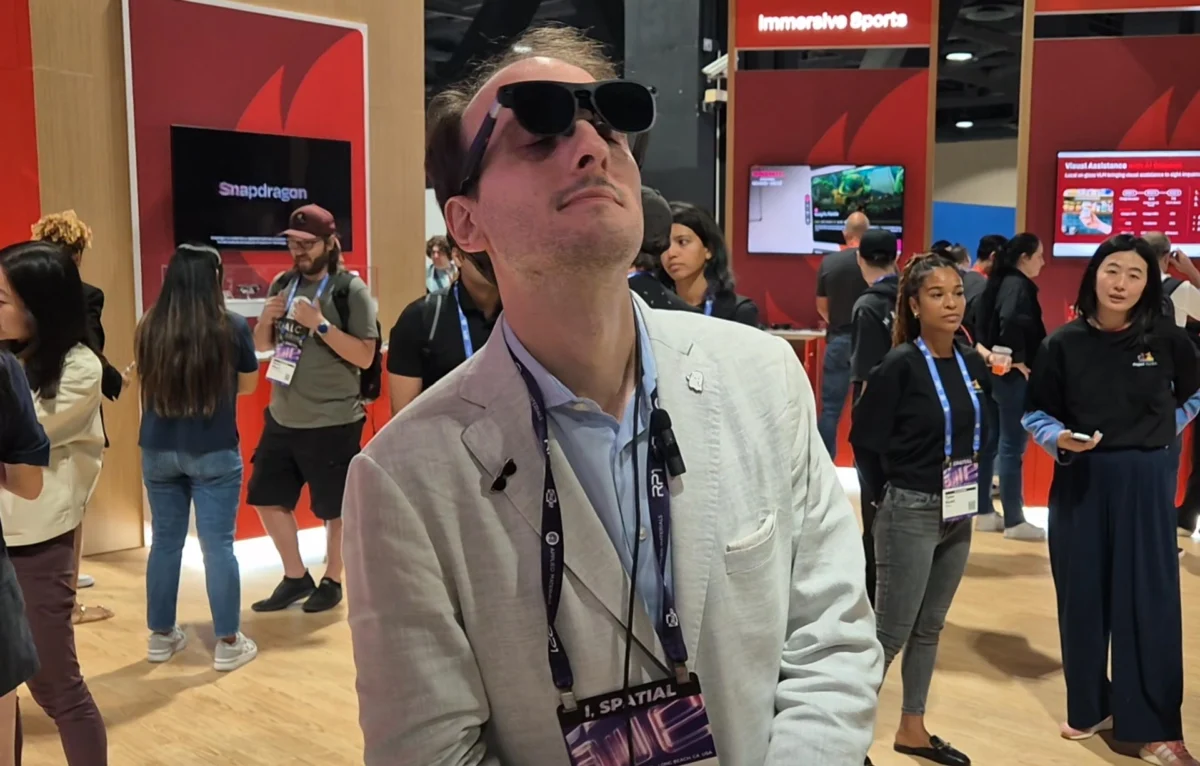
The landscape of wearable spatial computing underwent a significant transformation at the recent Augmented World Expo (AWE), where the XREAL Aura was unveiled as a leading contender for the first consumer-ready augmented reality (AR) glasses powered by the Android XR operating system. Developed through a high-level strategic partnership between Chinese manufacturer XREAL, Google, and Qualcomm, the Aura represents a pivot toward a more integrated, software-rich ecosystem designed to bridge the gap between niche enterprise tools and mainstream consumer electronics. The device, which separates its optical hardware from its processing unit, aims to deliver high-fidelity spatial experiences without the ergonomic compromises typically associated with standalone virtual reality (VR) headsets.

Architectural Innovation: The All-in-Two Design Philosophy
The XREAL Aura utilizes an "all-in-two" architecture, a design choice that is increasingly viewed as the optimal compromise for long-term wearable comfort. By offloading the primary computational components and the battery to a dedicated "computational puck," the eyewear itself maintains a weight of approximately 95 grams. While this remains above the 50-gram threshold often cited by ergonomic experts for "all-day" wearability, it is significantly lighter than the 500-to-600-gram weight of contemporary standalone VR headsets like the Meta Quest 3.

The eyewear component resembles a pair of slightly oversized sunglasses, housing the dual 1920 x 1200 pixel displays and birdbath optical engines. The computational puck, weighing roughly 300 grams, houses the Qualcomm Snapdragon Elite chipset. This separation allows for more efficient thermal management, as the heat-generating processor is kept away from the user’s face, and permits a larger battery capacity than could be integrated into the frames of the glasses. The connection is maintained via a physical tether, a choice that prioritizes data throughput and reduced latency over the total freedom of a wireless connection.

Technical Specifications and Optical Performance
The Aura’s visual output is defined by its 70-degree diagonal field of view (FOV). In the context of current AR hardware, a 70-degree FOV is considered a critical threshold for "usable" spatial computing; it is wide enough to allow for multiple virtual windows to be pinned in space without constant head movement, yet it remains narrower than the 90-to-110-degree FOV found in immersive VR devices.

A notable technical detail of the Aura is its 16:10 aspect ratio. While this provides ample horizontal space for productivity tasks and cinematic media consumption, initial demonstrations indicate a more constrained vertical FOV. This vertical limitation can lead to a "letterbox" effect when interacting with tall virtual objects or immersive 360-degree environments. However, the pixel density afforded by the 1920 x 1200 resolution ensures that text remains legible for document editing and web browsing, a key requirement for the device’s productivity-oriented marketing.

One of the standout features showcased at AWE was the electrochromic dimming technology. The Aura features five levels of adjustable transparency for its outer lenses. At the highest level of transparency, the device functions as a standard AR headset, allowing the user to remain present in their physical environment. At the maximum dimming setting, the lenses become nearly opaque, effectively transforming the device into a VR-like display. This transition can be toggled manually or triggered automatically by the operating system based on the content being launched.

The Android XR Ecosystem and Gemini AI Integration
The XREAL Aura is among the first wave of hardware to run Android XR, Google’s dedicated platform for spatial computing. This software foundation is a critical component of the device’s value proposition, as it grants users access to the vast Google Play ecosystem. Unlike proprietary operating systems that struggle with "app gaps," Android XR allows for the deployment of familiar 2D applications—such as Google Chrome, YouTube, and Google Docs—within a 3D spatial environment.

The integration of Google’s Gemini AI further enhances the device’s utility. Through the onboard cameras and microphones, Gemini can provide contextual information about the user’s surroundings. At AWE, demonstrations included "vibe-coded" experiences where the AI analyzed the environment to suggest interactive 3D overlays or automated productivity workflows. A dedicated privacy LED on the front of the glasses illuminates when the cameras are active, serving as a visual cue to bystanders that the device is processing visual data.

Interaction Modalities and Tracking Stability
XREAL has opted for a multi-modal control scheme for the Aura, eschewing traditional handheld controllers in favor of more naturalistic inputs. The primary interaction methods include:

- Hand and Finger Tracking: The device uses its front-facing cameras to track hand movements and gestures, such as pinching to select and swiping to scroll. While demonstrations showed high accuracy for finger-level articulation, a slight latency was noted in rapid movements, suggesting that the system is optimized for UI navigation rather than high-speed gaming.
- Puck Touchpad: The computational unit features a capacitive surface that allows it to function as a secondary controller, similar to a smartphone screen or a laptop trackpad.
- Voice Commands: Integrated microphones allow for hands-free operation via Google Assistant and Gemini.
- Physical Buttons: The frames include tactile buttons for volume control, power, and system menus.
The device features six-degree-of-freedom (6DOF) positional tracking, allowing virtual objects to remain anchored to specific coordinates in the real world as the user moves. While the tracking proved stable in standard office and expo environments, the hardware’s reliance on two forward-facing cameras means that hand tracking is lost if the user’s hands fall below the waist or move significantly to the periphery.

Market Context and Competitive Outlook
The XREAL Aura is positioned within the "prosumer" segment of the market. While an exact retail price has not been finalized, XREAL representatives at AWE indicated the device would cost "less than $1,500." This pricing strategy places the Aura in a competitive middle ground: it is significantly more expensive than the $500 Meta Quest 3 but substantially more affordable than the $3,500 Apple Vision Pro.

The launch is scheduled for Fall 2026, marking a pivotal moment for XREAL as it moves from being a manufacturer of "screen mirroring" glasses to a provider of full spatial computing systems. Industry analysts suggest that the success of the Aura will depend largely on the maturity of the Android XR platform at launch. While the hardware is impressive, the "killer app"—a use case that makes the device essential rather than a luxury—remains the industry’s most significant hurdle.

Broader Implications for the XR Industry
The collaboration between XREAL, Google, and Qualcomm serves as a powerful signal of the industry’s move toward standardization. By adopting Android XR, XREAL is betting on a future where spatial computing is an extension of the mobile ecosystem rather than a walled garden.

The use of the Snapdragon Elite chipset also highlights the increasing power of mobile silicon, enabling high-end AR features like electrochromic dimming and real-time AI spatial mapping in a form factor that can be worn in public. As the industry moves toward the 2026 launch window, the XREAL Aura stands as a benchmark for the "all-in-two" category, testing whether consumers are ready to trade a physical cable for a lightweight, high-performance AR experience.
About the Author