The landscape of content creation is undergoing a profound transformation, driven by the rapid advancements and widespread adoption of Artificial Intelligence (AI). As businesses and individuals grapple with the increasing demand for high-quality, engaging, and relevant content, AI-powered content generators have emerged as a pivotal solution, promising to enhance both efficiency and effectiveness. This article delves into the burgeoning field of AI content generation, exploring its implications and highlighting ten leading tools that are shaping this new era of digital communication in 2022.
The imperative for consistent, high-quality content has never been greater. In today’s digital-first world, content serves as the primary vehicle for brand communication, customer engagement, and business growth. From marketing copy and social media updates to in-depth blog posts and website articles, the need for a steady stream of original material is paramount. However, the traditional content creation process, reliant on human writers, can be time-consuming, resource-intensive, and subject to creative blocks. This is where AI content generators step in, offering a compelling alternative.
These sophisticated tools leverage natural language processing (NLP) and machine learning algorithms to produce human-like text. By analyzing vast datasets of existing content, they learn patterns, styles, and structures, enabling them to generate various forms of written material based on user prompts. The appeal of these generators lies not only in their speed but also in their ability to maintain a consistent tone and style, and to cater to specific audience needs. As a result, businesses across industries are increasingly integrating AI into their content strategies to streamline workflows, reduce costs, and scale their content production efforts.
The development of AI content generation tools has been a gradual but accelerating process. Early iterations focused on basic text completion and keyword insertion. However, recent advancements have led to more nuanced and creative outputs, capable of producing long-form articles, marketing slogans, and even creative fiction. This evolution reflects the broader progress in AI research, particularly in areas like deep learning and transformer models, which have significantly improved the coherence and contextual understanding of AI-generated text.
To navigate this rapidly expanding market, understanding the leading platforms is crucial. The following are ten prominent AI content generator tools that have gained significant traction in 2022, each offering unique features and catering to diverse user needs:

1. Jasper AI (Formerly Jarvis)
Jasper AI, previously known as Jarvis, stands as one of the most recognized and robust AI content generation tools available. Its core strength lies in its ability to produce a wide array of content, from marketing copy and social media posts to blog articles and website content. Jasper’s advanced AI models are trained to understand context and nuance, allowing it to generate content that is not only grammatically correct but also engaging and relevant to the intended audience.
Key Features:
Jasper boasts a comprehensive suite of features designed to cater to professional content creators. Its "Boss Mode" allows for more advanced control, enabling users to dictate the AI’s output with specific commands and direct it to write in a particular style or tone. It also offers over 50 templates for various content types, including blog post outlines, ad copy, and email subject lines. The tool integrates with tools like Surfer SEO for content optimization, further enhancing its utility for SEO professionals.
Pros:
Jasper’s ability to generate long-form content is a significant advantage. Its user-friendly interface, combined with its powerful AI, makes it accessible to both beginners and experienced writers. The extensive template library and integration capabilities streamline the content creation process.
Cons:
The premium pricing structure, particularly for the "Boss Mode," can be a barrier for individuals or small businesses with limited budgets. While the quality of output is generally high, occasional fact-checking and editing by a human are still recommended.
Pricing:
Jasper offers various pricing tiers, with the "Boss Mode" starting at $99 per month. Special promotional offers, such as 10,000 free credits for new sign-ups through specific affiliate links, are often available.
2. Copy.ai
Copy.ai has established itself as a versatile AI writing assistant, particularly adept at generating marketing copy and social media content. The platform provides users with access to over 90 templates, enabling the creation of diverse content formats such as bullet points, ad copy, and compelling hooks.
Key Features:
The tool’s strength lies in its ability to generate short-form content rapidly and effectively. Users can input basic information about their product or service, and Copy.ai can produce multiple variations of marketing copy, social media posts, product descriptions, and more. Its intuitive design makes it easy for users to experiment with different prompts and find the most suitable output.
Pros:
Copy.ai is lauded for its speed and the sheer volume of creative options it can generate. The free trial and affordable Pro plan make it an attractive option for small businesses and individuals looking to enhance their marketing efforts without significant investment.
Cons:
While proficient in short-form content, its capabilities for generating extensive long-form articles may not be as advanced as some competitors. The quality of output can sometimes require minor adjustments for optimal impact.
Pricing:
Copy.ai offers a free trial with limited daily runs. The Pro plan is priced at $49 per month, with a discounted annual rate of $420 ($35 per month). Special offers often include 7,000 free words and a discount on the paid plan if upgraded within four days of signing up.
3. Frase.io
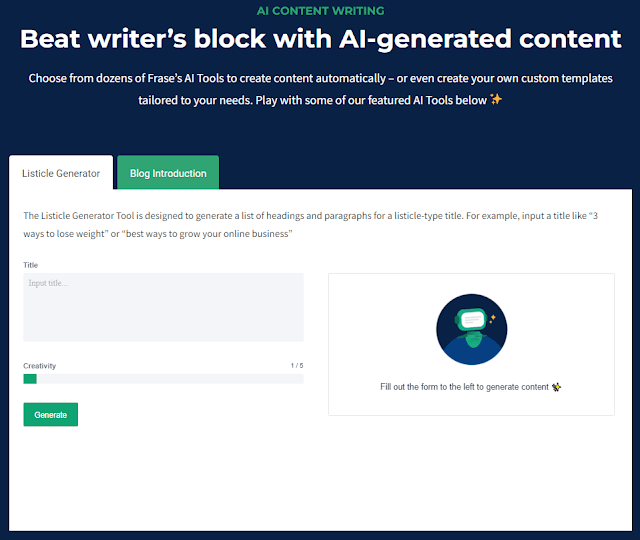
Frase.io positions itself as an AI-powered content optimization tool that also excels in content generation. It assists users in researching, creating, and optimizing content to improve search engine rankings. Frase analyzes top-ranking content for target keywords and provides data-driven insights to guide content creation.
Key Features:
Frase’s unique selling proposition is its integrated approach to SEO. It not only generates content but also provides tools to ensure that content is optimized for search engines. This includes keyword research, topic analysis, and content brief generation. The platform can also identify content gaps and suggest improvements to existing articles.

Pros:
The comprehensive SEO features, combined with AI content generation, make Frase a powerful tool for content marketers and SEO specialists. Its ability to streamline the entire content lifecycle, from research to optimization, offers significant efficiency gains.
Cons:
While it offers content generation capabilities, its primary focus is on optimization. Users looking solely for text generation might find other tools more specialized.
Pricing:
Frase offers various plans, including a Solo Plan ($14.99/month, $12/month annually) with 4 document credits, a Basic Plan ($44.99/month, $39.99/month annually) with 30 document credits, and a Team Plan ($114.99/month, $99.99/month annually) with unlimited document credits for three users. SEO add-ons are available for an additional $35 per month.
4. Article Forge
Article Forge distinguishes itself by its simplicity in content generation, requiring only a keyword to produce a complete article. This approach streamlines the process for users who need to generate content quickly without extensive input.
Key Features:
The core functionality of Article Forge is its ability to generate full-length articles from a single keyword. The tool is designed for speed and efficiency, aiming to produce SEO-friendly content that passes plagiarism checks. It also offers features like bulk article generation and content posting directly to WordPress.
Pros:
The ease of use and the ability to generate entire articles with minimal input are major advantages. The guarantee that all content passes Copyscape is a significant plus for users concerned about originality.
Cons:
While efficient, the quality of the generated content might require more significant editing compared to tools that offer more granular control or require more detailed prompts. The focus is heavily on article generation, potentially limiting its versatility for other content types.
Pricing:
Article Forge provides a 30-day money-back guarantee. Pricing includes a Basic Plan ($27/month) for up to 25,000 words per month, a Standard Plan ($57/month) with enhanced features, and an Unlimited Plan ($117/month) for unlimited article generation.
5. Rytr
Rytr.me is positioned as an accessible AI content writing assistant, particularly beneficial for small businesses, bloggers, and students. The platform is designed for ease of use and can generate SEO-friendly content, including blog posts and articles, in a matter of minutes.
Key Features:
Rytr offers a straightforward interface with over 30 use cases and more than 30 languages. It allows users to select the desired tone and generate content quickly. The built-in plagiarism checker adds a layer of assurance for content originality.
Pros:
Rytr is praised for its generous free plan, which allows users to generate up to 5,000 characters per month at no cost. This makes it an excellent entry point for individuals and small businesses exploring AI content generation. The affordability of its paid plans is also a significant draw.
Cons:
The character limit on the free plan, while useful for testing, can be restrictive for extensive content creation. Similar to other AI tools, human oversight for refinement is often necessary.

Pricing:
Rytr offers a free plan with limited features. The Saver Plan is priced at $9 per month ($90 annually), offering 50,000 characters per month, and the Unlimited Plan at $29 per month ($290 annually), providing unlimited character generation and priority support.
6. Writesonic
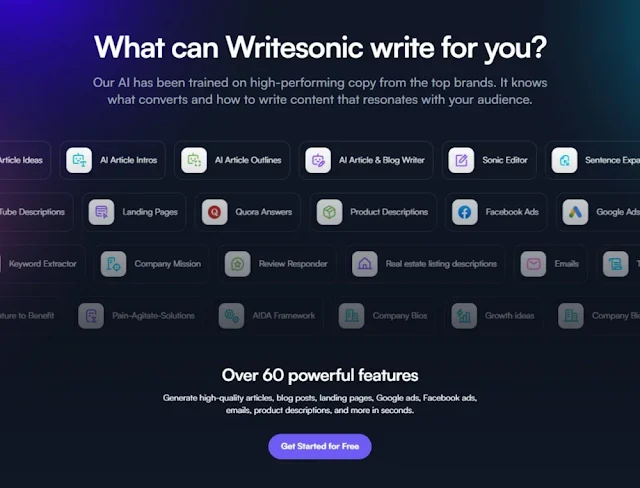
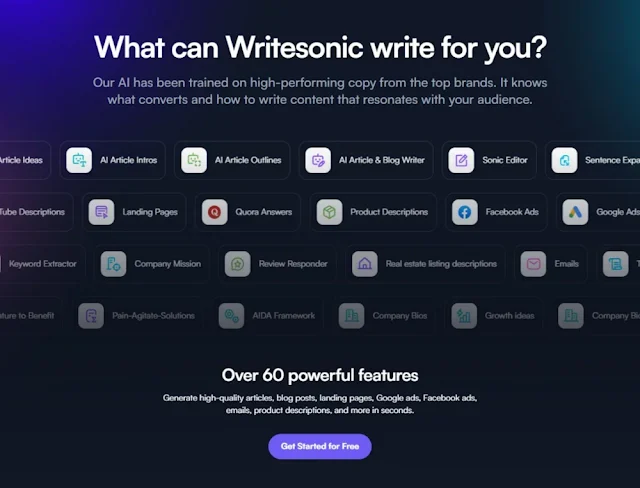
Writesonic is an AI-powered content generator that emphasizes ease of use and affordability, making it suitable for small businesses and solopreneurs. The platform is designed to assist in creating various forms of marketing content, website copy, and blog posts.
Key Features:
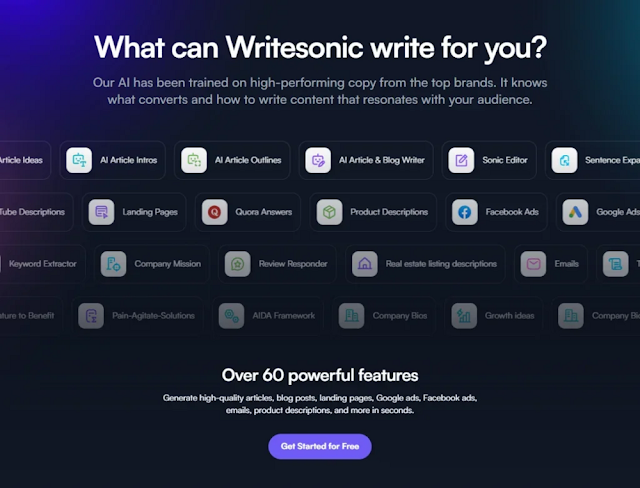
Writesonic provides tools for generating ad copy, landing page text, product descriptions, and blog content. It includes features like a grammar and plagiarism checker, enhancing the quality and originality of the output. The platform aims to simplify the content creation process for users on a budget.
Pros:
The tool’s affordability, especially its free tier, makes it accessible for a wide range of users. Its focus on marketing-oriented content and its integrated quality checks are valuable features.
Cons:
The free plan offers limited credits, functioning more like a trial. Extensive content generation would necessitate an upgrade to a paid plan.
Pricing:
Writesonic offers a free plan with ten credits. Paid plans include the Short-form plan ($15/month) and the Long-form plan ($19/month), with features varying based on the chosen tier and credit allocation.

7. CopySmith
CopySmith is an AI content generator designed to produce quality content rapidly, catering to both personal and professional document needs, including blogs and presentations. The platform emphasizes efficiency and provides a range of templates to accelerate the content creation process.
Key Features:
CopySmith offers a variety of templates to assist users in quickly generating different types of content. Its interface is designed for ease of use, allowing individuals and teams to create marketing materials, website copy, and other written assets efficiently.
Pros:
The speed at which CopySmith can generate content is a key advantage. The availability of templates helps users overcome writer’s block and get started quickly. The free trial without requiring a credit card is also a user-friendly feature.
Cons:
While efficient, the output may still require human editing to ensure it perfectly aligns with brand voice and specific campaign objectives.
Pricing:
CopySmith provides a free trial. Paid plans include a Starter Plan ($19/month), which offers a specific number of words and features, and an Enterprise plan with custom pricing.
8. Hypotenuse.ai
Hypotenuse.ai is an AI writing software that particularly excels in generating e-commerce product descriptions and marketing content. It offers a user-friendly interface, making it accessible for beginners looking to leverage AI for content creation.
Key Features:
The platform’s strength lies in its specialized tools for e-commerce, including bulk product description generation. It also provides features for creating articles, ad copy, and other marketing materials. Hypotenuse.ai aims to simplify content creation with an intuitive design.
Pros:
Its focus on e-commerce makes it a valuable tool for online retailers seeking to quickly populate their product catalogs with compelling descriptions. The ease of use is a significant advantage for users new to AI content generation.
Cons:
Hypotenuse.ai does not offer a free plan, relying instead on a free trial period. Users who require extensive content generation beyond the trial will need to subscribe to a paid plan.
Pricing:
Hypotenuse.ai offers a free trial. Paid plans include a Starter Plan ($29/month) and a Growth Plan ($59/month), with custom pricing available for enterprise clients.
9. Kafkai
Kafkai is a leading AI writing tool designed with SEO professionals and marketers in mind. It specializes in producing niche-specific content across a broad spectrum of topics, offering a high degree of personalization and a user-friendly interface.
Key Features:
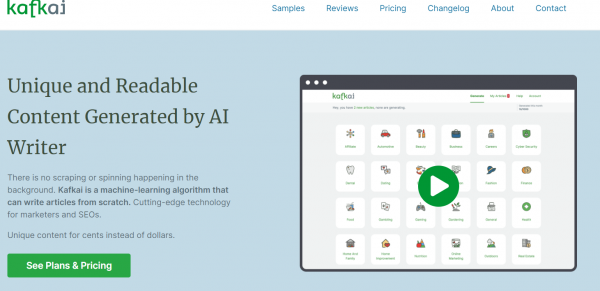
Kafkai’s AI models are trained on a vast corpus of text, enabling them to generate high-quality, niche-relevant content. The platform allows for customization and aims to produce content that is not only engaging but also optimized for search engines.

Pros:
The tool’s focus on niche content generation and its user-friendly interface make it a powerful asset for SEO specialists. The ability to produce a large volume of articles efficiently is also a significant benefit.
Cons:
Kafkai does not offer a free plan, but provides a free trial to allow users to test its capabilities. The pricing structure is based on the number of articles generated per month.
Pricing:
Kafkai offers a free trial. Paid plans include the Writer Plan ($29/month for 100 articles), the Newsroom Plan ($49/month for 250 articles), the Printing Press Plan ($129/month for 1,000 articles), and the Industrial Printer Plan ($199/month for 2,500 articles).
10. Peppertype.ai
Peppertype.ai is an online AI content generator that is particularly well-suited for small business owners seeking a powerful tool to craft and generate various types of content. Its ease of use makes it an attractive option for those looking to enhance their content marketing efforts without extensive technical expertise.
Key Features:
The platform offers a wide range of content generation capabilities, including blog post ideas, social media captions, and website copy. Peppertype.ai aims to provide a comprehensive solution for businesses needing to produce diverse content for multiple purposes.
Pros:
Its user-friendly interface and broad content generation capabilities make it a versatile tool for small businesses. The focus on practical applications for marketing and communication is a key strength.

Cons:
Peppertype.ai does not offer a free plan, but provides a free trial. Users will need to subscribe to a paid plan for ongoing access to its features.
Pricing:
Peppertype.ai offers a free trial. Paid plans include a Personal Plan ($35/month) and a Team Plan ($199/month), with custom enterprise pricing available.
The Broader Impact of AI in Content Creation
The widespread adoption of AI content generators signifies a fundamental shift in how digital content is produced. This technological evolution brings about several critical implications:
Enhanced Efficiency and Scalability: Businesses can now produce content at a scale previously unimaginable, meeting the ever-increasing demands of digital platforms. This allows marketing teams to focus on strategy and higher-level tasks, rather than being bogged down by the minutiae of writing.
Cost Reduction: AI tools can significantly reduce the cost associated with content creation, especially for businesses that rely on large volumes of written material. This can free up budget for other strategic initiatives.
Democratization of Content Creation: AI tools lower the barrier to entry for individuals and small businesses, enabling them to produce professional-quality content without needing to hire expensive writers or invest heavily in content production resources.
Potential for Job Displacement and Skill Evolution: While AI enhances efficiency, it also raises concerns about the future of human content creators. The industry is likely to see a shift in required skills, with an increased emphasis on editing, fact-checking, strategic oversight, and the ability to effectively prompt and guide AI tools. The role of the human writer may evolve towards that of a curator, editor, and strategic director of AI-generated content.
Ethical Considerations and Content Quality: The rise of AI-generated content also brings forth ethical questions regarding authenticity, bias, and the potential for misinformation. Ensuring the accuracy, originality, and ethical use of AI-generated content remains a critical challenge. Rigorous fact-checking and human oversight are essential to maintain trust and credibility.
SEO and Content Strategy: Search engines are increasingly adapting to AI-generated content. While AI can produce SEO-friendly content, the emphasis remains on providing genuine value to the user. Content creators must leverage AI as a tool to enhance their strategies, not as a replacement for understanding audience needs and search engine best practices.
Conclusion
The year 2022 has solidified the position of AI content generators as indispensable tools for modern content creation. These ten platforms represent the forefront of this technological wave, offering diverse solutions for a wide range of needs, from marketing copy to long-form articles. As AI continues to advance, its role in shaping our digital communication will only grow. The key for individuals and businesses will be to harness these powerful tools strategically, ensuring that AI enhances human creativity and expertise, rather than replacing it entirely. The future of content creation is a collaborative effort between human intelligence and artificial intelligence, promising unprecedented levels of efficiency, creativity, and reach.
About the Author