
The implementation of sophisticated artificial intelligence (AI) in video games has become a cornerstone of immersive and challenging interactive experiences, with a fundamental feature being the ability for AI characters or enemies to dynamically chase or follow a player. This seemingly complex functionality, critical to genres ranging from survival horror to action-adventure, is now remarkably accessible within Unreal Engine 5 (UE5), requiring only a minimal set of Blueprint nodes to achieve robust and persistent character tracking. This development significantly lowers the barrier to entry for developers aiming to integrate dynamic AI into their projects, leveraging UE5’s powerful visual scripting capabilities.
The core methodology, as recently demonstrated by various developer resources, hinges on a streamlined Blueprint configuration that replaces static or random AI movement patterns with direct targeting of the player character. This paradigm shift from pre-determined paths or area patrols to real-time player pursuit forms the backbone of many modern game mechanics, from relentless antagonists to loyal companions. The process is initiated by establishing a foundational navigation mesh (NavMesh) within the game environment, a prerequisite that defines the walkable areas for AI agents. This NavMesh acts as a digital roadmap, enabling AI characters to understand the traversable geometry of the level and calculate efficient paths to their designated targets.

Historically, AI pathfinding and tracking involved intricate C++ coding, often demanding a deep understanding of algorithms and engine architecture. The advent of visual scripting tools like Unreal Engine’s Blueprint system, however, has democratized this process, allowing designers and developers with varying levels of coding expertise to implement complex behaviors. The transition from Unreal Engine 4 (UE4) to UE5 has further refined these tools, enhancing performance and flexibility, making advanced AI more accessible than ever. For instance, the global video game market, valued at an estimated $184 billion in 2023 and projected to grow further, increasingly relies on sophisticated AI to meet player expectations for dynamic and reactive virtual worlds. Engines like Unreal Engine, which command a significant share of the high-fidelity game development market, are pivotal in driving this innovation by providing intuitive tools for complex tasks.
Blueprint Configuration for Persistent Pursuit
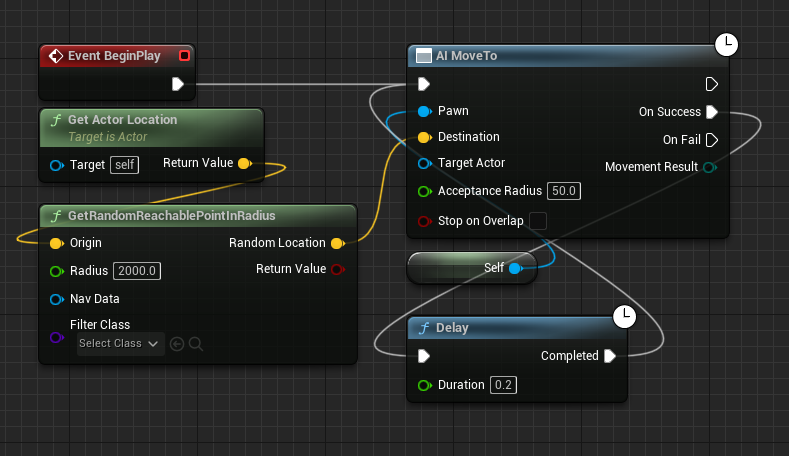
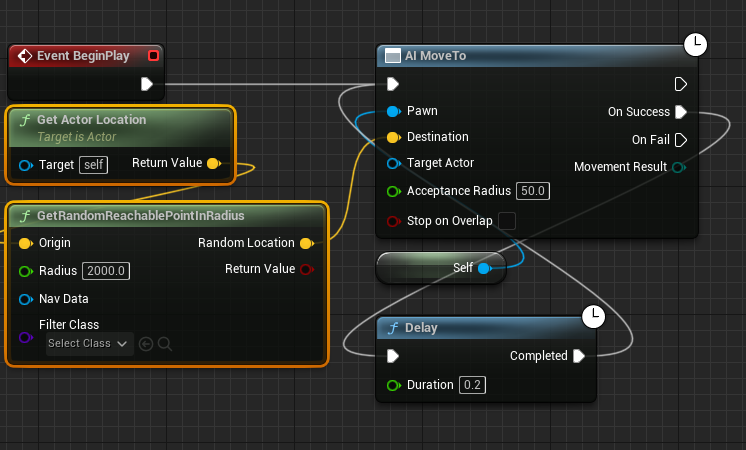
The technical procedure for enabling AI pursuit in UE5 involves a precise modification of existing AI movement Blueprints. Developers typically begin with a Blueprint script designed for basic AI locomotion, often involving nodes that direct the AI to move to random points within a specified radius. The critical first step in establishing player pursuit is the removal of these random target generation nodes, specifically the "Get Actor Location" and "GetRandomReachablePointInRadius" nodes, which are designed for autonomous, non-player-centric movement. These nodes are inherently incompatible with the objective of tracking a specific target – the player.
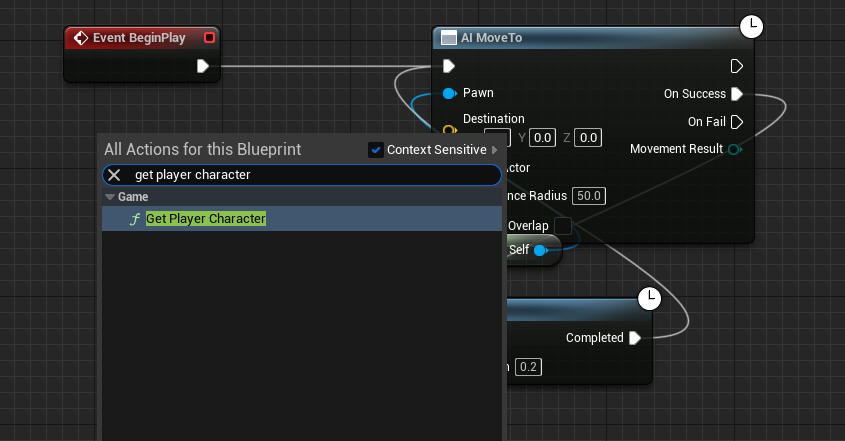
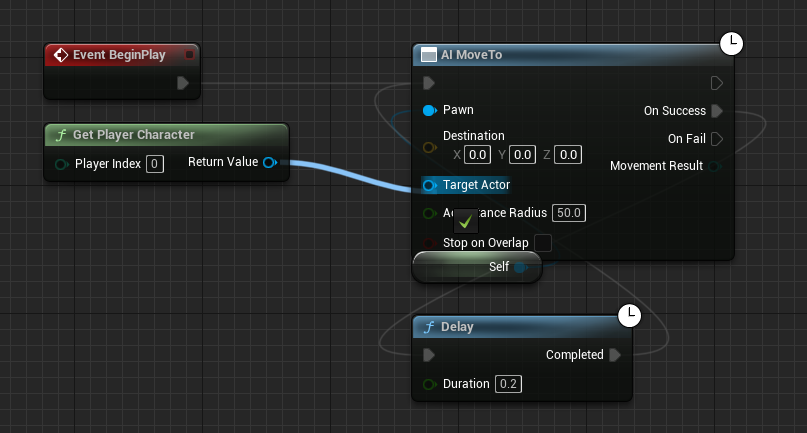
Following their removal, the Blueprint graph requires the introduction of a "Get Player Character" node. This node serves as the direct link to the player, dynamically retrieving their current location within the game world. Its "Return Value" pin, which outputs a reference to the player character, is then connected to the "Target Actor" pin of the "AI MoveTo" node. This connection is the lynchpin of the entire system, instructing the AI to use the player’s real-time position as its destination. The "AI MoveTo" node, a high-level function within Unreal Engine’s AI framework, handles the complex calculations of pathfinding across the NavMesh, factoring in obstacles and elevation changes to guide the AI character efficiently to its target. The acceptable radius parameter on the "AI MoveTo" node is also crucial, defining how close the AI needs to get to the target before considering its movement complete. A smaller radius creates a tighter pursuit, while a larger one allows for more distant following or patrolling around the player.
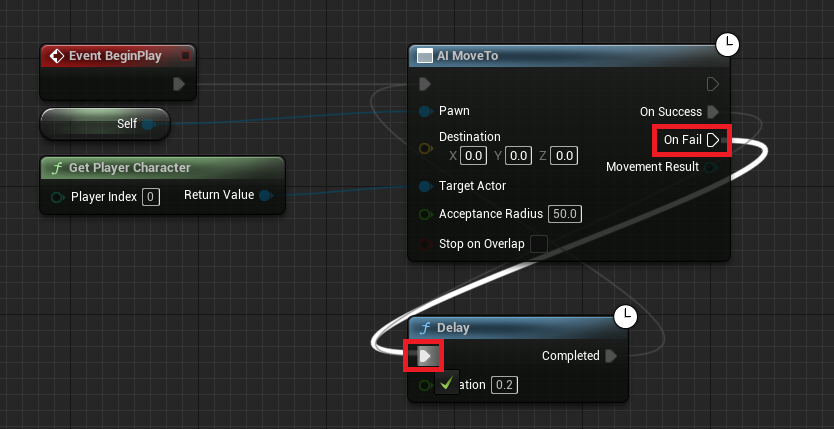
A crucial enhancement for ensuring robust and persistent AI tracking involves handling scenarios where the AI might temporarily fail to reach the player. This can occur due to various reasons, such as the player moving out of the NavMesh, encountering dynamic obstacles not accounted for in the initial path, or simply moving too quickly for the AI to keep pace with a single pathfinding request. To address this, the "On Fail" execution pin of the "AI MoveTo" node is connected back to a "Delay" node, which then loops back to re-initiate the "AI MoveTo" command. This creates a resilient feedback loop: if the AI successfully reaches its target (the player), the "On Success" pin would typically trigger further actions (e.g., attacking, interacting). However, if the movement fails for any reason, the "On Fail" path ensures that after a brief delay (e.g., 0.2 seconds), the AI attempts to re-calculate and resume pursuit. This mechanism is vital for maintaining continuous player tracking, preventing the AI from getting stuck or giving up if the player momentarily becomes unreachable or rapidly changes position.
Use Cases and Game Design Implications
The applications of this fundamental AI pursuit system are extensive and transformative for game design:
- Dynamic Enemies: From the relentless stalkers in horror games to the pursuing forces in action titles, this system allows for enemies that actively hunt the player, creating tension and requiring strategic evasion.
- Companion AI: In role-playing games or cooperative experiences, AI companions can be programmed to follow the player, providing support or simply adding to the immersion. This also extends to pets or escort missions.
- Objective-Based Tracking: Certain game objectives might require an AI character to follow the player to a specific location, or for the player to lead an AI to safety.
- Stealth Mechanics: In stealth games, AI patrol routes can be dynamically altered to include player pursuit upon detection, escalating the challenge and requiring quick reactions.
- Tutorial Systems: AI characters can guide players through initial levels by following them to key points or demonstrating mechanics.
The ability to implement such a core AI behavior with minimal effort directly impacts development cycles and resource allocation. Developers can rapidly prototype AI behaviors, iterate on pursuit parameters like speed and aggression, and focus on more nuanced AI decision-making (e.g., flanking maneuvers, taking cover) rather than foundational pathfinding. This efficiency is particularly valuable for independent studios and smaller teams, who can achieve professional-grade AI without extensive programming expertise.
The Evolution of AI in Game Development
The journey of AI in video games has been one of continuous evolution, mirroring advancements in computational power and algorithmic design. Early game AI relied heavily on simple state machines, finite sets of rules that dictated an AI’s behavior based on predefined conditions. A basic enemy might have states like "Patrol," "Detect Player," and "Attack," with simple transitions between them. As games grew in complexity, so did their AI. Navigation meshes emerged as a significant improvement over simpler grid-based pathfinding, allowing for more organic and realistic movement through complex 3D environments.
Unreal Engine has been at the forefront of this evolution, continually integrating advanced AI features. UE3 introduced basic NavMesh support, and UE4 significantly expanded upon this with robust AI controllers, behavior trees, and the visual scripting capabilities of Blueprints. Behavior trees, in particular, provided a more modular and hierarchical way to design complex AI decisions, allowing developers to chain together various actions and conditions. UE5 builds upon this legacy, offering improved performance, more intuitive tools, and greater integration with its rendering and physics systems, allowing for AI that interacts more seamlessly and realistically with the environment. The continuous refinement of tools like the "AI MoveTo" node and the flexibility of Blueprint scripting are testament to Unreal Engine’s commitment to empowering developers with accessible yet powerful AI solutions.
Broader Impact and Future Outlook
The ease of implementing dynamic AI pursuit has profound implications for the future of game design. It promotes more responsive and believable virtual characters, moving away from predictable, script-bound AI. This accessibility means that more indie developers can create games with high-quality AI, fostering greater innovation and diversity in the market. The time saved on foundational AI mechanics can be reinvested into developing richer narratives, more complex level designs, or exploring emergent AI behaviors.
However, challenges remain. While basic pursuit is simple, creating truly intelligent and challenging AI requires careful balancing. Developers must consider factors like AI awareness (how well it "sees" or "hears" the player), its decision-making processes beyond simple pursuit (e.g., when to give up, when to call for reinforcements), and performance optimization, especially when dealing with a large number of AI agents in open-world environments. The "rubber-banding" effect, where AI characters always seem to catch up regardless of player speed, must also be avoided to maintain a fair and engaging challenge.
Looking ahead, the integration of more advanced machine learning (ML) and deep learning techniques into game AI represents the next frontier. While the current Blueprint system provides robust deterministic AI, ML could enable AI characters to learn from player behavior, adapt strategies, and exhibit truly emergent and unpredictable actions. However, these advanced techniques would likely build upon the foundational pathfinding and targeting systems already made accessible by Unreal Engine’s Blueprint framework.
In conclusion, the simplified Blueprint-based method for enabling dynamic AI pursuit in Unreal Engine 5 is a significant boon for game developers. It underscores Unreal Engine’s commitment to democratizing advanced game development, transforming a potentially complex programming task into an intuitive, visual process. By leveraging a few key nodes and understanding their interconnected functions, developers can create AI characters that deliver engaging, challenging, and persistent interactions, ultimately enriching the player experience across a multitude of game genres. This accessibility ensures that sophisticated AI will continue to be a defining characteristic of next-generation interactive entertainment.
About the Author