The global mobile gaming landscape in August 2026 was characterized by a consolidation of power among established titles alongside a dramatic surge in the merge-game genre, led by the breakout success of Microfun’s Gossip Harbor. While total global consumer spending saw a marginal month-on-month decline of 1%, falling to $6.57 billion, the industry witnessed significant shifts in download patterns and regional market dominance. As the sector matures, the barriers to entry are shifting from technical development to market visibility, a trend underscored by a massive spike in app store submissions and the continued expansion of Chinese publishers into Western casual and midcore markets.
Global Revenue Performance and the Rise of the Merge Genre
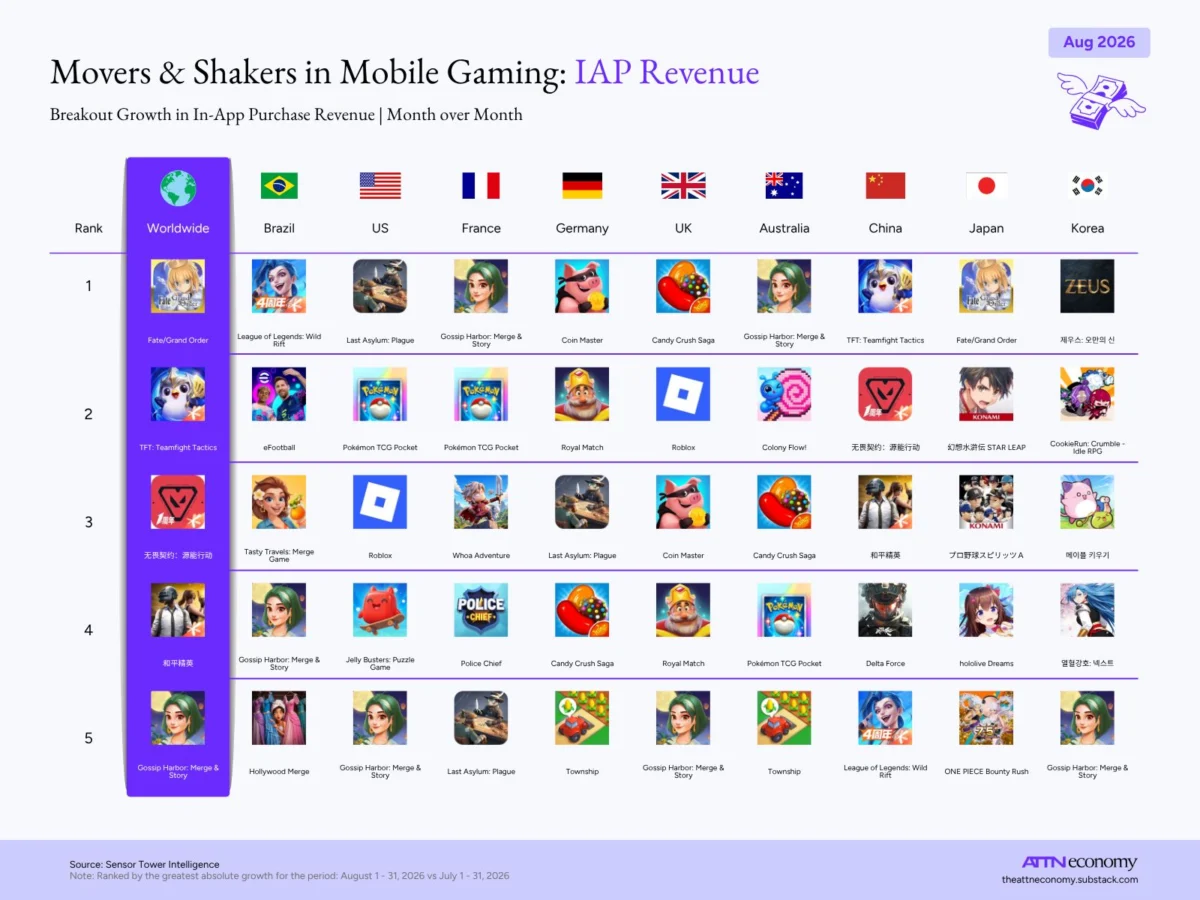
August 2026 marked a historic milestone for Microfun as its flagship title, Gossip Harbor, climbed to second place in the worldwide revenue charts. This achievement represents the first time a merge title has reached such a high position on the global stage, signaling a shift in consumer preferences within the casual gaming sector. While Tencent’s perennial leader, Honor of Kings, maintained its hold on the top spot, the rest of the top five was populated by heavyweights including Whiteout Survival, Royal Match, and Candy Crush Saga.

The success of Gossip Harbor is not an isolated incident but rather the spearhead of a broader trend. According to analysis from Attn Economy, the "merge match-2" sub-genre grew by a staggering 84% year-on-year. Gossip Harbor alone generated $111 million in in-app purchase (IAP) revenue during August, its most successful month to date. The game’s user base expanded by 64% year-on-year, and perhaps more importantly for long-term sustainability, its Average Revenue Per Daily Active User (ARPDAU) increased by 17%. Currently, Gossip Harbor commands a 40% market share within the merge match-2 category, illustrating the power of narrative-driven casual mechanics in capturing player spending.
Other notable performers on the revenue growth chart included Fate/Grand Order, which reclaimed a top position following its 11th-anniversary celebrations. Tencent also demonstrated its multi-title dominance, with five of the top ten growth spots occupied by its published or owned properties, including Teamfight Tactics and the mobile version of Valorant. In regional developments, Zeus: The God of Arrogance entered the global top ten after a dominant performance in the South Korean market, highlighting the continued importance of high-spending localized audiences.
Download Trends and the Impact of Cultural Anticipation
Worldwide mobile game downloads reached 3.76 billion in August 2026, a 1% increase compared to July. Roblox and Garena Free Fire continued to lead the charts in terms of absolute volume, benefiting from their massive, established player bases and social ecosystems. However, the growth charts revealed a different story, driven by new releases and cultural zeitgeists.

Tencent’s Gangstar Mirage City emerged as the leader of the download growth chart, climbing to seventh place overall following a successful multi-region rollout. Market analysts suggest that the success of crime-themed open-world titles like Gangstar Mirage City and Gangster Miami RP is being fueled by rising global anticipation for Grand Theft Auto VI. This "halo effect" has allowed mobile developers to capture a segment of the audience looking for similar experiences on portable devices.
The download data also reflects a broader trend of Asian publishers successfully bridging the gap between core and casual audiences. Of the top 20 spots on the global breakout revenue chart, Asian publishers claimed 18. This dominance is no longer restricted to traditional "hardcore" genres like MMORPGs or MOBAs; instead, these companies are increasingly finding success in midcore and casual titles, effectively challenging Western developers on their home turf.
The China Market: A Path Toward $60 Billion
The Chinese gaming market remains the world’s most significant engine for growth, despite regulatory hurdles and a maturing audience. In 2025, the market generated $51.8 billion, marking a 5.4% year-on-year increase and surpassing the $50 billion threshold for the first time. Data from Niko Partners projects that this growth will continue, with the market expected to reach $53.9 billion by the end of 2026.

By 2030, China’s gaming revenue is forecast to hit $59.8 billion, representing a five-year compound annual growth rate (CAGR) of 2.9%. This steady upward trajectory is supported by a player base that is expected to reach 769 million people. Furthermore, the quality of monetization is improving; Average Revenue Per User (ARPU) reached $70 for the first time in 2025 and is projected to climb to $77.68 by 2030. This growth indicates that while the total number of new players may be stabilizing, the existing audience is becoming more deeply engaged and willing to spend on digital entertainment.
Market Saturation and the Discovery Crisis
One of the most significant challenges facing the industry in 2026 is the sheer volume of new content entering the market. Data provided by 42matters and highlighted by Google’s CEE apps lead, Mariusz Gąsiewski, reveals that app and game submissions have nearly trebled in just over a year.
In March 2025, Google Play saw 46,136 submissions; by July 2026, that number had surged to 111,047. The Apple App Store followed a similar pattern, with submissions rising from 46,889 to 117,648 in the same period. This explosion in content is attributed to the increasing accessibility of development tools, including AI-assisted coding and asset generation, which have lowered the technical barriers to entry.

However, as Gąsiewski noted, "Making apps and games is getting easier, growing them harder." The massive influx of titles has led to a discovery crisis, where even high-quality games struggle to find an audience without significant marketing budgets or pre-existing metrics. Investors and publishers are increasingly hesitant to back projects that do not have proven data, making the "soft launch" phase more critical than ever for independent developers.
Corporate Financial Strategies and Restructuring
The financial health of major industry players remains a point of focus as companies navigate the post-pandemic economic environment. Embracer Group recently secured a new $206 million revolving credit facility. This two-year term loan, which includes an option for a two-year extension, is designed to consolidate several existing debts and provide liquidity for general corporate purposes.
This move is part of a broader strategic restructuring for Embracer, as it prepares for the planned 2027 spin-off of Fellowship Entertainment. As of mid-2026, Embracer reported approximately $157 million in current and non-current liabilities, balanced against a healthy cash reserve of $515 million. This financial maneuvering suggests a shift toward stability and focused growth after years of aggressive acquisitions.

In the mid-sized publisher tier, Top App Games reported strong results for its PvP strategy title, Ludus. The game generated $29 million in gross turnover during the first half of 2026, with the second quarter showing a 5.2% increase over the first. With a monthly active user (MAU) count of over 765,000 and a 5.1% payer conversion rate, Ludus demonstrates that specialized strategy titles can still achieve high profitability in a crowded market. The game’s cumulative player base has now surpassed 12 million, highlighting the effectiveness of its retention and monetization strategies.
Analysis of Broader Industry Implications
The data from August 2026 points toward a mobile gaming industry that is both thriving and increasingly difficult to navigate. The success of Gossip Harbor and the merge genre suggests that there is still room for innovation within casual mechanics, provided those mechanics are paired with strong narrative hooks and sophisticated monetization. The dominance of Asian publishers in the global charts indicates a successful export of monetization expertise, as companies from China and South Korea refine their approach to Western consumer habits.
However, the "trebling" of app store submissions serves as a warning for the sector. The democratization of game development has led to a "noise" problem that threatens to drown out all but the most well-funded or viral titles. For developers, the focus must now shift from merely creating a functional product to mastering the "Attention Economy."

Furthermore, the stability of the Chinese market provides a reliable foundation for global revenue, but the slowing CAGR suggests that the era of explosive growth in player numbers is coming to an end. Future revenue increases will likely depend on increasing ARPU through more sophisticated live-ops and cross-platform integration.
As the industry moves toward 2027, the focus will likely remain on consolidation, the refinement of casual-midcore hybrids, and the use of data-driven marketing to overcome the saturation of the digital storefronts. The mobile gaming sector remains a multi-billion dollar powerhouse, but the path to success is becoming narrower and more reliant on financial scale and analytical precision.
About the Author