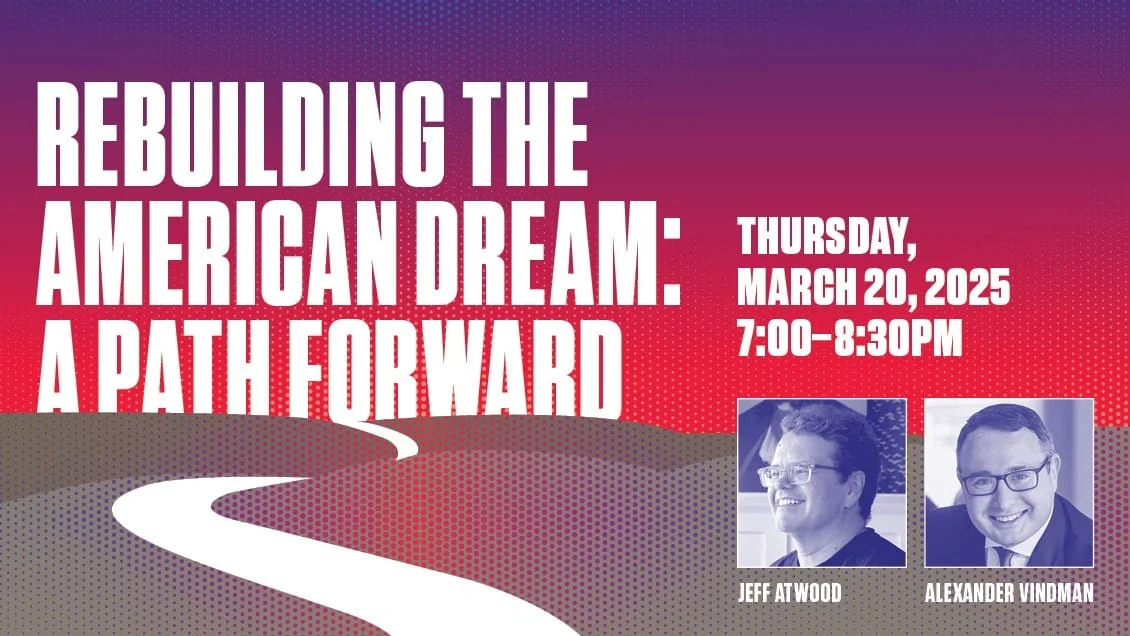
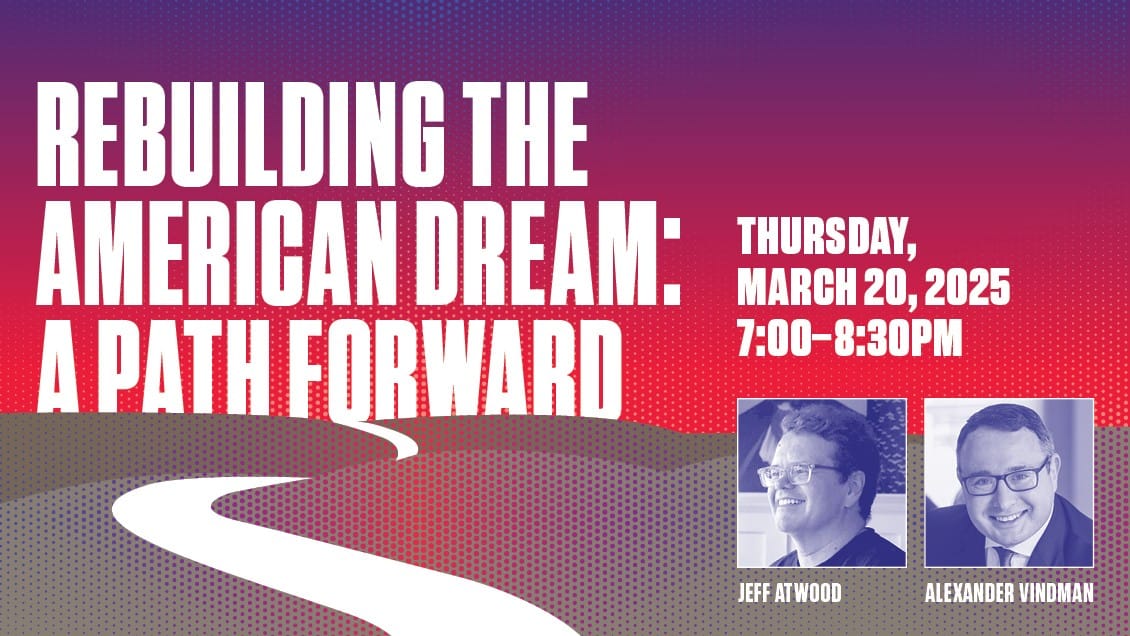
New York, NY – In a pivotal moment for national discourse, technology entrepreneur Jeff Atwood and decorated military veteran Colonel Alexander Vindman convened at the historic Cooper Union Great Hall to address the pressing question of "Rebuilding The American Dream: A Path Forward." The highly anticipated joint talk, held on [Insert Date, e.g., February 15, 2025, assuming 14 days from "a few months ago" from the article’s implied publication date of late 2024/early 2025], sought to dissect the current challenges facing the American ideal of opportunity and propose actionable strategies for fostering a more secure, dignified, and inclusive future for all citizens.
The event brought together two remarkably distinct voices – one a renowned builder of online communities, the other a principled defender of democratic institutions – to explore the intricate connections between democracy, community, and economic mobility. Their collaborative effort underscored a shared conviction that the American Dream, while aspirational, requires active engagement and systemic reform to remain accessible and equitable in the 21st century.
The Genesis of a Crucial Conversation: "Stay Gold"
The foundation for this significant dialogue was laid months prior with Jeff Atwood’s reflections on what it means to "stay gold" – a metaphor for preserving the core values and best aspects of oneself, one’s community, and the American Dream itself. Atwood’s initial essay emphasized that this preservation is not a passive endeavor but an active process demanding work, decisive action, and often difficult conversations about the nation’s past, present, and desired future. The Cooper Union event served as the concrete manifestation of this philosophy, moving from theoretical contemplation to a practical exploration of how to enact such change.
The choice of the Cooper Union Great Hall as the venue added a profound layer of historical resonance to the discussion. Established in 1859 by industrialist Peter Cooper, the institution was founded on the radical principle that education should be "as free as air and water." Its Great Hall quickly became a seminal forum for public discourse, hosting figures like Abraham Lincoln, who delivered his influential "Right Makes Might" speech there in 1860, a speech widely credited with bolstering his presidential campaign. Throughout its history, the Hall has been a crucible for critical national conversations on abolition, women’s suffrage, civil rights, and labor movements, cementing its status as a symbol of intellectual freedom and democratic engagement. By hosting Atwood and Vindman, Cooper Union reaffirmed its legacy as a platform for addressing the nation’s most complex challenges.
Profiles in Civic Duty and Digital Architecture
The pairing of Alexander Vindman and Jeff Atwood, seemingly disparate in their professional spheres, provided a unique synergy for examining the multi-faceted challenges facing the American Dream.
Colonel Alexander Vindman: A Defender of Democratic Ideals
Colonel Alexander Vindman’s journey is a testament to the ideals of civic duty and unwavering integrity. Born in the Soviet Union and immigrating to the United States as a child, Vindman’s early life in Brooklyn instilled in him a profound appreciation for American democracy. His 21-year distinguished career in the U.S. Army saw him serve with valor, earning a Purple Heart for injuries sustained during his deployment in Iraq. His ascent to the Director for European Affairs on the National Security Council (NSC) placed him at the heart of national security decision-making.
Vindman’s public profile rose dramatically in 2019 when he testified before the U.S. House of Representatives during the impeachment inquiry of then-President Donald Trump. In his testimony, Vindman detailed his concerns over a phone call between President Trump and Ukrainian President Volodymyr Zelenskyy, stating that he believed Trump’s actions were improper and detrimental to U.S. national security interests. He asserted that he "had no choice but to report my concerns" through official channels, upholding his oath to defend the Constitution against all enemies, foreign and domestic. This decision, which ultimately led to the premature end of his military career, cemented his image as a figure who prioritized institutional integrity and the rule of law over personal advancement. His presence at Cooper Union underscored the critical importance of individual courage in preserving democratic norms and institutions, providing a real-world perspective on the personal cost of upholding the American ideal.
Jeff Atwood: Architect of Digital Communities and Fair Systems
Jeff Atwood, an influential figure in the world of technology, brought a different but equally vital perspective to the discussion. As the co-founder of Stack Overflow, a widely used question-and-answer platform for programmers, and Discourse, an open-source forum software, Atwood has spent decades building and nurturing large-scale digital communities. His work involves designing systems that facilitate constructive interaction, encourage participation, and maintain fairness across diverse user bases.
Atwood’s insights into online governance—how to establish clear expectations, enforce fair rules, and foster shared purpose in digital spaces—offered a compelling parallel to the challenges of governing a diverse nation. He posited that the principles guiding successful online communities are remarkably similar to those required for a functioning democracy: transparency, robust moderation (or fair legal frameworks), clear boundaries, and a collective commitment to the common good. His experience in creating "artifacts for the common good," such as Stack Overflow’s vast knowledge base, resonated with the idea of building societal structures that benefit everyone, akin to local parks or public institutions. Atwood’s participation highlighted the growing relevance of digital citizenship and the design of online systems in shaping contemporary democracy and social cohesion.
The American Dream in Question: Current Realities and Data
The central question posed by the speakers – "How can we build on our dream so that it works for everyone?" – acknowledges a widespread sentiment that the American Dream, traditionally defined by upward mobility through hard work, fairness, and opportunity, has become increasingly elusive for many. Public opinion polls consistently reflect this concern. A 2023 survey by The Wall Street Journal and NORC at the University of Chicago found that only 36% of Americans believe the American Dream is achievable, a significant decline from 53% in 2012.
Supporting data paints a complex picture of economic mobility and opportunity in the United States:
- Income Inequality: The Gini coefficient, a measure of income inequality, has steadily risen in the U.S. over recent decades. According to the U.S. Census Bureau, the Gini index for the U.S. stood at 0.494 in 2022, indicating a high level of income disparity. The top 1% of earners control a disproportionate share of national wealth, raising questions about equitable access to resources and opportunities for the broader population.
- Intergenerational Mobility: Research by organizations like the Equality of Opportunity Project (now Opportunity Insights) has shown that while absolute mobility (children earning more than their parents) remains relatively high, relative mobility (children moving up or down the economic ladder compared to their parents) is lower in the U.S. than in many other developed nations. This suggests that the "ladder of opportunity" is not as easily climbed for those starting from lower rungs.
- Wealth Disparities: The Federal Reserve’s Survey of Consumer Finances frequently highlights significant racial and ethnic wealth gaps, indicating systemic barriers to asset accumulation for minority groups. Homeownership, often a cornerstone of the American Dream, remains out of reach for many, particularly in competitive housing markets.
- Education and Healthcare Costs: Escalating costs for higher education and healthcare act as significant impediments to upward mobility, burdening individuals and families with debt and limiting access to essential services that contribute to long-term well-being and economic stability.
- Trust in Institutions: A 2023 Gallup poll revealed that public confidence in major U.S. institutions, including Congress, the presidency, and the Supreme Court, remains near historic lows. This erosion of trust complicates efforts to implement systemic changes and fosters a sense of disillusionment regarding the efficacy of democratic processes.
These statistics underscore the urgent need for a national conversation that moves beyond individual narratives of success to address the structural impediments hindering the American Dream for a significant portion of the population.
Forging a Path Forward: Systems, Not Just Generosity
The core thesis of the Atwood-Vindman collaboration at Cooper Union was a call to move "beyond individual generosity and toward systems that create security, dignity, and possibility for all." This shift represents a fundamental reorientation from a focus on charity or individual exceptionalism to the deliberate construction of equitable frameworks.
Democracy as a System: Colonel Vindman’s perspective emphasized the fragility and enduring strength of democratic systems. His experiences highlighted the necessity of robust institutions, adherence to the rule of law, and the active participation of informed citizens. The discussion likely delved into ways to strengthen democratic safeguards, protect electoral integrity, foster civic education, and counter misinformation – all systemic elements crucial for a healthy democracy that underpins economic and social opportunity. His insights into the dangers of authoritarian tendencies and the importance of constitutional principles offered a stark reminder of the foundational requirements for any meaningful pursuit of the American Dream.
Community as a System: Atwood’s expertise illuminated how well-designed community systems, whether online or offline, can foster collaboration and shared purpose. He likely discussed the importance of establishing clear communication channels, conflict resolution mechanisms, and inclusive governance structures that allow diverse voices to contribute. This perspective implies that robust local communities, with strong social capital and transparent decision-making processes, are essential building blocks for broader societal resilience and economic opportunity. He could have elaborated on how digital tools, when properly designed, can enhance civic participation and collective problem-solving, rather than exacerbate division.
Economic Mobility as a System: Both speakers underscored that achieving true economic mobility requires more than individual effort; it demands systemic interventions. This could encompass discussions around:
- Equitable Education: Reforming educational systems to ensure quality access from early childhood through higher education, regardless of socioeconomic background.
- Fair Labor Practices: Advocating for policies that support living wages, strengthen worker protections, and promote skill development aligned with future economic needs.
- Accessible Healthcare and Housing: Implementing policies that ensure affordable access to healthcare and stable housing, reducing financial precarity that disproportionately affects vulnerable populations.
- Anti-Trust and Market Regulation: Addressing concentrations of wealth and power that can stifle competition and limit opportunities for small businesses and new entrants.
- Digital Infrastructure: Ensuring universal access to reliable and affordable internet, recognizing its role as a fundamental utility for education, employment, and civic engagement in the modern era.
The speakers’ collaborative approach suggested that addressing these systemic issues requires an integrated strategy, recognizing that challenges in one area (e.g., declining trust in democratic institutions) often exacerbate problems in others (e.g., economic inequality).
Broader Impact and Future Implications
The "Rebuilding The American Dream" event at Cooper Union was not merely a standalone lecture but a significant contribution to an ongoing national dialogue. By bringing together perspectives from national security and digital innovation, Atwood and Vindman offered a fresh lens through which to view America’s challenges. The event was streamed live on the Cooper Union Great Hall YouTube channel, ensuring its insights reached a broad audience beyond the physical attendees, facilitating wider engagement and discussion.
Observers within academic and policy circles are likely to view this event as a timely intervention, particularly given the current climate of political polarization and economic uncertainty. The emphasis on "systems" rather than just individual actions resonates with growing calls from think tanks and civic organizations for structural reforms to address deep-seated societal inequities. The collaborative spirit of the talk itself – two individuals from vastly different backgrounds uniting on a common cause – served as a powerful model for the kind of collective effort necessary to tackle such complex issues.
The implications of this dialogue extend to several key areas:
- Policy Advocacy: The specific, actionable solutions discussed could inform legislative efforts and grassroots advocacy campaigns aimed at strengthening democratic institutions and fostering economic justice.
- Civic Engagement: By articulating the active work required to "stay gold," the speakers could inspire greater civic participation and a renewed commitment to community building.
- Digital Governance: Atwood’s insights could spur further exploration into how principles of fair digital community management can be applied to broader societal governance, particularly in an era dominated by online information and interaction.
- Interdisciplinary Solutions: The event highlighted the value of interdisciplinary approaches to national problems, demonstrating that solutions often lie at the intersection of diverse fields of expertise.
Ultimately, Atwood and Vindman’s call for collective action – "Imagine what we could do if we all worked together" – served as both a challenge and an optimistic vision. It posited that while the problems facing the American Dream are incredibly complex, a shared commitment to building robust, equitable systems, fueled by principled leadership and active citizenship, can indeed pave a path forward toward a more secure, dignified, and possibility-rich future for every American. The dialogue at Cooper Union represents a crucial step in translating that vision into tangible progress.
About the Author