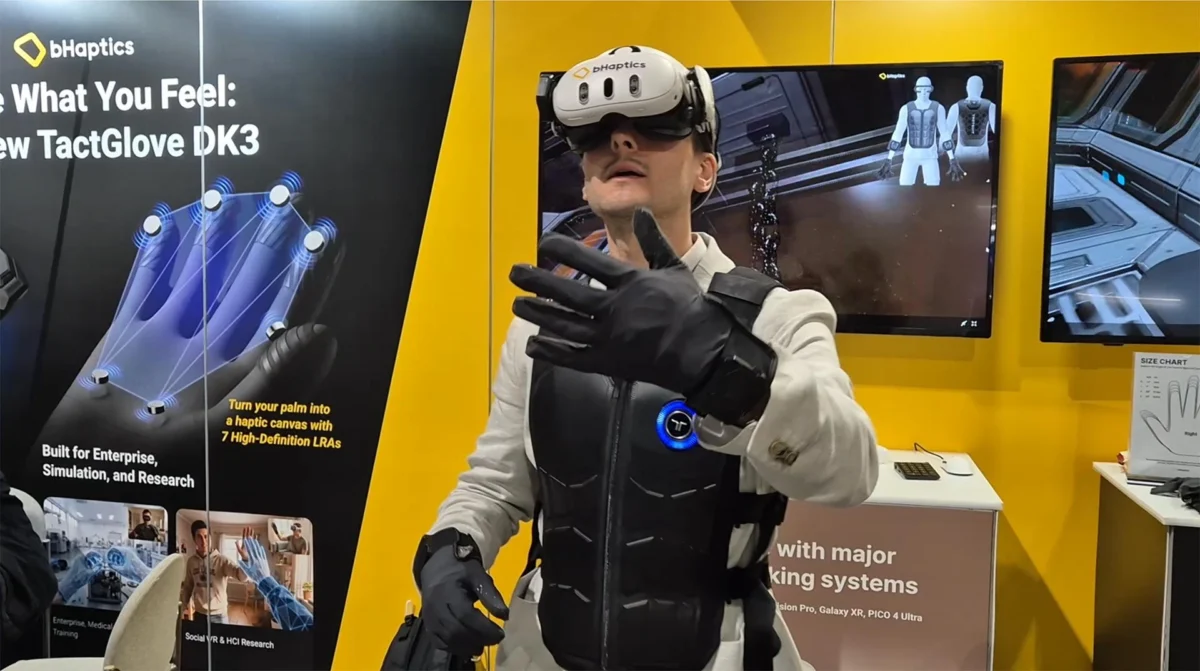
The Augmented World Expo (AWE) served as the primary stage for the debut of the TactGlove DK3, the latest iteration of haptic wearable technology from the South Korean firm bHaptics. As the extended reality (XR) industry continues to seek deeper levels of immersion beyond visual and auditory stimuli, bHaptics has positioned itself as a leader in the consumer and enterprise haptic markets. The introduction of the DK3 represents a significant technological leap for the company, moving away from generalized vibration toward a more sophisticated, nuanced emulation of tactile sensations.
The Evolution of Vibrational Haptics in XR
Founded with a focus on providing physical sensations to supplement virtual reality (VR) experiences, bHaptics has built a robust ecosystem of accessories, including the widely recognized TactSuit series. Unlike high-end enterprise solutions such as SenseGlove or HaptX, which utilize bulky exoskeletons or pneumatic systems to provide force feedback, bHaptics specializes in vibrational haptics. This approach utilizes small, strategically placed motors to simulate the sensation of being touched, hit, or interacting with objects.

The TactGlove DK3 is the culmination of several years of iterative development. While previous versions provided basic feedback, the DK3 aims to cross the threshold into what industry observers describe as "believable" haptics. By refining the frequency and intensity of the internal motors, the company has successfully transitioned from simple "buzzing" to a varied spectrum of touch-based data. This development is critical for gaming and professional training applications where the distinction between textures and pressure levels is paramount to the user’s sense of presence.
Technical Specifications and Design Innovations
The TactGlove DK3 features a redesigned architecture intended for both comfort and functionality. The gloves are constructed from a lightweight, synthetic material designed for long-term wear. A notable design improvement is the implementation of a magnetic wrist strap, replacing the traditional Velcro closures found on earlier models. This change facilitates a quicker "donning and doffing" process, which is particularly beneficial in high-throughput environments like VR arcades or enterprise training centers.
Key technical features of the DK3 include:

- Multi-Point Vibrational Motors: Distributed across the fingertips to provide localized feedback.
- Touchscreen-Friendly Fingertips: Allowing users to operate mobile devices or physical control panels without removing the gloves.
- Washable Fabric: The synthetic liners are designed to be removed and cleaned, addressing hygiene concerns in shared environments.
- Universal Compatibility: The hardware is designed to integrate seamlessly with major platforms, including the Meta Quest Store and SteamVR.
During technical demonstrations at AWE, the gloves were paired with the Meta Quest’s native optical hand tracking. A significant hurdle for haptic gloves has historically been the interference with the headset’s cameras; however, the DK3 maintains a low profile that does not obstruct the infrared or optical sensors, ensuring that finger tracking remains precise even during complex manual tasks.
Demonstrations and Performance Analysis
At the bHaptics booth at AWE, attendees were invited to participate in a simulated spaceship repair scenario. This environment provided a variety of tactile challenges, ranging from pressing small buttons and rotating knobs to interacting with soft objects, such as a virtual pet. The demonstration highlighted the DK3’s ability to differentiate between "light" and "heavy" interactions.
Industry analysts noted that the tactile feedback for simple "touch" actions—such as resting a finger on a table or tapping a virtual button—has reached a level of nuance previously unseen in vibrational-only hardware. The feedback is no longer a uniform vibration; instead, it provides a subtle "pop" or "resistance" sensation that mimics the haptic click of a physical button.

However, the limitations of vibrational technology remain evident in tasks involving weight and resistance. While the DK3 excels at simulating the initial contact with a virtual object, it cannot provide the force feedback required to simulate the weight of a heavy tool or the resistance of a spring-loaded lever. For these sensations, users would still require more expensive, mechanical force-feedback gloves. Despite this, for the $385 price point, the DK3 provides a level of immersion that significantly outpaces standard VR controllers.
Developer Integration and Ecosystem Growth
The success of haptic hardware is inextricably linked to software support. bHaptics has historically maintained a developer-friendly stance, providing robust SDKs and direct support to studios. This was evidenced by the integration of bHaptics support in titles like HitMotion: Reloaded, where developers reported that the hardware could be fully integrated into existing software architectures within a matter of hours.
The company continues to work closely with developers to ensure that haptic patterns are "baked" into popular VR titles. By providing a library of pre-defined haptic sensations, bHaptics allows studios to add physical feedback to their games without needing to program individual motor frequencies from scratch. This ecosystem-first approach has resulted in bHaptics having one of the largest libraries of supported titles in the haptic industry.

Market Positioning and Economic Impact
The haptic technology market is projected to grow substantially over the next five years, driven by the expansion of the "Metaverse" and the increasing use of VR in medical and industrial training. With a preorder price of $385, the TactGlove DK3 is positioned as a mid-tier peripheral. It is accessible enough for dedicated VR enthusiasts while remaining sophisticated enough for enterprise applications that do not require the extreme precision of $5,000 exoskeleton gloves.
The global VR haptics market is currently seeing a shift toward "wearability." Early haptic devices were often cumbersome and required external power sources or tethering. The DK3’s wireless, lightweight design reflects the broader industry trend toward "frictionless" XR, where the hardware becomes less noticeable to the user over time.
Chronology of Availability
The announcement at AWE 2026 marks the beginning of the DK3’s commercial lifecycle. According to the company’s official timeline:

- June 2026: Pre-orders opened globally via the bHaptics official website.
- Late June 2026: Initial shipping for early-bird pre-orders and enterprise partners.
- Q3 2026: Broad retail availability and integration updates for major SteamVR and Quest titles.
Broader Implications for the XR Industry
The refinement of haptic gloves like the TactGlove DK3 suggests that the industry is moving closer to a "multisensory" standard for virtual interaction. As visual fidelity reaches a plateau with high-resolution micro-OLED displays, the next frontier for immersion lies in the "lesser" senses: touch and even smell.
By delivering a product that is both affordable and technically capable, bHaptics is lowering the barrier to entry for high-quality tactile feedback. While vibrational motors may eventually be supplanted by micro-fluidics or advanced polymers, the DK3 represents the current state-of-the-art for consumer-grade haptics. Its ability to operate alongside optical hand tracking without the need for controllers points toward a future where "natural interaction"—using one’s own hands to feel and manipulate the digital world—becomes the primary method of navigating virtual spaces.
For enterprise users, the DK3 offers a cost-effective way to increase the efficacy of muscle memory training. For gamers, it provides the "missing link" of physical presence that elevates VR from a visual experience to a physical one. As shipping begins at the end of June 2026, the industry will be watching closely to see how quickly developers adopt the new nuanced haptic profiles made possible by this latest hardware iteration.
About the Author