The Augmented World Expo (AWE) served as a platform for Canon to demonstrate its latest advancements in the mixed reality (MR) sector, highlighting a strategic focus on enterprise applications rather than the consumer-facing virtual reality market. The company’s exhibition featured two distinct hardware paths: an experimental, ultra-compact handheld MR module and the established MREAL X1 enterprise headset. These devices represent Canon’s ongoing effort to integrate its high-end optical expertise into the spatial computing landscape, though the demonstrations revealed a significant divide between the company’s hardware pricing and the rapidly advancing specifications of mass-market competitors.

The Handheld Prototype: A New Paradigm for Public Installations
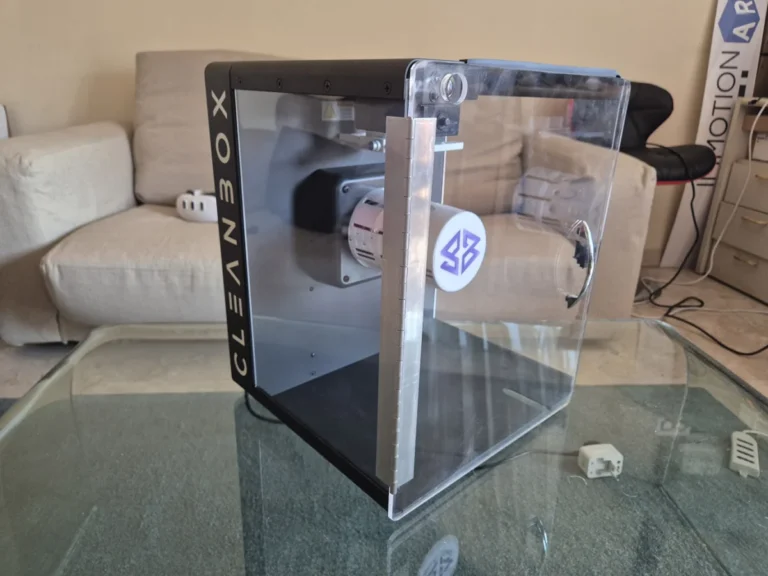
Among the most discussed reveals at the Canon booth was a prototype mixed reality device characterized by its remarkably small form factor. Unlike traditional head-mounted displays (HMDs), this device consists solely of an optical module mounted on a handle. It lacks internal computation units, batteries, or head straps, requiring a physical tether to a PC or a high-performance workstation to function.
The design philosophy behind this prototype is rooted in high-traffic enterprise environments, such as museums, galleries, and trade show floors. By removing the need for a head strap, Canon aims to eliminate the "friction" of the user experience. In a public setting, the time required to adjust straps and provide fitment instructions to each visitor creates a logistical bottleneck. Canon’s handheld solution allows users to simply lift the device to their eyes, similar to a pair of digital binoculars, view the mixed reality content, and return the device to its dock. This approach also addresses hygiene concerns, as the device does not make extensive contact with the user’s face or hair.

Technical specifications for the prototype, however, indicate that portability has come at the cost of immersion. The device currently offers a Full HD resolution (1080p) with a field of view (FOV) estimated in the mid-50-degree range. In the context of 2024-2025 industry standards, where consumer headsets frequently exceed 90 degrees of FOV, a 50-degree window offers a significantly more constrained experience. Furthermore, the prototype currently lacks integrated positional tracking, relying instead on marker-based systems. During demonstrations, users interacted with objects covered in QR-style markers to anchor 3D assets, a technique that was foundational to early AR but has largely been replaced by Simultaneous Localization and Mapping (SLAM) in modern standalone devices.
The MREAL X1: High-Investment Enterprise Hardware
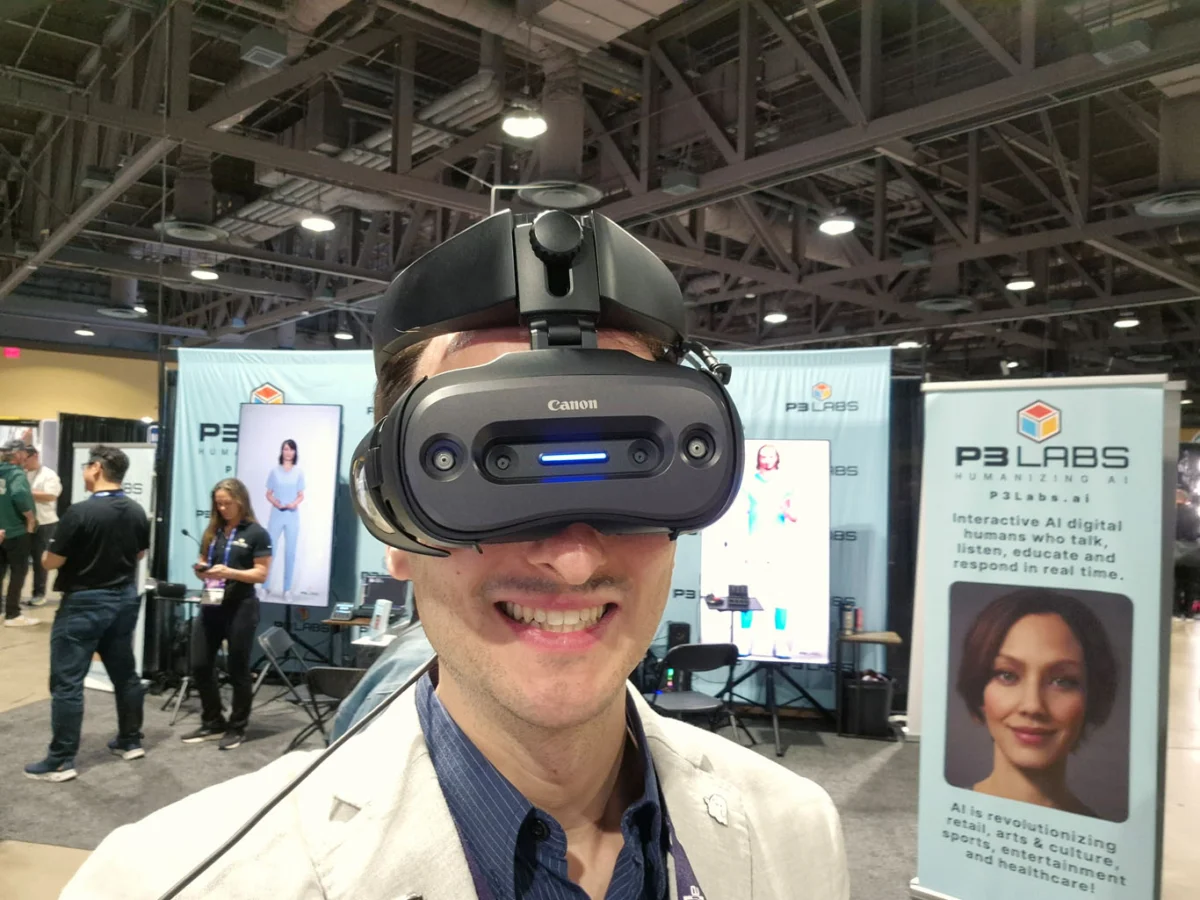
In addition to the handheld prototype, Canon showcased the MREAL X1, the successor to the MREAL S1. The X1 is positioned as a more "accessible" entry in the MREAL lineup, with a kit price—including the headset, a dedicated interface box, and a laptop—totaling approximately $20,000. This follows the MREAL S1, which was noted for a headset-only price of nearly $38,500 upon its initial release.

The MREAL X1 features a "flat" design profile similar to other recent MR entries like the Lynx R1. It utilizes a halo-style strap for weight distribution and offers an open periphery, allowing users to maintain natural situational awareness of their physical surroundings. For applications requiring higher immersion, Canon provides lateral blinders that can be attached to the frame.
The hardware specifications of the MREAL X1 include:

- Resolution: 1920 x 2160 pixels per eye.
- Field of View: 58 degrees horizontal by 60 degrees vertical.
- Connectivity: Requires a proprietary external connection box between the headset and the host PC.
- Weight: Designed for lightweight operation to facilitate long-term professional use.
Despite the $20,000 investment, the MREAL X1’s technical performance at the expo drew mixed comparisons to modern consumer and prosumer hardware. While the pixel density is high due to the narrow FOV, the overall visual "window" is smaller than that of the Meta Quest 3 or the Apple Vision Pro. Observers noted that the tracking stability occasionally suffered from latency and jitter, particularly when the user moved rapidly or moved away from the floor-mounted markers used to calibrate the environment.
Chronology of Canon’s Mixed Reality Development
Canon’s involvement in the MR space is not a recent development but a decade-long evolution of its MREAL (Mixed Reality) platform.

- 2012: Canon launches the original MREAL system, targeting automotive designers and manufacturing engineers.
- 2016-2020: The company refines its optical see-through and video pass-through technologies, focusing on high-fidelity color reproduction.
- 2021: Release of the MREAL S1, the smallest HMD in the lineup at the time, aimed at portability.
- 2022-2023: Introduction of the MREAL X1, designed to lower the barrier to entry for the MREAL ecosystem while maintaining enterprise-grade optics.
- 2024: Presentation of the handheld prototype, suggesting a pivot toward public-facing "experience" sectors like tourism and education.
Market Context and Competitive Analysis
The enterprise MR market has become increasingly crowded, placing Canon’s high-cost, specialized hardware under intense scrutiny. Industry analysts point to the Varjo XR-4 series as a primary competitor. The Varjo XR-4 Focal Edition, which sits in a similar price bracket to the MREAL X1, offers significantly higher specifications, including 4K-per-eye resolution, a 120-degree FOV, and advanced LiDAR-driven pass-through.
Canon’s value proposition relies heavily on its legacy in optical engineering and its existing relationships with industrial giants in Japan and abroad. For certain manufacturing workflows, the specific color accuracy and distortion-free lenses provided by Canon may outweigh the raw FOV or resolution numbers found in consumer-derived hardware. However, as pass-through technology in devices like the Quest 3 ($499) continues to improve, the "value gap" for $20,000 tethered systems becomes harder to justify for all but the most specialized niches.

Official Positioning and Broader Implications
Canon representatives at AWE emphasized that the handheld module remains a prototype and that the company is actively exploring how to integrate its core optical modules into various form factors. The company’s strategy appears to be one of modularity, where the same high-quality display and lens assembly could be utilized in handheld devices, head-mounted displays, or stationary viewers.
The broader implication of Canon’s showcase is the continued divergence of the XR market. While companies like Meta and HTC are pushing for "all-in-one" versatility, Canon is doubling down on "purpose-built" hardware. The handheld prototype, in particular, suggests a future where MR is not always something a user "wears," but something they "use" momentarily to augment a specific task or observation.

For the enterprise sector, Canon’s persistence in the MR space provides a necessary alternative to the data-driven ecosystems of Silicon Valley tech giants. Large-scale industrial firms often prefer the closed-loop, PC-tethered stability of a Canon system over the cloud-integrated nature of modern standalone headsets. Nevertheless, for Canon to maintain its relevance through 2025 and 2026, industry experts suggest the company must address the "immersion gap" by expanding the field of view and transitioning away from legacy marker-based tracking in favor of robust, integrated SLAM solutions.
As the expo concluded, the consensus among attendees was that while Canon’s hardware remains an outlier in terms of cost and specifications, its unique form factors offer a glimpse into specialized use cases that the broader consumer market has yet to address. Whether the convenience of a handheld MR device can overcome the limitations of a 50-degree field of view remains a question that only further development and market adoption will answer.
About the Author