Canon Inc. has utilized the Augmented World Expo (AWE) to demonstrate its continued commitment to the enterprise mixed reality (MR) market, showcasing two distinct hardware solutions that emphasize specialized industrial use cases over consumer-grade entertainment. The exhibition featured a highly experimental, ultra-compact handheld MR prototype alongside the MREAL X1, a high-fidelity system designed for professional design and manufacturing environments. These demonstrations highlight Canon’s strategic focus on high-margin enterprise sectors, such as museums, showrooms, and industrial engineering, where rapid deployment and optical precision are prioritized over broad-market accessibility.

The Handheld Mixed Reality Prototype: A Solution for Public Exhibitions
One of the most notable entries at the Canon booth was an ultra-compact MR device that departs from traditional head-mounted display (HMD) design. The prototype consists almost entirely of an optical module equipped with a handle, lacking the straps, internal computation units, and battery packs typically found in modern headsets. This "handheld" form factor is designed specifically for high-turnover public environments, such as museums or trade show installations, where the friction of donning and adjusting a traditional headset often creates logistical bottlenecks.
The device is intended to be tethered to an external workstation or, in future iterations, a mobile device. By removing the mounting hardware, Canon aims to provide a "pick-up-and-go" experience that requires zero user instruction. From a technical perspective, the prototype currently offers Full HD (1920×1080) resolution per eye with a field of view (FOV) estimated in the 50-degree range. While these specifications are modest compared to contemporary consumer VR headsets, the device’s primary value proposition lies in its ergonomics and hygiene, as it never makes full contact with the user’s face in the way a strapped HMD does.

Current iterations of the prototype utilize marker-based tracking rather than simultaneous localization and mapping (SLAM). During demonstrations, users held the device to their eyes while interacting with physical objects covered in tracking markers. This allows for the precise overlay of digital twins—such as high-fidelity 3D models of Canon’s own professional camera line—onto the physical world. Canon representatives indicated that while the device is still in the prototyping phase, the underlying optical modules are expected to be integrated into a broader range of future AR and VR hardware.
The MREAL X1: Evolution of High-Cost Enterprise Systems
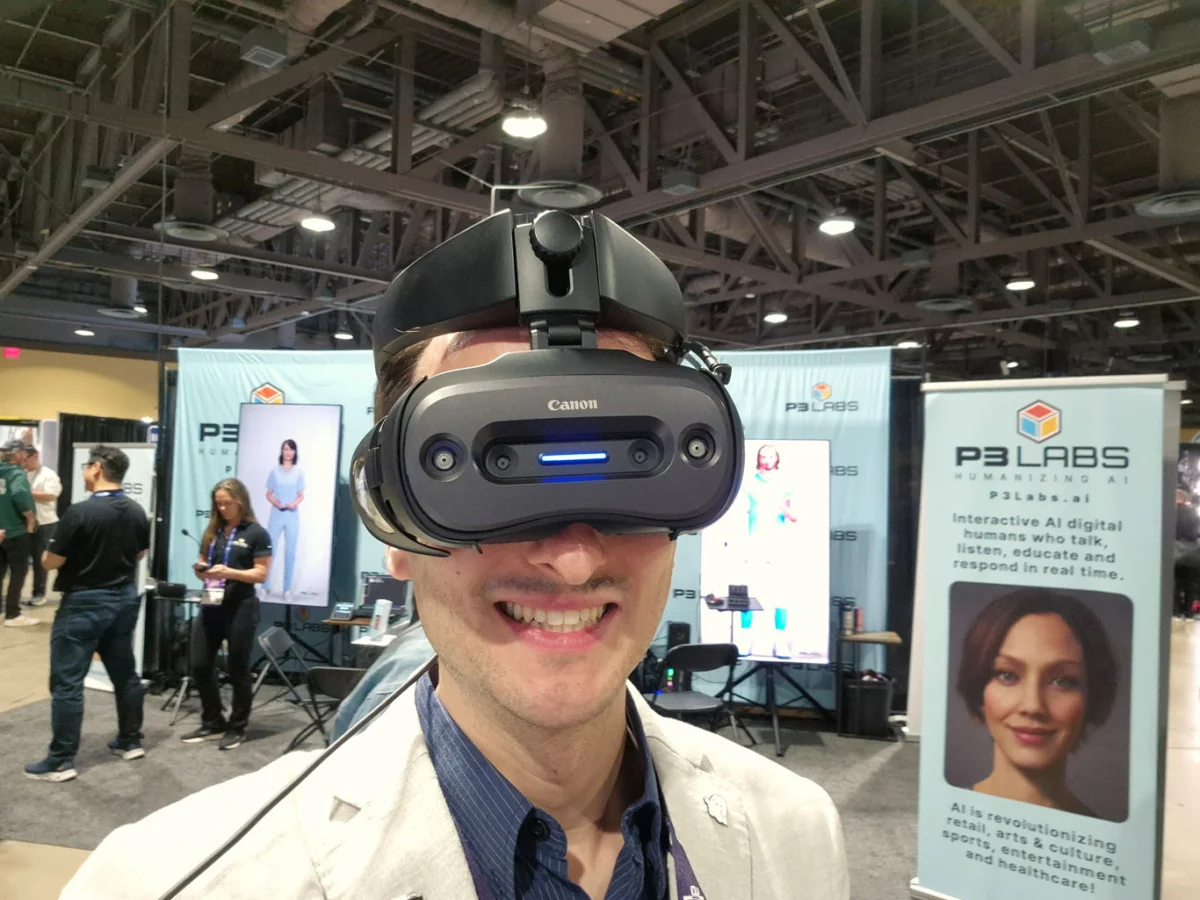
In addition to the handheld prototype, Canon showcased the MREAL X1, the current flagship in its enterprise MR lineup. The X1 serves as a more affordable successor to the MREAL S1, which entered the market with a staggering price tag of approximately $38,500. The MREAL X1 system, which includes the headset, a dedicated interface box, and a specialized PC, is positioned at a more competitive—though still premium—price point of roughly $20,000.

The MREAL X1 features a "flat" design philosophy similar to the Lynx-R1, prioritizing a generous open periphery. This design allows users to maintain full situational awareness of their physical surroundings, a critical safety and comfort requirement for engineers and designers working in large-scale industrial spaces. For users requiring deeper immersion, the device includes lateral blinders that can be deployed to block out peripheral light. The headset is secured via a halo-style strap with a rear adjustment knob, designed to balance the weight of the front-mounted optical stack.
Technical Specifications and Performance Metrics
The MREAL X1 delivers a resolution of 1920×2160 pixels per eye. While this resolution is technically lower than that of some mid-range consumer headsets released in the mid-2020s, the pixel density is optimized for close-range inspection of digital assets. However, the field of view remains a point of contention for industry analysts; the X1 offers approximately 58 degrees horizontally and 60 degrees vertically. This narrow FOV is a hallmark of Canon’s current optical approach, which prioritizes clarity and distortion-free viewing over the wide-angle immersion seen in gaming-centric hardware.

A significant component of the MREAL X1 system is the external interface box. Unlike standalone headsets or direct-to-PC tethered devices, the X1 requires this intermediary hardware to manage data processing and ensure low-latency video passthrough. This architecture, while reminiscent of earlier generations of VR hardware, is utilized by Canon to maintain the stability of the MR overlay, which is paramount in precision-heavy tasks like automotive design or surgical planning.
Despite the high cost, evaluations of the hardware during the expo noted some performance limitations. Reports indicated that the tracking system, which often relies on floor-based markers for initial calibration, can exhibit jitter and latency when the user performs rapid head movements. Furthermore, the passthrough video—though functional for enterprise tasks—displays noticeable motion blur and does not yet match the visual fidelity of high-end competitors like the Varjo XR-4 series.

Comparative Market Analysis and Industrial Impact
The positioning of the MREAL X1 at the $20,000 mark places it in direct competition with elite enterprise hardware such as the Varjo XR-4 Focal Edition. For comparison, the Varjo system offers a significantly higher resolution of 3840 x 3744 per eye and a much wider 120-degree horizontal field of view. This disparity highlights Canon’s unique niche; the company is not competing on raw specifications alone but rather on its legacy of optical engineering and its specific software integrations tailored for Japanese and global industrial sectors.
The XR market in 2026 has seen a massive influx of high-performance, lower-cost passthrough devices, such as the Meta Quest 3 and subsequent Pro iterations. These consumer-grade devices have raised the baseline expectation for what mixed reality should look like, even for professional users. Consequently, Canon faces a challenging landscape where its "MREAL" ecosystem must justify a 10x to 20x price premium through specialized support, durability, and integration into existing CAD (Computer-Aided Design) workflows.

Chronology of Canon’s MR Development
Canon’s journey into the mixed reality space has been a multi-decade endeavor, far predating the current "metaverse" trend.
- Early 2010s: Canon began developing the MREAL system primarily for the Japanese automotive industry, focusing on reducing the need for physical prototypes.
- 2020-2021: The launch of the MREAL S1 marked an attempt to miniaturize the hardware, though the $38,000+ price point limited its adoption to Tier-1 industrial giants.
- 2022-2023: The MREAL X1 was introduced to provide a more "accessible" enterprise solution by nearly halving the cost of the S1 while improving the passthrough optics.
- 2024-2026: The current phase involves experimenting with the handheld form factor to address the needs of the "Location-Based Entertainment" (LBE) and museum sectors, where traditional headsets are often deemed impractical.
Future Outlook and Official Stance
Canon representatives at AWE emphasized that their hardware is not intended to be a "general-purpose" computer. Instead, they view their MR devices as precision instruments. The company is reportedly working on expanding its SLAM capabilities to reduce the reliance on physical markers, which would significantly broaden the environments in which the MREAL X1 can operate effectively.

Industry experts suggest that Canon’s path forward likely involves the licensing of its compact optical modules to other hardware manufacturers. The handheld prototype seen at AWE may serve as a reference design for a new category of "casual AR" viewers used in tourism and education. While the MREAL X1 shows its age in terms of FOV and tracking stability, Canon’s dedication to the enterprise sector ensures that they remain a key player in the specialized hardware niche, even as the broader market moves toward more affordable, all-in-one consumer solutions.
The broader implication of Canon’s display at AWE is the realization that the XR market is fragmenting into highly specific verticals. While one segment of the industry pursues the "all-day wearable" glasses for the general public, Canon is doubling down on the "task-specific" tool, proving that in the world of high-end engineering, there is still a place for expensive, tethered, and highly specialized optical systems.
About the Author