The video game industry is witnessing a significant shift in its approach to asset reuse, with developers increasingly advocating for its necessity in sustainable game design. This evolving candor, particularly from a historically guarded company like Nintendo, highlights a growing industry consensus: efficient resource management is paramount in the era of increasingly complex and costly game development. In the past year, prominent figures such as Alex Hutchison, former director for Far Cry and Assassin’s Creed; Junya Ishizaki, director of Elden Ring Nightreign; and IO Interactive CEO Hakan Abrak have all openly discussed the critical role of re-using game assets—be it 3D models, sound effects, or other creative elements—in maintaining development viability. This newfound openness marks a departure from previous years, where player communities often voiced strong complaints about perceived asset recycling. However, the sheer scale and demands of modern game production appear to have superseded these historical backlashes, pushing sustainability to the forefront of industry discourse.
Industry Context: The Shifting Stance on Asset Reuse
For decades, the concept of asset reuse in video games has been a contentious topic among players. Instances where identical or minimally altered assets appeared across different titles, or even extensively within the same game, often drew criticism, sometimes leading to accusations of developer laziness or cost-cutting at the expense of originality. This player sentiment, fueled by a desire for novel experiences and unique aesthetics in every release, created an environment where developers were often hesitant to openly discuss their asset management strategies. The unspoken rule seemed to be: reuse assets, but do so subtly.
However, the economics of game development have undergone a dramatic transformation. The average cost of developing a AAA game has skyrocketed, with some titles exceeding budgets of $200 million or even $300 million, a stark increase from the millions required in the early 2000s. A significant portion of this budget is allocated to asset creation, which encompasses everything from detailed 3D models and high-resolution textures to complex animations and immersive soundscapes. Creating these assets from scratch for every single element within a sprawling open-world environment or a meticulously detailed character roster is not only time-consuming but also financially prohibitive. Industry reports often cite that asset creation can account for 50-70% of a game’s total art budget.
This escalating cost and development timeline have forced a pragmatic re-evaluation. Developers are now openly discussing asset reuse not as a compromise, but as a strategic imperative. Alex Hutchison’s assertion that "asset reuse in videogames is essential and we need to embrace it—we redo too much stuff" encapsulates this sentiment. Junya Ishizaki further clarified, stating that FromSoftware, developers of the critically acclaimed Elden Ring Nightreign, doesn’t view asset reuse as "one-to-one copy-paste" but rather as "an efficient way to build these games." This reframing highlights a mature understanding of development efficiencies, recognizing that smart reuse can free up resources for innovation in other areas, such as gameplay mechanics, narrative depth, or new core features.
Nintendo’s Revelation: A Deep Dive into Donkey Kong Bananza‘s Voxelization
Against this backdrop of evolving industry dialogue, Nintendo, a company renowned for its meticulous attention to detail and often perceived as maintaining a tight veil over its development processes, has emerged from its traditional reticence. At the 2026 GDC Festival of Gaming, during a presentation titled "Constructive Destruction: Fusing Voxel Tech and 3D Action-Platforming in Donkey Kong Bananza," Nintendo programmer Tatsuya Kurihara offered a rare glimpse into the studio’s innovative approach to environmental design and, by extension, asset reuse.
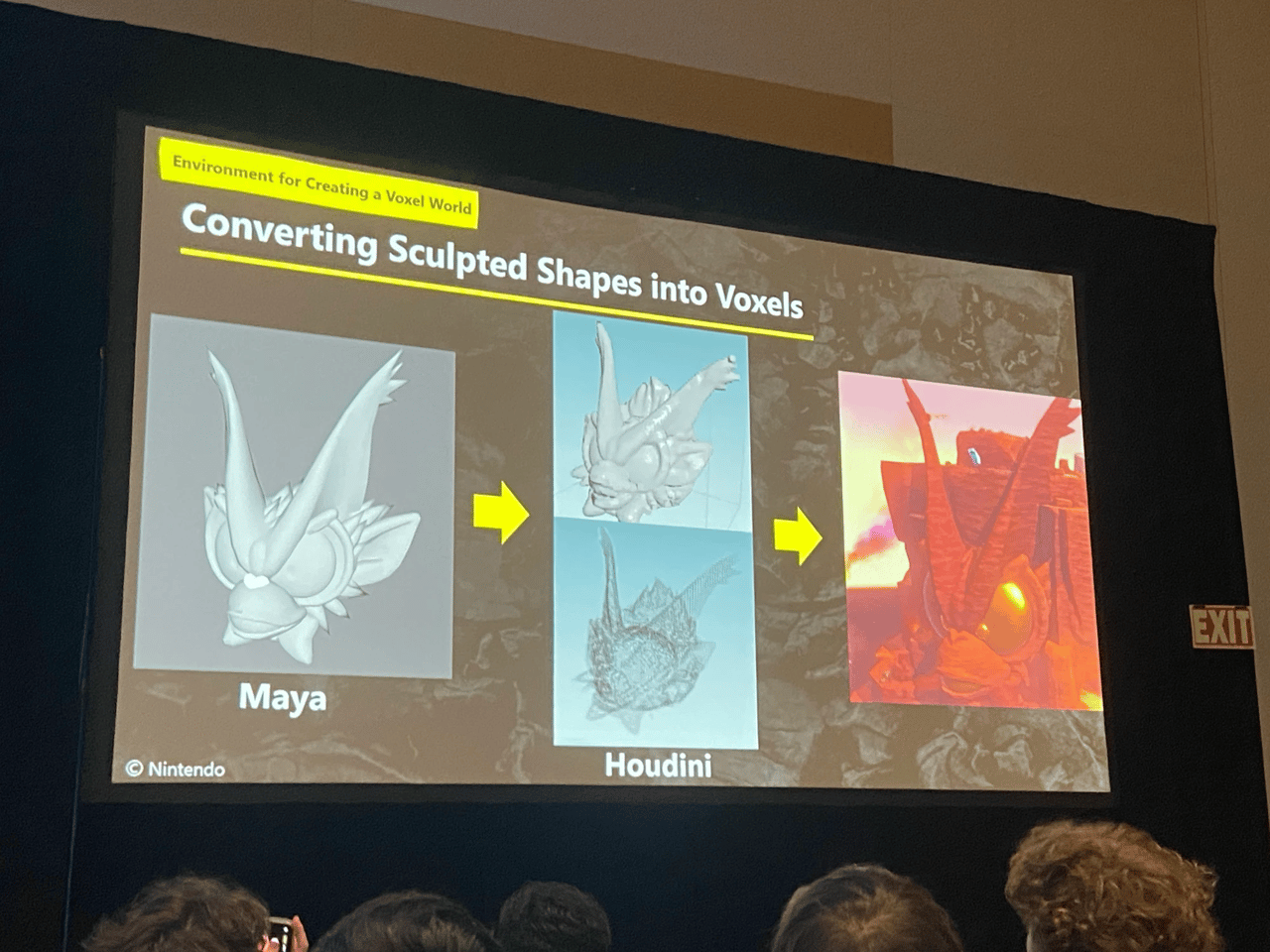
The presentation detailed a sophisticated pipeline developed by Kurihara’s team, enabling Bananza‘s art team to rapidly create destructible objects from pre-existing 3D sculpted assets. This system underpins the game’s core mechanic of destructible voxel environments, which is a key gameplay loop in Donkey Kong Bananza. Kurihara’s explanation, though brief, provided a clear technical overview of how traditional 3D models are transformed into interactive, destructible elements within the game world.
Using the head of Bananza‘s antagonist, Void Kong, as a prime example, Kurihara elucidated the multi-stage process. A detailed 3D model, such as Void Kong’s head, is initially crafted in industry-standard software like Maya. This model is then exported and processed in Houdini, a powerful 3D animation software known for its procedural generation capabilities, where it is converted into voxel data. Voxels, or volumetric pixels, are essentially 3D equivalents of pixels, allowing for highly granular and dynamic destruction effects. Finally, this voxel data is "voxelized" at runtime within the Bananza engine, generating polygons on the fly to render the destructible terrain.
.jpg?disable=upscale&width=1200&height=630&fit=crop)
Crucially, this pipeline was not used to render Void Kong’s character model directly but rather to create a monumental, destructible piece of terrain sculpted in his likeness. Kurihara drew an analogy to Mount Rushmore, where the faces of four US presidents are carved into a mountain—a landmark also known by the Sioux Nation, which maintains its territorial claim to the mountain, as "Six Grandmothers." This colossal effigy of Void Kong serves a dual purpose within the game: it acts as a shrine to the villain’s ego, projecting his dominance, and simultaneously functions as a physical manifestation of player frustration, offering a cathartic "punching bag" for players to channel their aggression against the "pint-sized corporate villain." Kurihara confirmed that "The shapes of items and enemies, as well as iconic terrain within levels are all created using this system."
The Genesis of Innovation: Art Team’s Influence on Development
The genesis of Donkey Kong Bananza‘s voxelization pipeline is particularly insightful, illustrating a collaborative and iterative development process. According to Kurihara, the sophisticated voxelization process was not an initial design decision but emerged later in Bananza‘s development cycle. Initially, the programming team had provided the game’s artists and level designers with basic tools for creating their own voxel-based elements. What followed was an unexpected surge of creativity from the art team.
"That leads to a situation where the artists or the level designer will start chugging away, and they’ll create this complex voxel design that even I, as the creator, [would say] ‘I didn’t know you could create something so complicated in this level editor,’" Kurihara recounted. This unexpected creativity, while impressive, also highlighted a potential bottleneck. The manual creation of intricate voxel designs, though possible, was time-consuming and labor-intensive for complex shapes.
This realization prompted Kurihara to consider how to streamline the process. "It got me thinking—’well, what kind of features can I add to make this process easier?’" he explained. The artists, having pushed the limits of the initial voxel creation tools, subsequently approached the engineering team with a specific request: "we want to be able to actually ‘shave’ voxels in this state." This feedback loop was critical. In response, the programming team implemented a specialized tool that allowed for the "shaving" or more precise manipulation of voxelized forms.
This iterative development, driven by the practical needs and creative aspirations of the art team, led directly to the sophisticated Maya-to-Houdini pipeline. The new system offered unparalleled flexibility. Artists could now either create entirely new 3D assets explicitly designed for voxelization or, more importantly, take existing 3D assets – perhaps character models, environmental props, or even parts of enemy designs – and seamlessly convert them into destructible voxel environments. This adaptive approach not only enhanced the game’s visual and interactive fidelity but also significantly boosted development efficiency by leveraging existing creative assets in novel ways.
Beyond Conventional Reuse: Expanding Asset Lifecycle
What makes Donkey Kong Bananza‘s approach particularly noteworthy is not merely the act of asset reuse itself, but how this specific method expands the conceptual lifecycle of a 3D model far beyond its original intended purpose. Traditionally, asset recycling is often understood as the direct deployment of assets across multiple games or within different contexts in the same game with minimal modification. A common example cited is the reuse of animations. For instance, in Horizon Forbidden West, some robotic monster animations were reportedly carried over from Horizon Zero Dawn with very little alteration. While efficient, this form of reuse primarily serves to expedite production without fundamentally changing the asset’s function.
Another form of internal reuse involves more expansive modification, often for purely aesthetic or environmental purposes. The Elder Scrolls V: Skyrim famously employed this by manipulating existing bookshelf models to create varied furniture pieces, such as end tables, by partially embedding them into the floor. This clever technique reduced the need for creating entirely new models to populate diverse indoor environments, saving development time and resources while still achieving visual variety.
Donkey Kong Bananza‘s voxelization process, however, elevates this concept further. It introduces a transformative pipeline that allows objects and characters, initially designed for static representation or specific character roles, to be dynamically manifested as destructible terrain. This means a character model, or part of it, can transition from a non-interactive background element or a combatant into an integral, destructible part of the gameplay environment. These objects no longer exist merely for aesthetic purposes; they become active participants in the core gameplay loop, offering players a tangible and impactful interaction. The process essentially gives existing assets a new lease on life, transforming them from passive elements into dynamic, gameplay-affecting components. This represents a significant evolution in asset management, pushing beyond simple replication or minor modification to a deeper, functional repurposing.
Gameplay Implications: The Philosophy of Destructible Beauty
Beyond the technical efficiencies, Donkey Kong Bananza‘s innovative asset reuse method also underpins a fascinating design philosophy that emerged during the game’s development. Kurihara revealed that as iteration progressed, the team discovered a powerful psychological aspect to their destructible environments: it is inherently more satisfying for players to destroy objects that do not look like they should be destroyed.
This principle suggests that the visual contrast between an aesthetically pleasing, seemingly robust object and its eventual, gratifying destruction enhances the player’s experience. The Void Kong head effigy is a prime example. Designed as a grand, imposing structure symbolizing the antagonist’s ego, its very presence invites a powerful response from players. Its destruction, facilitated by the voxelization pipeline, becomes more impactful because it subverts expectations. It’s not just a generic block; it’s a monument to a villain, imbued with a sense of significance that makes its demolition all the more triumphant.
Kurihara encapsulated this design tenet with a statement that elicited laughter from the packed GDC audience in San Francisco: "It is more fun to destroy that which is beautiful." This pithy observation speaks volumes about the emotional resonance that thoughtful game design can achieve. By taking beautifully crafted 3D models—assets that typically represent permanence or a specific non-destructive function—and making them vulnerable to player interaction and destruction, Donkey Kong Bananza taps into a primal satisfaction. It provides a deeper sense of agency and impact, turning the act of destruction into a meaningful and enjoyable gameplay loop rather than a mere visual effect.
Broader Industry Impact and Future Outlook
Nintendo’s candid discussion and demonstration of their voxelization pipeline for Donkey Kong Bananza carries significant implications for the wider game development community. Firstly, it further legitimizes asset reuse as a sophisticated, integral part of modern game development, even for companies known for their high quality and innovation. Nintendo’s participation in this open discourse adds considerable weight to the argument that efficiency and creativity are not mutually exclusive.
Secondly, the specific methodology employed by Bananza offers a compelling blueprint for other studios seeking to maximize the utility of their existing asset libraries. By providing a pathway to convert static 3D models into dynamic, destructible voxel environments, Nintendo has showcased a method for extending the value and functional lifespan of digital assets. This approach could inspire similar innovations in other games, leading to richer, more interactive environments without necessarily escalating development costs proportionally. It points towards a future where asset libraries are not just repositories of static models but dynamic resources that can be transformed and repurposed in myriad ways to serve diverse gameplay mechanics.
Furthermore, this development highlights the growing importance of procedural tools and robust pipelines in game creation. The Maya-to-Houdini workflow demonstrated by Kurihara underscores how sophisticated software integrations can empower artists and designers, allowing them to iterate faster and create complex content with greater efficiency. This trend is likely to continue, with more studios investing in tools and pipelines that facilitate rapid prototyping, asset transformation, and the creation of dynamic, responsive game worlds.
Finally, the philosophical insight about the joy of destroying "that which is beautiful" offers a valuable lesson for game designers. It encourages a deeper consideration of the psychological impact of environmental interaction and how asset repurposing can contribute to more engaging and emotionally resonant gameplay experiences. As the industry continues to push the boundaries of realism and interactivity, innovative approaches to asset management like Nintendo’s Donkey Kong Bananza pipeline will be crucial in balancing creative ambition with the practical realities of game development. This marks a turning point, signaling a more transparent and collaborative future for how games are made, where efficiency is celebrated as a catalyst for innovation rather than a compromise.
About the Author