In a significant stride towards enhancing developer accessibility and streamlining the game distribution process, itch.io has unveiled a major upgrade to its desktop application, integrating its powerful Butler command-line interface with a user-friendly graphical user interface (GUI). This update, rolling out to users of the itch.io app, empowers developers to upload builds directly within the application, bypassing the need for terminal commands and lowering the barrier to entry for managing game updates. The new functionality, accessible through a dedicated "Upload" section, is poised to revolutionize how indie developers interact with the platform, making the sophisticated patching technology of Butler available to a broader audience.
Background and Context: The Evolution of Itch.io and Butler
Itch.io has long distinguished itself as a vibrant and developer-centric marketplace for independent games, digital assets, and tools. Founded on principles of open access and fair revenue sharing, it has become a crucial ecosystem for creators seeking alternatives to mainstream distribution platforms. A cornerstone of its technical infrastructure for developers has been Butler, a proprietary command-line tool designed for efficient and robust build management.
Introduced years ago, Butler addressed a critical challenge in game development: the cumbersome process of updating large game files. Traditional methods often require developers to upload entire new versions of their games, leading to significant bandwidth consumption and lengthy download times for both developers and players. Butler was engineered to mitigate this by implementing delta patching, a sophisticated technique that only uploads and downloads the changes between builds, rather than the complete files. This innovation dramatically reduced file sizes for updates, saving time, bandwidth, and storage space across the board. For instance, a typical game update that might be several gigabytes in full size could be reduced to just a few hundred megabytes, or even tens of megabytes, through Butler’s intelligent patching. This efficiency has been particularly beneficial for developers iterating frequently on their projects, such as during beta phases or early access programs, where multiple small updates are common.
Despite its technical prowess and the substantial benefits it offered, Butler’s command-line-only nature presented a hurdle for some. Developers unfamiliar or uncomfortable with terminal environments often found the initial setup and ongoing usage intimidating. This segment of the developer community, though equally dedicated to creating and distributing games, was effectively excluded from leveraging Butler’s full potential, resorting instead to less efficient browser-based uploads for full game files. The itch.io team recognized this disparity, understanding that democratizing access to their most powerful tools was essential for fostering an even more inclusive and efficient development community. The recent integration of Butler into the itch.io app’s GUI marks the culmination of efforts to bridge this gap, extending advanced functionalities to all developers, regardless of their command-line proficiency.
The Power of Delta Patching: Efficiency Unleashed
At the heart of Butler’s efficacy lies its intelligent delta patching system. Unlike simple file uploads, which replace an entire build with a new one, Butler meticulously compares the new version of a game to the previously uploaded one. It then identifies only the discrete differences – new files, modified segments of existing files, and deleted files – and packages these changes into a compact "patch." This patch is then uploaded to itch.io’s servers.
The benefits of this approach are manifold and impactful. For developers, the initial upload of a project using Butler sends the entire build. However, subsequent updates to the same "channel" (a designated version stream, such as windows-beta or macos-preview) only transmit the differential data. This drastically cuts down on upload times, especially for large projects with minor updates. For example, a developer might spend hours uploading a 5GB game initially, but subsequent patches containing only bug fixes or small content additions could take mere minutes, transmitting perhaps 50-100MB of data instead of the full 5GB. This efficiency allows for more frequent updates, faster iteration cycles, and less disruption to the development workflow.
For players, the advantages are equally significant. When a user of the itch.io app updates a game managed by Butler, their client downloads only the necessary patch, not the entire game. This translates to considerably faster download times and significantly less internet bandwidth consumption. In regions with slower internet speeds or restrictive data caps, this feature is not just a convenience but a critical enabler for accessing game updates. Furthermore, itch.io’s servers perform additional background re-compression and optimization on these patches, ensuring that the delivered update files are as small as possible, maximizing efficiency for the end-user. This seamless, optimized update experience contributes directly to higher player satisfaction and engagement, fostering a more positive perception of games hosted on the platform.
Bridging the Divide: From Command Line to Graphical Interface
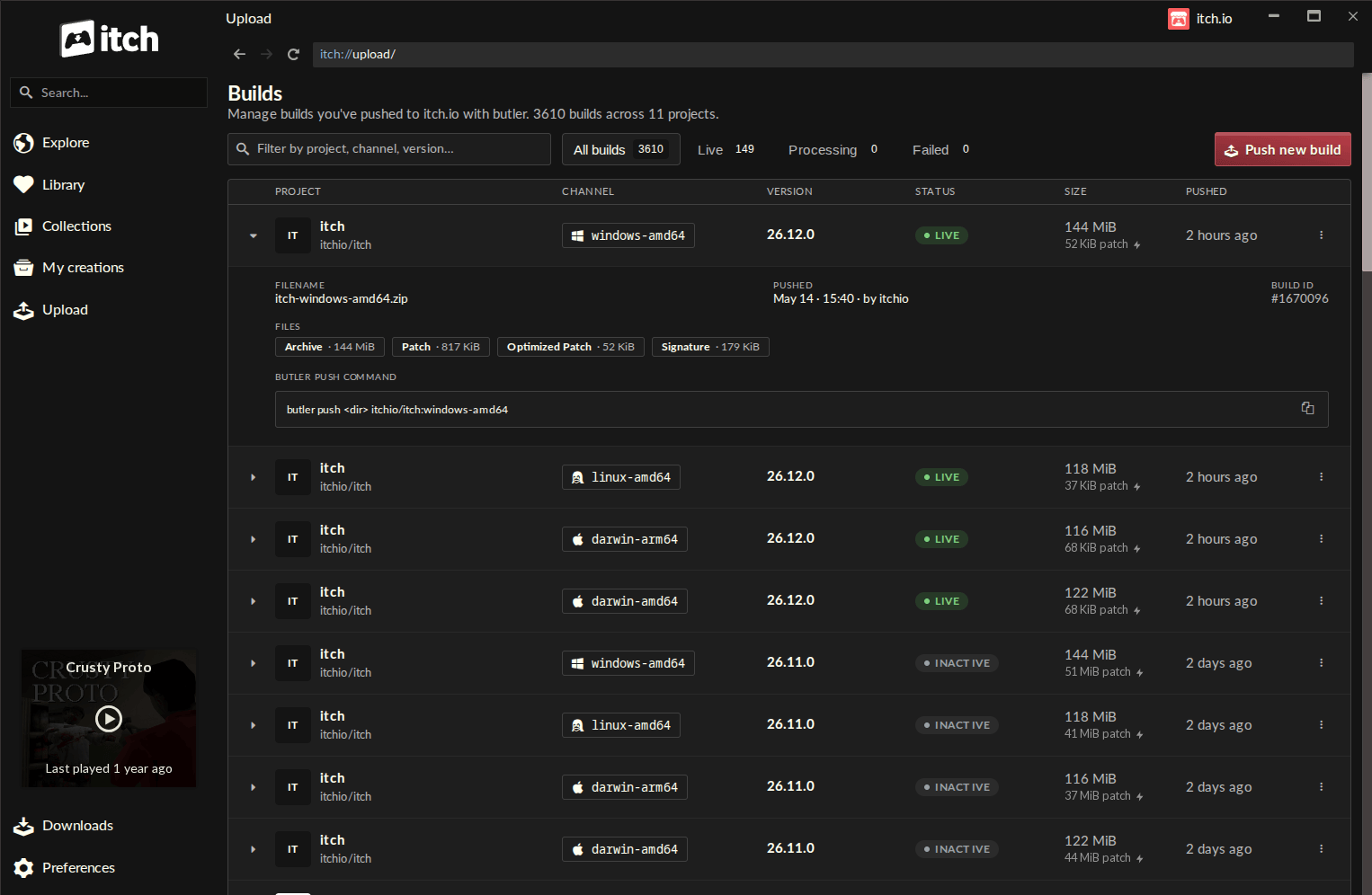
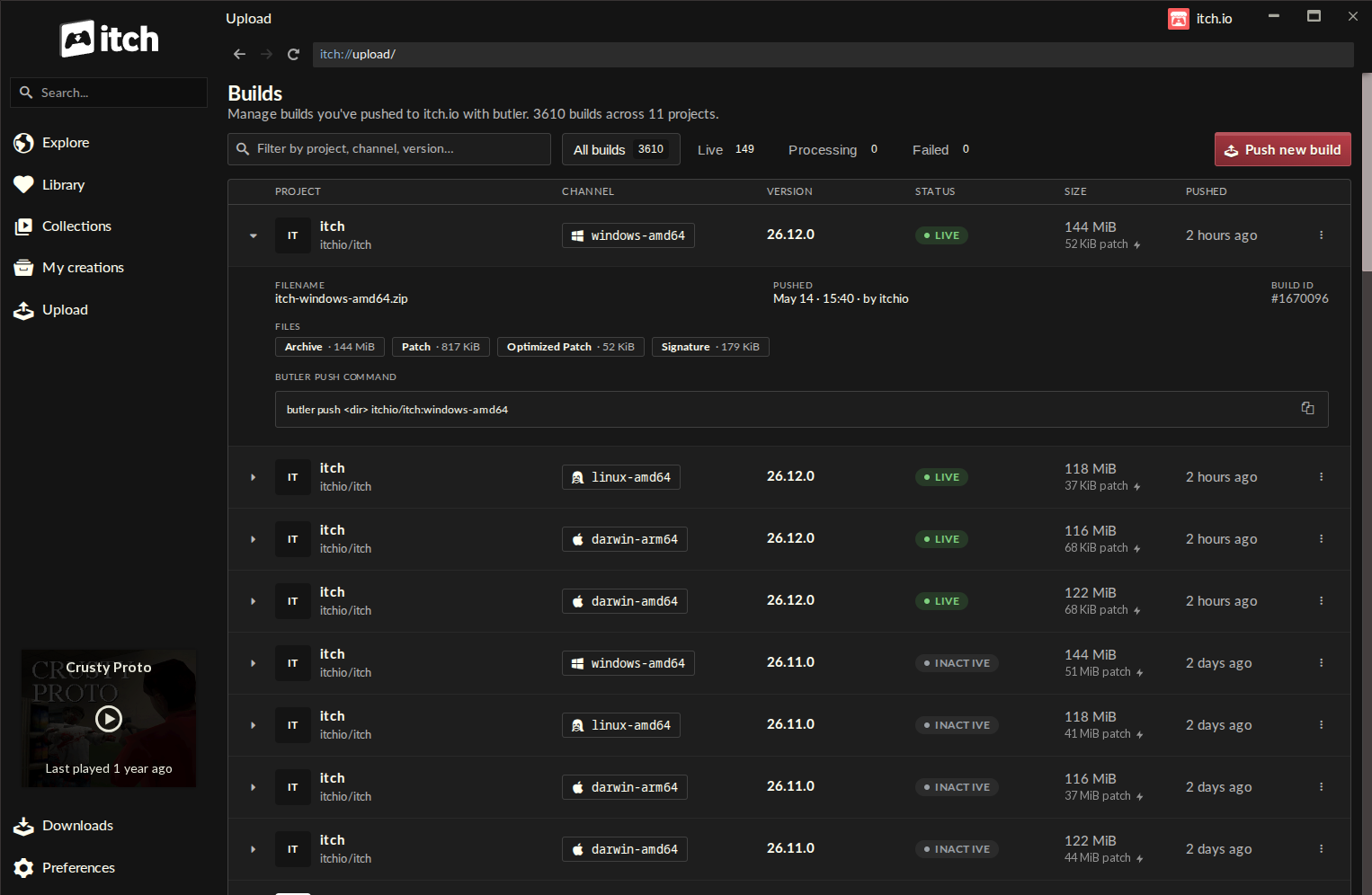
The most recent update, requiring at least v26.12.0 of the itch.io app, introduces a dedicated "Upload" entry in the sidebar, leading to the new "Builds" page. This centralized hub provides developers with a comprehensive overview of all builds associated with projects their account can edit. Each row on this page offers essential information at a glance: the project name, the specific channel it belongs to, its version number, current status, file size, and the timestamp of its last push. This dashboard-like view brings much-needed transparency and organization to build management, moving beyond the fragmented nature of individual command-line executions.
The core of this new functionality resides in the "Push new build" dialog, accessible via a prominent button on the Builds screen. This intuitive interface guides developers through the entire upload process. Users first select the target project from a dropdown list. They then choose an existing channel or define a new one simply by typing a name – a flexible approach that supports diverse release strategies (e.g., stable, unstable, alpha-test). Developers can also optionally assign a specific version string, which is crucial for tracking progress and communicating updates to players.
The process of selecting files for upload has been simplified to a drag-and-drop interface, allowing developers to easily specify a folder or a .zip file containing their game build. A convenient "recent folders" list further enhances workflow by providing quick access to previously used locations.
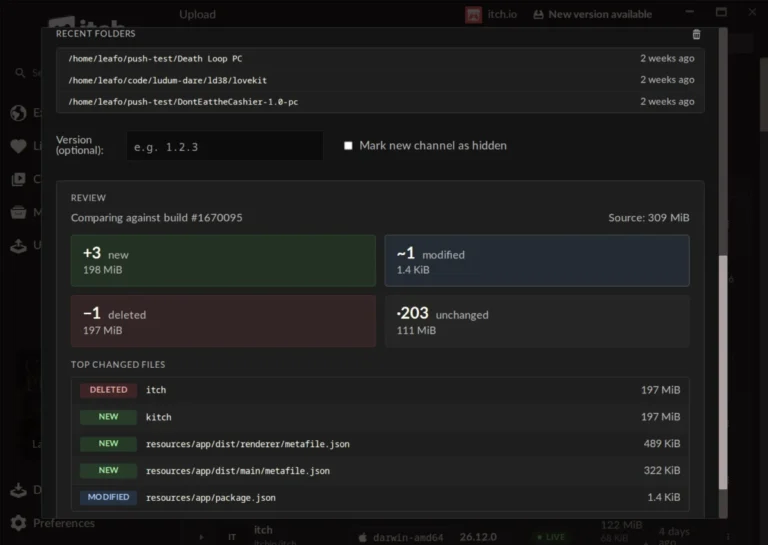
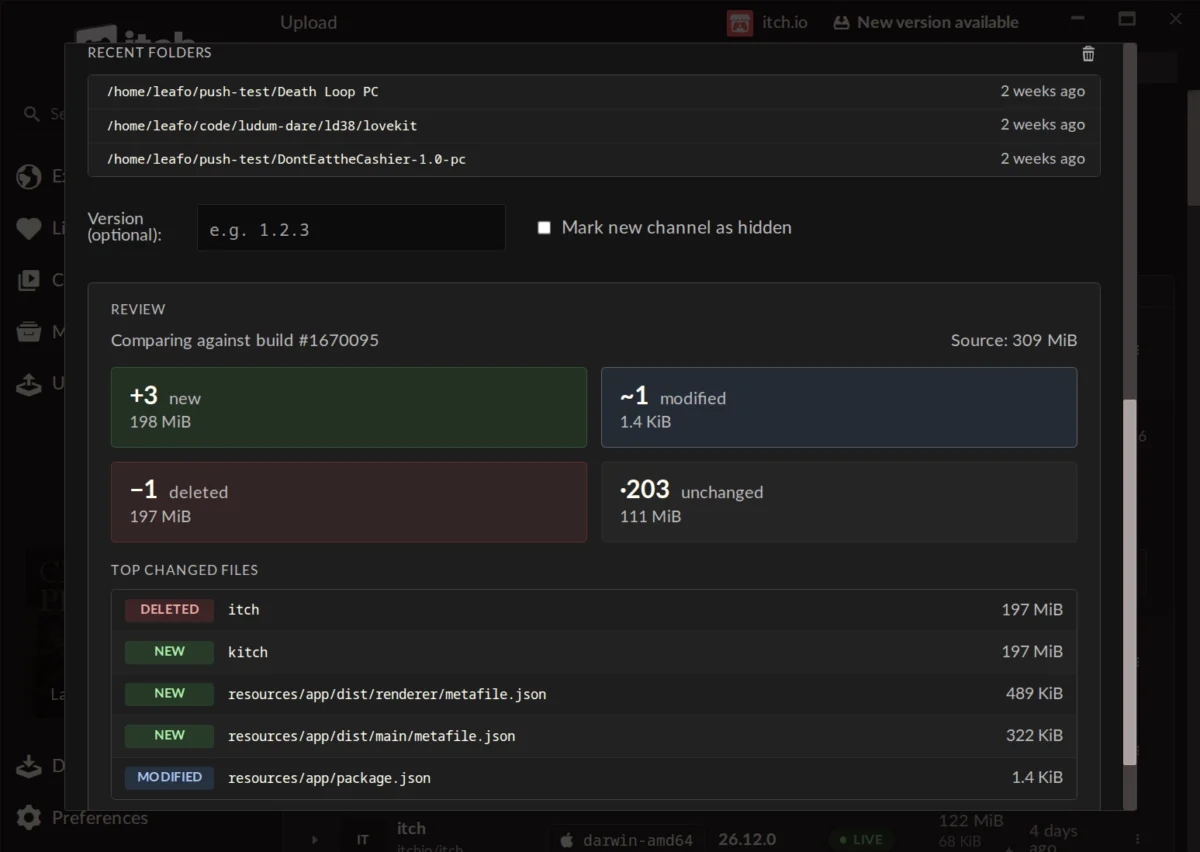
A standout feature of the new GUI is the pre-upload preview. Before initiating an upload, developers can generate a detailed report outlining the changes between their current build and the last one pushed to the chosen channel. This preview categorizes changes into "new files," "modified files," "deleted files," and "unchanged files," complete with size breakdowns for each group. It also highlights the largest changed files, offering critical insights that can help developers identify potential errors, understand the scope of their update, and verify that only intended modifications are being pushed. This diagnostic step significantly reduces the risk of accidental uploads or misconfigurations, a common concern when dealing with command-line tools.
Furthermore, the Butler version embedded within the itch.io app is automatically updated, eliminating the developer’s responsibility to manually maintain the tool. This ensures that users are always leveraging the latest optimizations and features. The integration also seamlessly utilizes the credentials of the logged-in itch.io account, simplifying authentication, particularly for developers managing multiple profiles or projects. This tight integration means switching between different developer accounts within the app also switches the active Butler credentials, offering unparalleled convenience for studios or individuals managing a diverse portfolio of games.
Developer Reactions and Community Impact
The initial reception from the developer community has been overwhelmingly positive, underscoring the demand for such a feature. Feedback collected since the release highlights a consensus that the GUI integration dramatically improves the ease and organization of updating games. Developers who previously found Butler’s command-line interface "complicated and fiddly" have lauded the app’s new functionality for its straightforwardness and robustness. As one developer noted, the self-enforcing nature of the "Compare" step makes it "almost literally impossible to mess it up, even as a noob to the app," emphasizing the feature’s role in error prevention and user confidence.
Many developers have expressed that this change makes the itch.io app "a lot more useful," prompting considerations to migrate their software distribution to the platform. This sentiment reflects a broader impact: by lowering the technical barrier to entry for advanced features, itch.io not only retains its existing developer base but also attracts new creators who might have been deterred by the complexities of command-line tools. The enhanced visibility and control offered by the Builds page and the push dialog contribute significantly to a smoother development pipeline, freeing up developers to focus more on creation and less on the mechanics of distribution.
While the response has been largely celebratory, some developers have raised pertinent questions, such as the possibility of converting existing games not originally uploaded with Butler to the new system. Itch.io representatives have clarified that this functionality is not currently available, as Butler pushes require specific metadata computed during the initial upload. However, they acknowledged it as a potential future addition, demonstrating responsiveness to user feedback and a commitment to ongoing platform improvement. This type of direct engagement with the community reinforces itch.io’s developer-first ethos.
Strategic Implications for Itch.io and Indie Developers
The integration of Butler into the itch.io app carries significant strategic implications for both the platform and the broader indie game development landscape. For itch.io, this move strengthens its position as a comprehensive, developer-friendly ecosystem. By making its most powerful build management tool universally accessible, itch.io enhances its value proposition, potentially attracting a larger cohort of developers who prioritize ease of use alongside robust functionality. This could lead to an increase in the number and quality of games hosted on the platform, further diversifying its offerings and reinforcing its identity as a hub for independent creativity.
In the competitive digital distribution market, where platforms like Steam and Epic Games Store also offer various developer tools, itch.io’s enhanced Butler integration provides a unique selling point. While other platforms have sophisticated update mechanisms, Butler’s delta patching, now with a GUI, provides a distinct advantage in efficiency and accessibility for indie creators. This could be particularly appealing to solo developers or small teams with limited resources, for whom every saved minute and megabyte translates into tangible benefits.
For indie developers, the implications are profound. The simplified workflow for pushing updates means less time spent on technical logistics and more time on game development, marketing, or community engagement. This increased efficiency can accelerate development cycles, facilitate more responsive bug fixing, and enable richer, more frequent content updates, ultimately leading to higher-quality games and more engaged player communities. Moreover, the visual feedback provided by the pre-upload preview fosters a greater understanding of the update process, empowering developers with confidence and control. This reduction in technical overhead aligns perfectly with the indie ethos of creative freedom and streamlined production.
Looking Ahead: The Future of Distribution on Itch.io
This latest update is not merely an incremental improvement; it represents a foundational shift in how itch.io approaches developer tools, prioritizing user experience without compromising on technical sophistication. It suggests a future where even the most complex aspects of game development and distribution are made accessible to a wider audience, fostering innovation and creativity across the board.
Future enhancements could potentially include further integration of build analytics, more detailed reporting on patch performance, or even expanded support for automated build pipelines directly within the app, building upon the solid foundation now established. As the platform continues to evolve, the principles of developer empowerment, efficiency, and accessibility, exemplified by this Butler GUI integration, will undoubtedly remain central to itch.io’s strategic direction. The company’s commitment to continuously refining its tools, driven by developer feedback, positions it as a dynamic and responsive partner for independent creators navigating the complexities of digital game distribution.
Accessing the Update
The itch.io app features an automatic update mechanism, ensuring that most users will receive this significant upgrade seamlessly. Developers can also manually check for updates via the Preferences screen if they wish to expedite the process. For those new to the itch.io ecosystem, the app is readily available for download from the official itch.io website. To fully leverage the new "Upload" tab and its features, users must ensure their app version is at least v26.12.0. Detailed documentation for Butler’s command-line capabilities remains available for developers who prefer or require its advanced functionalities, providing a comprehensive resource for all levels of technical expertise. This thoughtful approach ensures that while new doors are opened, existing pathways remain fully supported.
About the Author