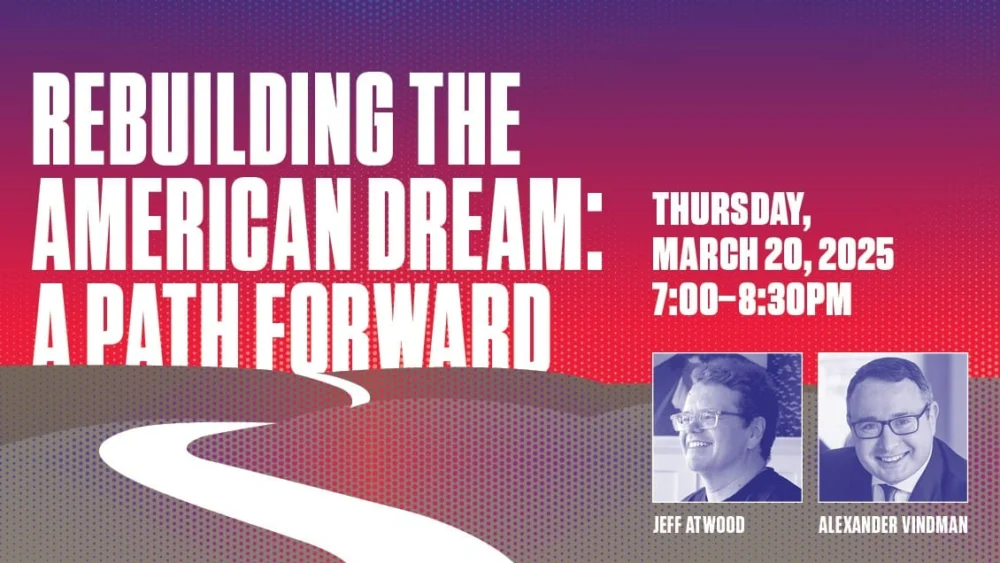
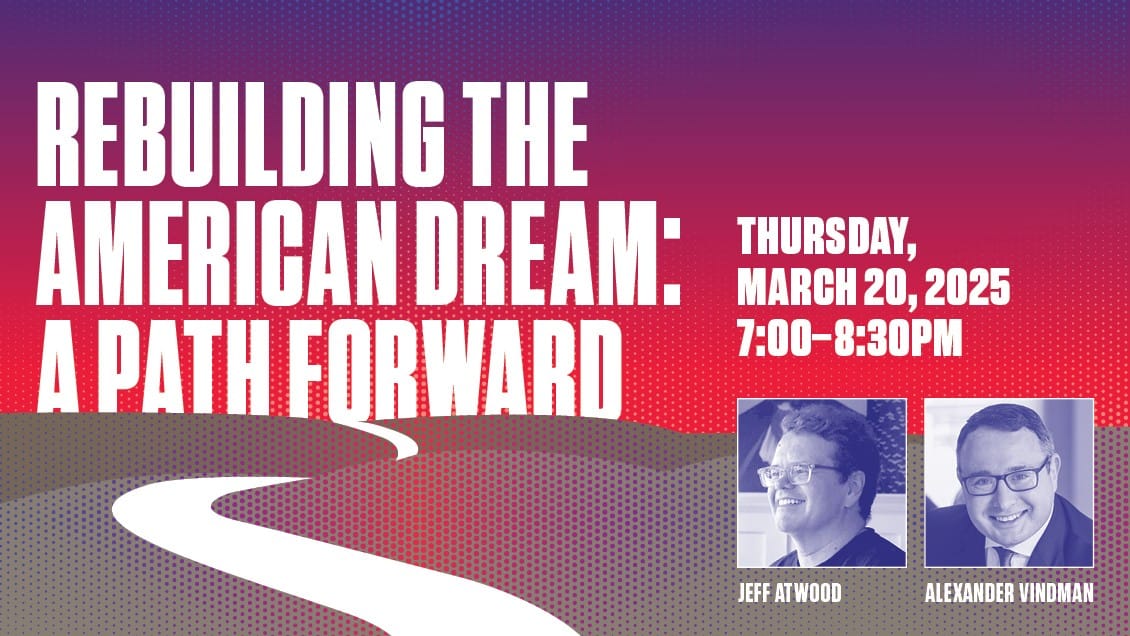
The historic Cooper Union Great Hall in New York City recently hosted a significant public discourse titled "Rebuilding the American Dream: A Path Forward," featuring internet entrepreneur and author Jeff Atwood, co-founder of Stack Overflow and Discourse, alongside decorated U.S. Army veteran and former National Security Council official, Lieutenant Colonel (Ret.) Alexander Vindman. The event, made accessible to a global audience through a live stream on the Cooper Union Great Hall YouTube channel, convened these two influential figures from seemingly disparate fields to critically examine the contemporary challenges confronting the American Dream and to propose actionable strategies for its revitalization through systemic change and active civic engagement.
The Imperative for Action: Rekindling "Stay Gold" Principles
The conceptual foundation for this joint presentation was rooted in Jeff Atwood’s earlier philosophical explorations of what it means to "stay gold"—a powerful metaphor derived from S.E. Hinton’s novel The Outsiders, signifying the preservation of one’s purest essence, the most valuable aspects of community, and the fundamental ideals underpinning the American Dream itself. Atwood has consistently argued that this preservation is far from a passive state; instead, it demands continuous effort, intentional action, and a willingness to engage in challenging dialogues that compel individuals and communities to confront their past, assess their present, and define their desired future. The Cooper Union event served as a public, collaborative manifestation of this philosophy, moving beyond theoretical musings to concrete discussions on practical pathways forward.
In the current socio-political climate, particularly as reflected in 2025, the traditional understanding of the American Dream – the belief that hard work, equitable treatment, and accessible opportunities can lead to a better life – increasingly faces public skepticism and scrutiny. Public sentiment, as indicated by various national surveys, frequently questions the dream’s current accessibility and inclusivity, especially for marginalized communities or those facing economic hardship. This pervasive questioning fueled the central inquiry of the Atwood and Vindman discussion: "How can we build on our dream so that it works for everyone?" Their collaborative endeavor aimed to dissect this complex query through a multi-faceted approach, focusing on the critical intersections of democracy, community resilience, and economic mobility, recognizing that a truly robust American Dream necessitates strength across all these dimensions.
Diverse Expertise, Unified Purpose: The Speakers’ Contributions
The decision to pair Jeff Atwood with Alexander Vindman as co-presenters was a deliberate strategic choice to harness seemingly disparate professional expertise in addressing multifaceted national challenges. Despite their distinct career trajectories, both individuals share a profound, demonstrable commitment to the core tenets of fairness, opportunity, and the pursuit of the common good. Their combined insights offered a unique synthesis of practical governance, ethical leadership, and the dynamics of large-scale human organization.
Lieutenant Colonel (Ret.) Alexander Vindman: Embodiment of Civic Duty
Lieutenant Colonel (Ret.) Alexander Vindman contributed to the discourse with a life story that powerfully illustrates an unwavering dedication to democratic principles and the foundational ideals of the United States, often in the face of significant personal adversity. His journey began in the Soviet Union, from where he immigrated to the U.S. as a child, growing up in Brooklyn, New York. This immigrant background, culminating in a distinguished military career, serves as a compelling testament to his profound allegiance to his adopted nation and its values.
Vindman’s 21 years of service in the U.S. Army were marked by exceptional dedication, including earning a Purple Heart for injuries sustained during combat operations in Iraq. He ascended through the ranks, ultimately serving as the Director for European Affairs on the National Security Council, a pivotal role that placed him at the nexus of U.S. foreign policy and national security decision-making. His tenure at the NSC garnered significant public attention due to his resolute adherence to professional ethics and constitutional duty during a period of intense political pressure. When faced with a choice between personal career advancement and upholding the oath he swore to protect the Constitution, Vindman famously chose the latter, a decision that led to the premature conclusion of his military career but irrevocably solidified his reputation for integrity, moral courage, and unwavering civic responsibility. His contributions to the Cooper Union discussion were therefore imbued with a rare combination of military discipline, nuanced diplomatic experience, and a deeply personal understanding of the sacrifices occasionally required to safeguard democratic institutions. Vindman’s insights offered a powerful, real-world perspective on the practical application of civic duty and the defense of core American ideals against both internal and external threats.
Jeff Atwood: The Architect of Digital Governance
Complementing Vindman’s on-the-ground experience in national security and traditional governance, Jeff Atwood presented a perspective forged in the crucible of designing and managing digital societies. As the co-founder of seminal internet platforms like Stack Overflow, an indispensable resource for software developers, and Discourse, an influential open-source discussion forum, Atwood has spent decades at the vanguard of understanding and shaping online human interaction. His work inherently involves grappling with the complexities of how individuals collaborate, communicate, and navigate conflict within large-scale digital environments, and, crucially, how to engineer systems that foster fairness, encourage broad participation, and facilitate constructive dialogue.
Atwood’s extensive professional journey has equipped him with a unique and profound understanding of the fundamental principles necessary for effective self-governance, whether applied to an online forum with millions of users or a nation-state. He posits that the underlying requirements for successful human organization remain remarkably consistent across scales and contexts: the establishment of clear expectations, the implementation of demonstrably fair systems, the enforcement of strong yet reasonable boundaries, and the cultivation of a widely shared sense of purpose. These principles, he argues, are not merely theoretical constructs for digital platforms but are absolutely foundational to constructing resilient, equitable, and functional societies. His contribution to the Cooper Union discussion illuminated how the practical lessons gleaned from building scalable, self-regulating digital communities can be directly applied to address complex societal challenges, particularly in fostering a more inclusive and functional democracy. Atwood’s long-standing commitment to designing systems that generate "artifacts for the common good," analogous to universally accessible public spaces like local parks, underscores his belief in creating broadly shared benefits for all members of a community.
The Central Thesis: Beyond Individual Generosity to Systemic Reform
A pivotal tenet of the Atwood and Vindman presentation revolved around a critical distinction: the difference between individual acts of generosity and the implementation of profound, systemic, and structural change. While acknowledging the value and necessity of individual kindness and philanthropic endeavors, both speakers emphasized that effectively addressing deep-seated societal inequities and truly ensuring the American Dream’s accessibility for every citizen demands far more than episodic goodwill. It necessitates the deliberate design, establishment, and continuous refinement of systems that are inherently structured to create security, uphold dignity, and expand possibilities for all individuals, irrespective of their socio-economic origins or demographic background.
This unwavering focus on systemic solutions represents a crucial evolution in the broader national conversation about social progress and equity. Rather than relying solely on charitable impulses or individual efforts to overcome structural barriers, the speakers passionately advocated for the development and adoption of policies and societal structures that embed fairness, opportunity, and resilience into the very fabric of society. This comprehensive approach includes, but is not limited to, the re-evaluation of current economic policies, the robust strengthening of democratic institutions and norms, and the deliberate cultivation of community frameworks that actively prevent marginalization while vigorously promoting upward mobility for all.
The American Dream in 2025: A Landscape of Data and Disparity
The assertion by Atwood and Vindman that the American Dream has evolved from a clear promise to a pressing question is substantially corroborated by a wealth of contemporary socioeconomic data and analyses. Recent studies from reputable organizations such as the Pew Research Center, the Brookings Institution, and the Economic Policy Institute consistently reveal burgeoning concerns about escalating economic inequality and a perceptible decline in intergenerational mobility across the United States. For instance, statistical data indicates a significant decrease over the past several decades in the likelihood of children earning more than their parents, a trend particularly pronounced among those born into lower- and middle-income households. Concurrently, the wealth gap has continued to widen dramatically, with an increasingly disproportionate share of national wealth concentrated within the uppermost echelons of earners, thereby challenging the long-held ideal of widespread opportunity.
Furthermore, the current climate of heightened political polarization and a notable decline in public trust in key institutions, as consistently evidenced by various public opinion polls (e.g., from Gallup and the Edelman Trust Barometer), significantly complicates any concerted efforts to achieve collective goals and implement necessary reforms. Research frequently highlights eroding public confidence in governmental bodies, mainstream media, and even major corporations, making it increasingly arduous to forge the broad consensus required for substantial systemic changes. The fragmentation of communities, often exacerbated by the isolating effects of digital echo chambers and a documented decline in traditional forms of civic engagement, further poses a tangible threat to the shared sense of purpose that Atwood identifies as absolutely critical for effective governance and societal cohesion.
In this context, Lieutenant Colonel Vindman’s perspective on the critical importance of defending democratic ideals resonates with particular potency. The integrity and functionality of democratic processes—encompassing fair and transparent elections, an independent judiciary, and a robust, free press—are paramount to ensuring that the systems designed to foster opportunity remain resilient, accountable, and ultimately, effective. His personal experience serves as a powerful testament to the inherent vulnerability of these essential systems when individuals or institutions deviate from their core ethical principles and constitutional mandates.
The Reverence of Place: Cooper Union’s Great Hall
The selection of the Cooper Union Great Hall as the venue for this critical discussion imbued the event with an additional layer of profound historical and symbolic resonance. Located in the heart of New York City, the Great Hall has stood as an iconic beacon of free inquiry, robust public discourse, and intellectual exchange since its inauguration in 1859. It achieved enduring national fame as the site of Abraham Lincoln’s transformative "Right Makes Might" speech in February 1860, an address that not only significantly bolstered his nascent presidential campaign but also powerfully articulated the moral imperative against slavery. Throughout its illustrious history, the hall has served as a revered platform for an array of presidents, pioneering abolitionists, leading suffragists, influential labor leaders, and iconic civil rights activists, including luminaries such as Frederick Douglass, Susan B. Anthony, Mark Twain, and Franklin D. Roosevelt. Its hallowed walls have borne witness to countless debates and pronouncements that have indelibly shaped the nation’s trajectory, making it an exceptionally fitting setting for a contemporary, comprehensive examination of the American Dream and its prospective future. The institution itself, founded by the visionary industrialist Peter Cooper, was established upon groundbreaking principles of providing education accessible to all, irrespective of race, religion, sex, or socio-economic class, further aligning seamlessly with the talk’s overarching themes of universal opportunity and radical inclusivity.
Enduring Implications and a Call for Collective Agency
The joint appearance of Jeff Atwood and Alexander Vindman transcended the format of a typical public lecture; it represented a deliberate and powerful act of modeling cross-disciplinary collaboration as a vital approach to addressing the complex, interconnected challenges confronting modern society. Atwood’s profound insights into the architectural principles of building self-governing digital communities, which he noted had become "far more relevant to the future of democracy than I ever would have dreamed possible," offered fresh, innovative perspectives on how to foster widespread participation, establish clear and equitable rules, and constructively manage inevitable conflicts within large-scale human systems. Conversely, Vindman’s lived experience of courageously defending American ideals provided an invaluable moral compass and served as a potent testament to the enduring power of principled action within those very systems.
The underlying message of their dialogue powerfully asserted that the future vitality and accessibility of the American Dream are inextricably linked to a collective, unwavering commitment to strengthening its foundational pillars. This necessitates active, sustained efforts to enhance democratic processes, cultivate genuine and meaningful community connections both in online and offline spheres, and implement forward-thinking economic policies that genuinely promote widespread mobility, security, and opportunity for every citizen. While acknowledging the inherent, immense complexity of achieving "long-term structural change that creates opportunity for everyone," the speakers were unequivocal in their pledge to deliver an "honest, unfiltered conversation about how we move forward, with specifics."
The broader implication of their unified message is a resonant call to transcend passive observation or isolated acts of charity. It emphatically suggests that every citizen bears a crucial role in advocating for and actively contributing to the construction of systems that inherently ensure dignity and expand possibilities for all. By reframing the American Dream not as a guaranteed entitlement but as an ongoing, dynamic project demanding constant vigilance, dedicated effort, and collaborative engagement, Atwood and Vindman extended a compelling invitation to the audience to collectively envision the transformative potential of unified action. "Imagine what we can do if Alex and I work together. Imagine what we could do if we all worked together," Atwood concluded, powerfully encapsulating the event’s core message of shared responsibility and collective agency in shaping the nation’s future. The complete discussion remains readily accessible to the public, offering a valuable and enduring resource for all who seek to deeply engage with these critical questions about the American experience.
About the Author