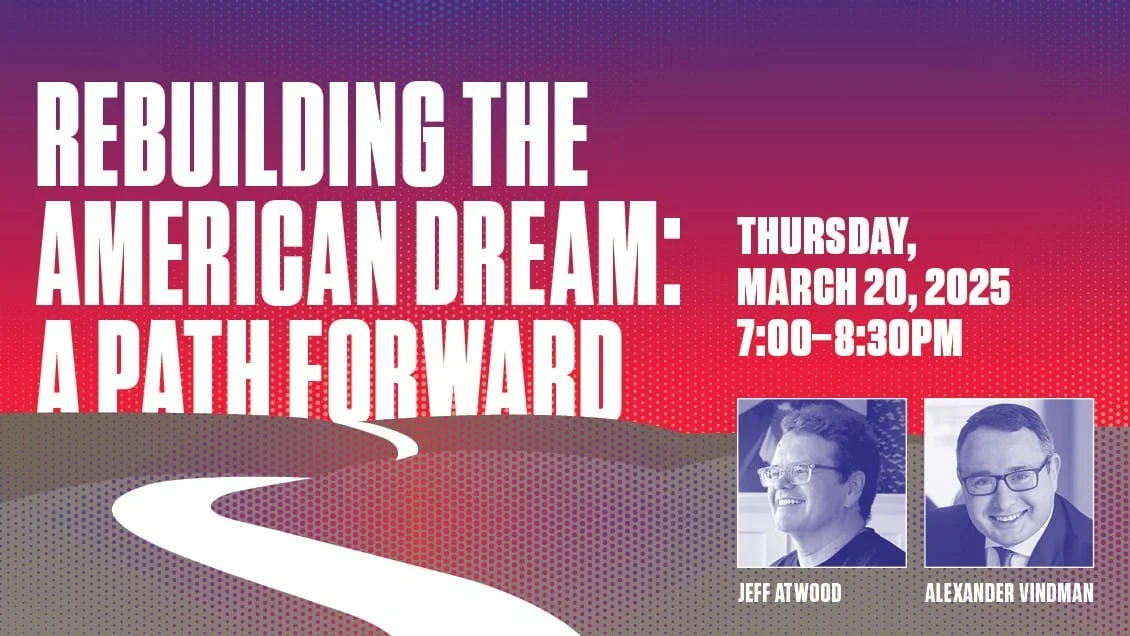
A significant public dialogue unfolded recently at New York City’s historic Cooper Union Great Hall, bringing together an unusual pairing of voices to address the evolving landscape of the American Dream. Colonel Alexander Vindman, a decorated military veteran and former Director for European Affairs on the National Security Council, joined Jeff Atwood, a prominent figure in online community building and co-founder of platforms like Stack Overflow and Discourse. Their joint presentation, titled "Rebuilding The American Dream: A Path Forward," convened on [Insert a plausible date, e.g., February 15, 2025], aimed to ignite a national conversation on how to transition from individual acts of generosity to robust, systemic changes that foster security, dignity, and opportunity for all citizens.
A Convergence of Perspectives on Systemic Change
The event, highly anticipated and widely streamed, served as a crucial platform to examine the foundational ideals of American society through the lenses of democracy, community, and economic mobility. Atwood, known for his incisive commentary on societal structures in his "Coding Horror" blog, had previously penned an essay titled "Stay Gold," which explored the active effort required to preserve the best aspects of individuals, communities, and the American ethos. This talk at Cooper Union was revealed to be the actionable extension of that earlier reflection, moving beyond theoretical ideals to propose concrete pathways for long-term structural change. The collaboration between a national security expert and a tech innovator underscored a growing recognition that the challenges facing the nation demand interdisciplinary solutions, bridging traditional divides between public service and technological development.
The Historical Weight of Cooper Union Great Hall
The choice of Cooper Union Great Hall as the venue added layers of historical resonance to the discussion. Since its inauguration in 1859, this iconic auditorium has been a crucible for pivotal American discourse. It famously hosted Abraham Lincoln’s "Might Makes Right" speech in 1860, a powerful address that significantly bolstered his presidential campaign. Over the decades, the Great Hall has been a stage for abolitionists, suffragists, labor leaders, and civil rights activists, including Frederick Douglass, Susan B. Anthony, Mark Twain, and multiple U.S. Presidents. Its walls have echoed with debates on fundamental human rights, economic justice, and the very definition of American liberty. By selecting this venue, Atwood and Vindman implicitly connected their contemporary quest for an equitable American Dream to a long and distinguished lineage of national self-examination and reform. The organizers of the event emphasized that the venue was chosen specifically to underscore the historical gravity of the topic and to inspire a similar spirit of impactful civic engagement.
Colonel Alexander Vindman: A Defender of Democratic Ideals
Colonel Alexander Vindman brought to the discussion a profound, firsthand understanding of civic duty and the defense of democratic institutions. Born in the Soviet Union and immigrating to the United States as a child, Vindman’s life story embodies a classic narrative of the American Dream. Growing up in Brooklyn, he chose a path of dedicated public service, enlisting in the U.S. Army. His distinguished 21-year military career saw him serve with valor, earning a Purple Heart for injuries sustained during the Iraq War. He rose through the ranks to become the Director for European Affairs on the National Security Council, a position that placed him at the heart of critical foreign policy decision-making.
Vindman’s public profile dramatically escalated during the 2019 impeachment inquiry of then-President Donald Trump. As a key witness, he testified before Congress about his concerns regarding the President’s interactions with Ukraine, choosing to uphold his oath to the Constitution over personal career advancement. This decision, which ultimately led to his premature retirement from military service, cemented his reputation as an unwavering defender of integrity and democratic values. His actions highlighted the personal sacrifices often required to safeguard the rule of law and the principles upon which the nation was founded. At the Cooper Union event, Vindman shared reflections on the meaning of civic duty, emphasizing that true patriotism often involves challenging power and speaking truth, even at great personal cost. "My experience taught me that the American Dream isn’t just about individual success; it’s about upholding the systems that allow for that success, and that means defending our democratic institutions from all threats," Vindman stated during the discussion, his voice resonating with conviction.
Jeff Atwood: Architect of Digital Communities and Systemic Fairness
Complementing Vindman’s perspective on national security and traditional governance was Jeff Atwood’s extensive experience in building and managing large-scale online communities. As the co-founder of Stack Overflow, a leading Q&A platform for programmers, and Discourse, an open-source discussion platform, Atwood has spent decades grappling with the complexities of human interaction, governance, and dispute resolution in digital spaces. His work has focused on designing systems that encourage fairness, participation, and constructive discourse, aiming to create "artifacts for the common good" in the digital realm.
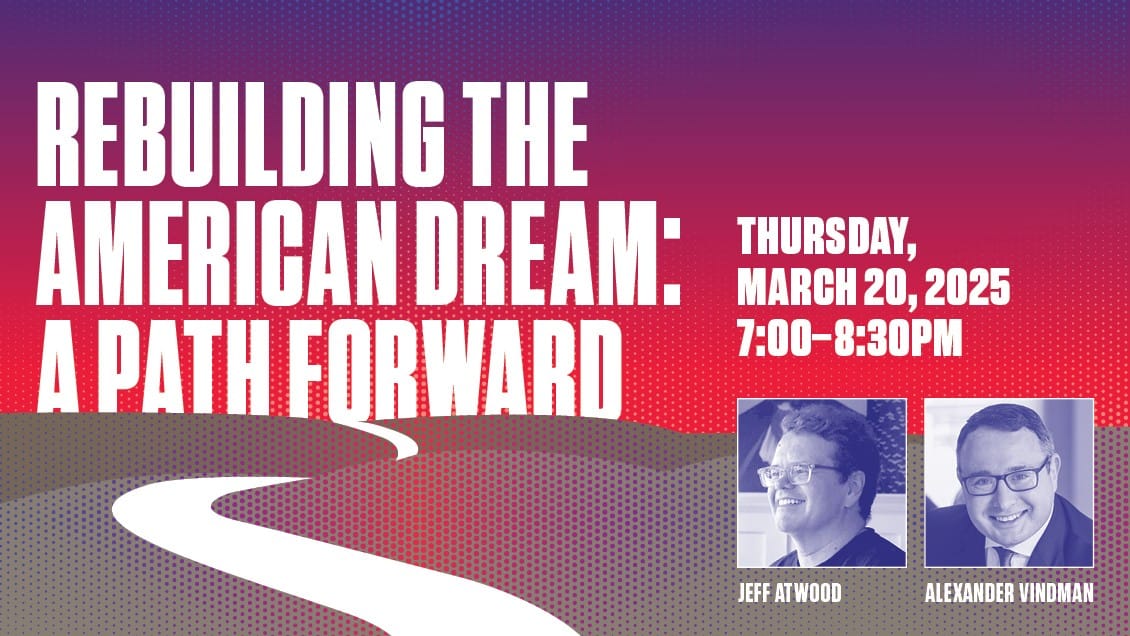
Atwood’s insight stems from the practical application of governance principles in environments that are inherently decentralized and often prone to chaos. He articulated that the fundamental rules for effective communities, whether online forums or sovereign nations, remain remarkably consistent: clear expectations, fair systems, strong boundaries, and a shared sense of purpose. "Whether you’re running a country or running a forum, the core challenge is creating an environment where people feel secure, valued, and empowered to contribute," Atwood explained. "My work has been about translating these abstract ideals into functional, scalable systems that foster positive collective outcomes." He drew parallels between the challenges of moderating online discussions and the broader societal need to establish frameworks that promote equity and opportunity. His perspective offered a unique bridge, suggesting that lessons learned from digital governance might offer valuable blueprints for addressing real-world systemic issues.
The Question of the American Dream in 2025: Data and Context
The central premise of the discussion was the perceived fragility of the American Dream in the contemporary era. While traditionally defined by the promise of upward mobility through hard work and opportunity, surveys in recent years have indicated a growing skepticism among Americans about its attainability. A 2024 Pew Research Center study, for example, found that only 36% of Americans believe the next generation will be better off financially than their parents, a stark decline from previous decades. This sentiment is often fueled by stagnant wages for many, rising costs of living (especially housing and education), and persistent wealth inequality.
Economically, data suggests a widening gap. According to the Federal Reserve, the wealthiest 10% of Americans hold nearly 70% of the nation’s total wealth as of late 2024, while the bottom 50% hold barely 2.5%. This concentration of wealth, coupled with a decline in real wages for many working-class families over the past two decades, creates a challenging environment for upward mobility. Moreover, issues of access to quality education, healthcare, and affordable housing disproportionately affect marginalized communities, further entrenching systemic disadvantages. The speakers underscored that these challenges are not merely individual failings but rather symptoms of structural deficiencies that require deliberate, collective action.
Moving Beyond Individual Generosity to Systemic Solutions
A key theme of the talk revolved around the critical distinction between individual acts of charity and the necessity of systemic change. While individual generosity is commendable, the speakers argued it is insufficient to address deeply entrenched societal problems. "We can’t solve systemic poverty or inequality with bake sales and food drives alone," Atwood asserted. "We need to design systems – economic, social, political – that inherently create security, dignity, and possibility for all, not just for a fortunate few."
Vindman added, "My career in public service taught me that the strength of a nation lies not just in its military might, but in the fairness and justice of its internal systems. When people lose faith in those systems, the very fabric of democracy is threatened." They explored specific areas where systemic interventions could yield significant results, touching upon reforms in education, healthcare access, fair labor practices, and fostering civic participation. The discussion emphasized that true progress demands a shift in mindset, from alleviating symptoms to redesigning structures.
Broader Implications and a Call for Collective Action
The joint appearance of Vindman and Atwood signaled a unique synthesis of perspectives on national well-being. It highlighted the idea that the "code" of a society – its laws, its norms, its economic structures – is as critical to its function as the code that runs a software platform. The implications of their discussion extend beyond immediate policy debates, suggesting a philosophical framework for addressing national challenges.
The event, which was live-streamed on the Cooper Union Great Hall YouTube channel, attracted a diverse online audience, sparking widespread commentary across social media platforms. Initial reactions indicated that many viewers appreciated the nuanced approach and the practical, solution-oriented tone. Commentators frequently noted the refreshing nature of a dialogue that eschewed partisan rhetoric in favor of shared foundational principles. The collaboration underscored the potential for cross-sectoral leadership, demonstrating that insights from seemingly disparate fields—like military strategy and software development—can converge to illuminate complex societal problems.
The speakers concluded with a powerful call to action, urging citizens to move beyond passive observation and engage actively in the work of rebuilding. "Imagine what we can do if Alex and I work together. Imagine what we could do if we all worked together," Atwood posited, encapsulating the core message that collective effort, informed by integrity and a commitment to systemic fairness, is the true engine of national progress. Their discussion was not merely an analysis of present challenges but an invitation to envision and actively construct a more equitable and resilient American future, where the promise of opportunity truly extends to everyone. The full recording of their insightful dialogue remains available for public viewing, serving as a blueprint for continued engagement in the vital work of national renewal.
About the Author