The landscape of extended reality (XR) is undergoing a significant sensory expansion as hardware developers look beyond visual and auditory stimuli to achieve true immersion. Scentient, an emerging startup specializing in olfactory technology, recently showcased the latest iteration of its "Escents" device at the United XR Europe conference. This wearable scent emitter represents a growing trend in the industry to integrate the sense of smell—one of the most biologically ancient and emotionally resonant human senses—into virtual and augmented reality workflows.
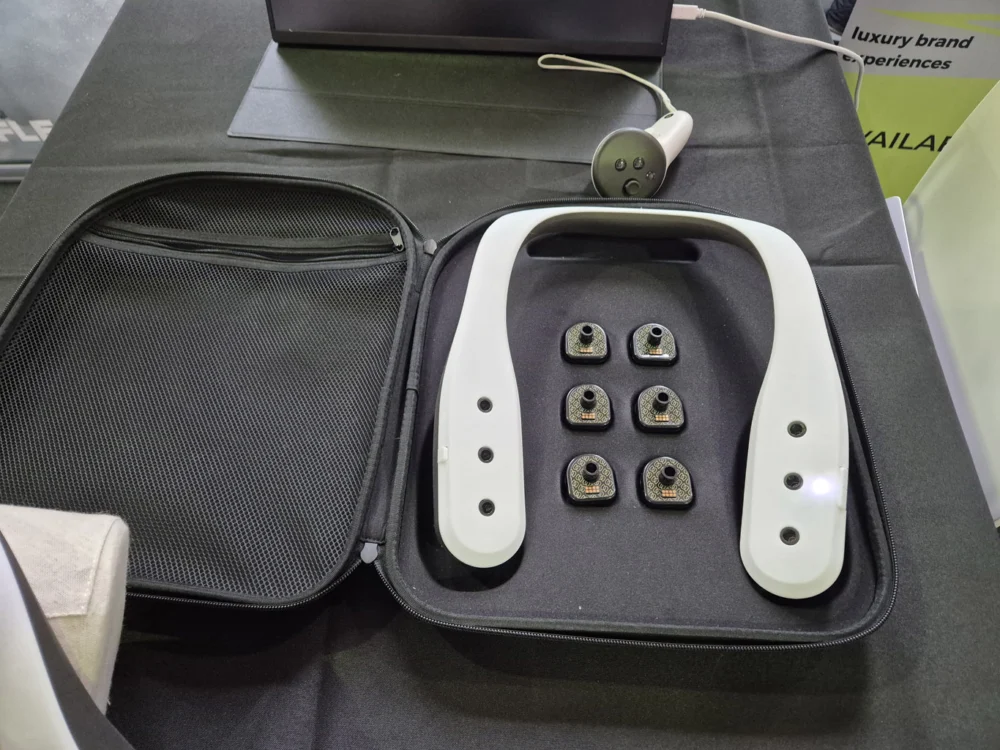
The Escents system is a neck-worn peripheral designed to connect wirelessly with leading standalone headsets, such as the Meta Quest and Pico series. By utilizing a cartridge-based delivery system, the device attempts to solve one of the most persistent challenges in XR: the digital emulation of odor. Unlike the visual spectrum, which can be recreated using a combination of red, green, and blue (RGB) light, olfaction lacks a universal primary set of components. Consequently, Scentient’s hardware utilizes a physical library of six pre-computed scent cartridges that are vaporized and directed toward the user’s nose via a controlled airflow mechanism.

Technical Architecture and Delivery Mechanism
The Escents hardware is characterized by its ergonomic collar design, a departure from previous industry attempts to mount scent emitters directly onto the face or the VR headset itself. The device features six distinct slots, each housing a cartridge containing a specific fragrance. When a trigger is activated within the VR software—via Scentient’s software development kit (SDK)—the corresponding cartridge vaporizes a small amount of scented fluid. A localized "breeze" then transports the particles toward the user’s olfactory receptors.
During the most recent demonstrations at United XR Europe, the company presented a curated library of six fragrances: jasmine, chocolate, green fig, pine, burnt wood, and petrol. This selection highlights the device’s potential applications across various sectors. For instance, "burnt wood" and "petrol" are highly relevant for industrial training and first-responder simulations, while "jasmine" and "chocolate" cater to consumer-facing marketing and therapeutic relaxation experiences.
The decision to utilize a neck-worn form factor addresses several ergonomic concerns. Traditional headset-mounted peripherals often increase the "front-heavy" nature of VR gear, leading to neck strain and reduced user comfort over extended periods. By shifting the weight to the shoulders, Scentient allows for larger cartridges and a more robust battery life without compromising the user’s center of gravity. However, this design introduces a mechanical challenge: the increased distance between the emitter and the nose requires a more forceful air-delivery system to ensure the scent reaches the user with minimal latency.

Evolution of Olfactory Hardware: A Chronology
The development of Escents has followed a rapid iterative cycle over the last eighteen months. The device first gained international attention at AWE EU 2024, where a prototype version was showcased. At that stage, the hardware was largely experimental, with a more industrial, less refined aesthetic and issues regarding scent persistence—a phenomenon known as "olfactory saturation."
In early 2024, initial testing indicated that scents often lingered in the air or on the user’s clothing long after the virtual trigger had ended. This created a "muddied" sensory experience where different odors would blend together, breaking the illusion of reality. By the time of the United XR Europe event, Scentient had significantly improved the precision of its emission cycles. The current model demonstrates a sophisticated ability to switch between scents rapidly—such as moving from the sweet aroma of chocolate to the sharp, pungent scent of pine—without significant overlap.
The hardware has also transitioned from a 3D-printed prototype appearance to a retail-ready product, now featuring a refined chassis and a dedicated carrying case for professional transport. According to company representatives, the focus has shifted from basic proof-of-concept to ensuring the reliability and repeatability required for enterprise and healthcare deployments.

Market Context and Supporting Data
The integration of olfaction into XR is backed by significant neurological research. Studies suggest that the olfactory bulb is directly connected to the amygdala and hippocampus, the brain regions responsible for emotion and memory. This connection allows scents to trigger "presence" more effectively than sight or sound alone. According to market analysis by various XR research firms, the multisensory VR market—including haptics and olfaction—is expected to grow as enterprise clients seek higher-fidelity training simulations.
Scentient enters a competitive field that includes other specialized firms such as OVR Technology and various experimental projects from academic institutions. The challenge for all players in this space remains the "chemical" nature of synthetic scents. While Escents provides a high degree of recognizability for its fragrances, the current state of scent synthesis often results in aromas that feel "chemically produced" rather than fully organic. Despite this, the increase in immersion reported by users in controlled demos suggests that even "symbolic" scents are sufficient to heighten the brain’s acceptance of a virtual environment.
Applications in Healthcare, Training, and Marketing
The implications for the Escents device extend far beyond gaming. In the healthcare sector, olfactory VR is being explored as a tool for treating Post-Traumatic Stress Disorder (PTSD) through exposure therapy. By recreating the specific smells associated with a traumatic event in a controlled, safe environment, clinicians can help patients process memories more effectively.

In industrial and safety training, the ability to simulate the smell of smoke or gas leaks can be life-saving. Trainees who have been "primed" to recognize the scent of a hazard in a virtual simulation are statistically more likely to react quickly when encountering the same stimulus in the real world. Scentient’s inclusion of "petrol" and "burnt wood" in their standard demo kit suggests a clear intent to capture this professional training market.
Furthermore, the marketing industry sees potential in "sensory branding." Luxury brands and food retailers can utilize the Escents device in pop-up installations to provide customers with a multisensory preview of products, creating a more memorable brand interaction than a standard visual advertisement.
Official Pricing and Availability
Scentient has officially opened pre-orders for the Escents device through its corporate website. The unit is priced at £999, positioning it as a professional-grade tool rather than a mass-market consumer peripheral. Each purchase includes the primary wearable device and the initial set of six scent cartridges.

The company has indicated that the first batch of retail units is expected to begin shipping in the first quarter of 2026. This timeline suggests a final phase of software optimization and manufacturing scaling. As the device moves toward its commercial launch, Scentient’s primary goal will be the expansion of its "fragrance library," allowing developers to order custom scents tailored to specific simulation requirements.
Broader Implications for the XR Industry
The maturation of Scentient’s Escents platform signals a pivotal moment for the XR industry. As visual fidelity reaches a point of diminishing returns with 4K-per-eye resolutions and advanced pancake optics, hardware manufacturers are looking for new ways to differentiate their offerings. Multisensory integration is the next logical frontier.
While the £999 price point and the logistical requirement of replaceable cartridges may limit Escents to enterprise and high-end enthusiast use cases in the short term, the technology serves as a blueprint for future consumer integrations. The successful reduction of olfactory saturation and the improvement in ergonomic comfort are critical milestones that bring the industry closer to a truly "holistic" virtual reality experience. As Scentient prepares for its 2026 rollout, the XR community will be watching closely to see if the addition of smell can finally bridge the "uncanny valley" of sensory immersion.
About the Author