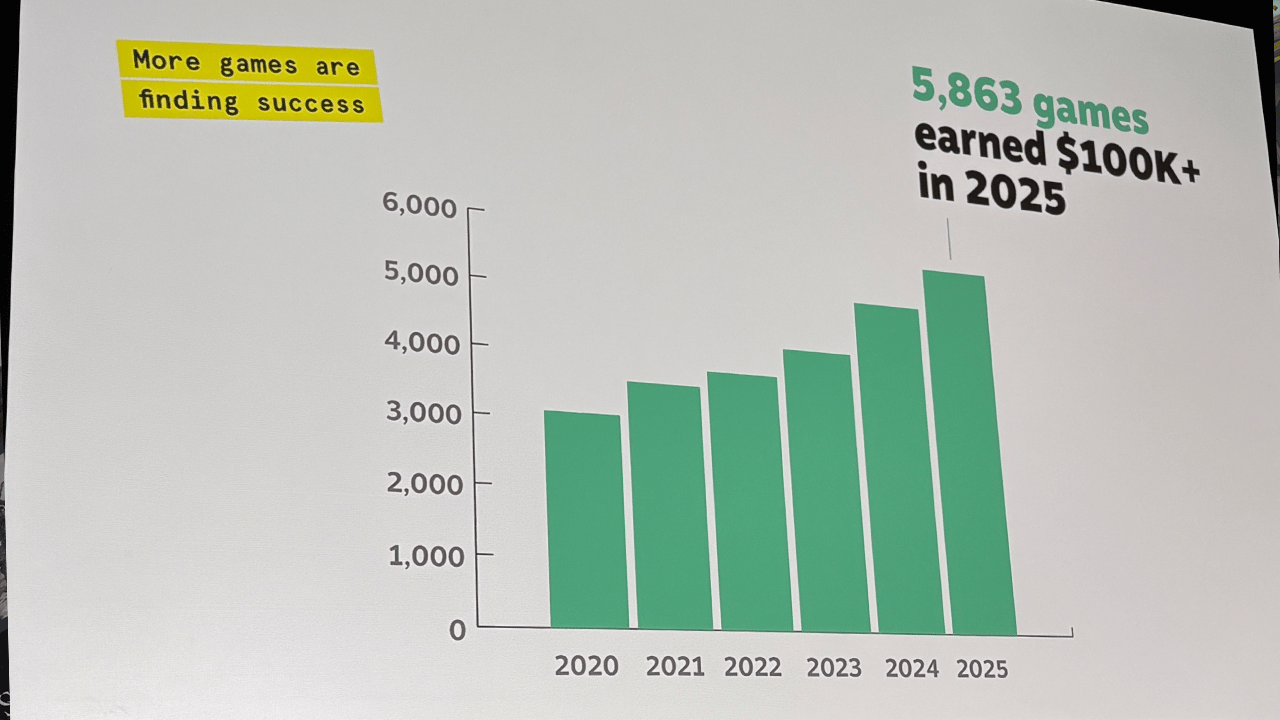
Valve, the proprietor of the world’s leading PC gaming platform, Steam, has unveiled a suite of impressive performance metrics for 2025, indicating robust health and sustained growth across its ecosystem. During a comprehensive presentation at the GDC Festival of Gaming, the company announced that a significant 5,863 games released on Steam collectively earned over $100,000 in the past year. This figure represents a near doubling of successful titles compared to 2020, when approximately 3,000 games reached the same revenue threshold, underscoring a period of accelerated expansion for the digital storefront.
The revelations, shared by Tom Giardino of the Steam Business team and Kaci Aitchison Boyle, Valve’s communications head, paint a picture of a thriving platform that continues to be a primary revenue stream for thousands of developers. Giardino emphasized that while $100,000 in earnings could signify triumphant success for a small indie team or a challenging outcome for a larger studio, the overarching trend indicates a substantial increase in the number of games achieving meaningful commercial viability on the platform. This growth isn’t confined to the $100,000 mark; Giardino confirmed that similar upward trends are observed at higher revenue brackets, including titles surpassing $500,000 and even $1 million annually.
A Booming User Base Fuels Developer Success
Central to Steam’s impressive financial performance is its continuously expanding user base. Just weeks prior to the GDC announcement, Steam hit an unprecedented peak of 42 million concurrent users. Giardino clarified that this figure represents the number of individuals with the Steam client running, acknowledging that not all users are actively gaming or shopping at any given moment. However, to provide a more direct measure of engagement, he revealed that in-game concurrent users also reached a new record of 13.9 million. These user statistics are particularly striking when viewed chronologically: both peak concurrent users and in-game concurrent users have more than doubled over the last five years since 2020, demonstrating an exponential increase in player engagement.
This parallel growth between user numbers and the quantity of successful games is a critical indicator of Steam’s healthy ecosystem. Giardino highlighted that the number of games finding success is generally keeping pace with the platform’s user growth, suggesting that the expanding audience is translating into broader opportunities for developers. For an industry often characterized by intense competition and discoverability challenges, a growing player pool provides a crucial foundation for more titles to find their niche and generate revenue.
Valve’s Distinctive Philosophy: Prioritizing Users and Developers
In an industry frequently driven by quarterly earnings reports and investor expectations, Valve’s unique corporate structure and philosophy stand out. Giardino articulated that unlike many publicly traded companies, Valve operates as a private entity, free from the pressures of external investors, stock prices, or "impossible expectations around infinite growth." This independence, he argued, allows the company to focus on long-term sustainability and make decisions that genuinely benefit players and developers, rather than being swayed by short-term financial incentives.
"A lot of companies are structured in a way where the numbers and the growth – and number go up – is kind of the driving force," Giardino explained. "That structure of problem solving creates a lot of short-term thinking and a lot of short-term incentives and sometimes incentivizes decisions that aren’t necessarily great for players or for long-term sustainability of a platform. Valve is pretty different. We’re a relatively small company in terms of headcount. We are private. We don’t have investors. We don’t have a stock price, and we don’t have impossible expectations around infinite growth."
This developer-centric ethos, Giardino stressed, is what guides Valve’s continuous efforts to "make the opportunity bigger on Steam." While acknowledging valid concerns about platform saturation, the company’s strategy is to foster an environment where a diverse range of games can thrive, rather than solely focusing on a handful of blockbusters.
Revolutionizing Daily Deals: A Blueprint for Inclusive Growth
A prime example of Valve’s commitment to developer success is the recent overhaul of its Daily Deals system. Recognizing the potential for these promotional slots to drive significant sales, Valve tweaked the system by "leaning really hard into personalization" and dramatically increasing the volume of available deals. The most impactful change involved providing developers with direct access to Steam’s internal calendar, allowing them to claim open Daily Deal slots that best align with their promotional strategies and game updates.
The results of these adjustments have been nothing short of transformative. In 2025, Steam Daily Deals featured over 1,500 individual titles, a substantial increase that broadened the exposure for a wider array of games. Crucially, 69 percent of these featured video games had never been part of a Daily Deal before, providing invaluable visibility to emerging or less-prominent titles. On the consumer side, 8.2 million customers purchased a Daily Deal in 2025, representing a remarkable 125 percent increase year-on-year.
The financial impact for developers was even more pronounced. Giardino proudly announced that developer revenue from Daily Deal spots surged by an astonishing 274 percent year-over-year. This growth substantially outpaced both Valve’s own revenue growth and the overall user growth on the platform, demonstrating the direct and tangible benefits of the revamped system. "This is what we mean by making the pie bigger," Giardino remarked, emphasizing how the investment in this new system allowed "a lot more devs making a lot more money from Daily Deals." This initiative showcases Valve’s strategic approach to not just grow the platform, but to distribute that growth more equitably among its vast developer community.
Contextualizing Steam’s Dominance in the PC Gaming Landscape
Steam’s journey from a proprietary digital distribution platform for Valve’s own titles in the early 2000s to its current status as the undisputed leader in PC digital storefronts has been marked by continuous innovation and adaptation. Its vast library, robust community features, and developer tools have cemented its position. The data presented at GDC further solidifies this dominance, showcasing not just a large market share but an expanding, dynamic ecosystem.
The growth in successful titles comes amidst an increasingly competitive PC gaming market, with storefronts like Epic Games Store and GOG vying for developer and player attention. However, Steam’s deep integration into the PC gaming experience, from its social features to its powerful backend services, continues to give it a significant edge. The company’s ability to consistently double its user base and the number of commercially viable games within a five-year span, despite increased competition and a global economic slowdown in parts of the world, speaks volumes about its enduring appeal and strategic effectiveness.
For independent developers, these figures offer a mixed but generally optimistic outlook. While the platform’s growth means a larger potential audience, the sheer volume of new releases—tens of thousands annually—still poses significant discoverability challenges. The fact that nearly 6,000 games are crossing the $100,000 threshold suggests that strategic marketing, engaging game design, and leveraging features like the new Daily Deals system are more critical than ever. The success of the Daily Deals initiative, in particular, provides a clear pathway for smaller studios to gain visibility and generate revenue, offering a counter-narrative to the perception that only established titles or those with massive marketing budgets can succeed.
Implications for the Future of PC Game Development
The insights from Valve at GDC offer several key implications for the future of PC game development. Firstly, the emphasis on personalization and direct developer access to promotional tools suggests a continued evolution towards a more data-driven and developer-empowered ecosystem. As Valve continues to refine its algorithms and promotional mechanisms, developers who understand and utilize these tools effectively will likely see greater returns.
Secondly, Valve’s steadfast commitment to its unique private structure signals a long-term vision that prioritizes platform health over short-term financial gains. This approach could foster greater trust within the developer community, as decisions are less likely to be influenced by immediate market pressures. Such stability is invaluable for developers planning multi-year projects.
Finally, the substantial growth in both users and successful games reiterates the robust health of the PC gaming market itself. Despite predictions of market saturation or shifts towards mobile and console gaming, the PC platform, spearheaded by Steam, continues to expand its audience and economic opportunities. This sustained growth provides a fertile ground for innovation and diverse game experiences, ensuring that PC gaming remains a vibrant and lucrative sector for developers worldwide.
The GDC Festival of Gaming served as a crucial platform for Valve to reaffirm its position not just as a technology provider but as a key partner in the success of countless game developers. The 2025 metrics, particularly the dramatic increase in games surpassing significant revenue milestones and the overwhelming success of the revamped Daily Deals, underscore Valve’s ongoing commitment to fostering a thriving and inclusive ecosystem for game creators and players alike. As the digital landscape continues to evolve, Steam’s strategic focus on user growth and developer empowerment appears to be a winning formula for sustained success.
About the Author