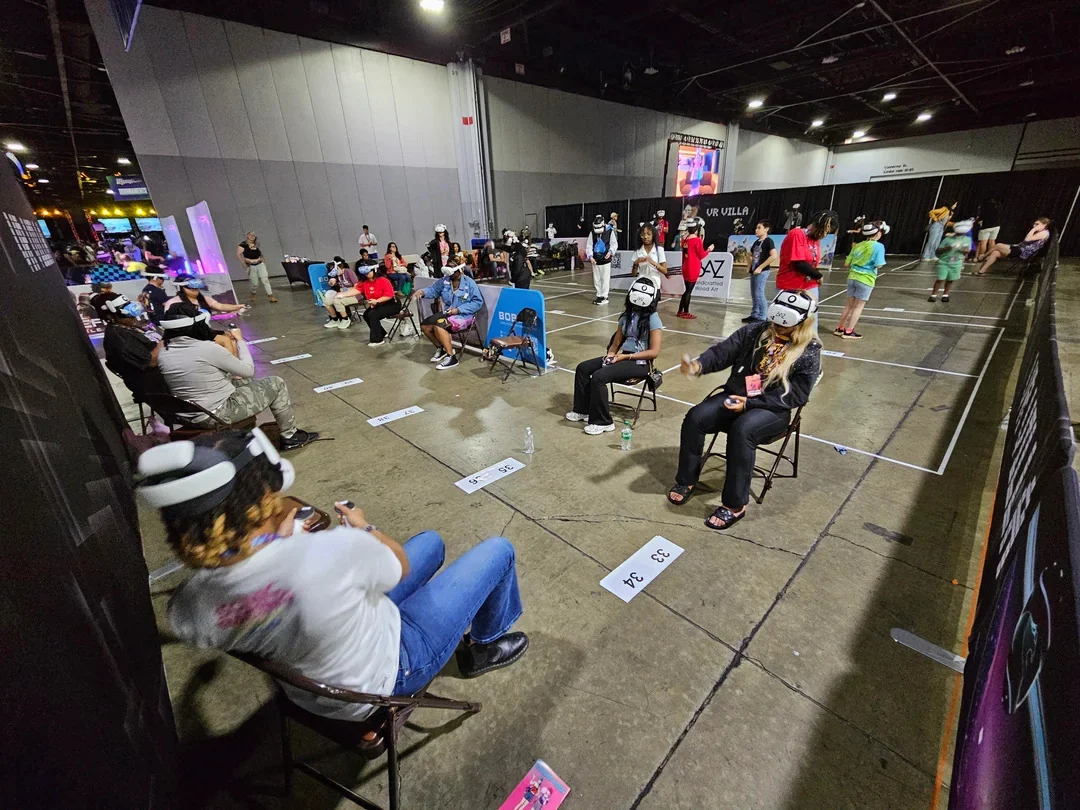
The landscape of virtual reality (VR) adoption is undergoing a significant shift, driven not only by multi-billion-dollar corporate marketing budgets but by independent, grassroots initiatives that prioritize hands-on experience over traditional advertising. At the forefront of this movement is Jeff Basladynski, known within digital communities as “Bazitron,” the founder of VR Villa. While his primary professional endeavor involves the manufacture of high-end, exotic wooden chopsticks through his company, Baz LLC, Basladynski has spent the last eight years building what has become one of the most prolific independent VR advocacy programs in the United States. By organizing massive, free-to-play VR "LAN parties" at major conventions, Basladynski has bridged the gap between curious consumers and a technology that many still find inaccessible.

The Genesis and Growth of VR Villa
The trajectory of VR Villa began in 2016, a pivotal year for the industry marked by the release of the original HTC Vive and Oculus Rift. Basladynski, a lifelong gamer, recognized early on that the primary barrier to VR adoption was the "seeing is believing" hurdle. He began integrating VR demonstrations into his existing business travel. As he traveled across the country to sell custom woodcraft at comic-cons and anime festivals, he brought along a small number of headsets to share his hobby with fellow attendees after exhibit halls closed.
What began as an informal gathering of enthusiasts evolved into a sophisticated logistical operation. Over the ensuing eight years, the initiative transformed into "VR Villa," a community-centric group that functions similarly to a traditional computer club but focuses exclusively on immersive technology. The organization has since expanded its reach, operating at major events from Hawaii to Washington, D.C., and collaborating with over 68 different software studios, including industry leaders such as Resolution Games, Schell Games, and Mighty Coconut.

Operational Logistics and the "Chopstick" Business Model
The sustainability of VR Villa is inextricably linked to Basladynski’s primary business, Baz LLC. By utilizing the logistical infrastructure of his retail operation, Basladynski is able to transport massive amounts of VR hardware to events with significantly lower overhead than a dedicated tech firm. During major activations, the team has been known to transport upwards of 200 pounds of equipment as checked luggage or ship multiple pallets of hardware, including projectors, AV equipment, and dozens of headsets, to cover floor spaces exceeding 5,000 square feet.
This "piggyback" model allows VR Villa to operate at conventions where corporate presence is often lacking. Basladynski frequently serves as the de facto director of VR content for these shows, negotiating for cost coverage, hotel accommodations, and staffing support rather than paying for traditional exhibitor space. This unique positioning allows the group to remain objective; because they are not direct sales representatives for hardware manufacturers, the public perceives their recommendations as genuine peer-to-peer advice rather than a high-pressure sales pitch.

Data-Driven Insights into VR Adoption
In the last four years, VR Villa has transitioned into a data-heavy operation, meticulously tracking player metrics to better understand the hurdles facing the industry. The statistics gathered from these events offer a rare glimpse into real-world consumer behavior:
- User Volume: The organization has served over 80,000 unique players in the last four years alone. In a single calendar year, the group facilitates approximately 25,000 to 30,000 individual sessions.
- Engagement Duration: The average playtime per session has seen a steady increase. In 2022, sessions averaged 22 minutes. By the end of 2023, that number rose to 32 minutes, with some users engaging in deep-play sessions of titles like Demeo for up to four and a half hours.
- First-Time Users: Despite the technology being on the market for nearly a decade, roughly 30% of VR Villa’s participants are experiencing VR for the very first time.
- Conversion Potential: Internal surveys conducted by the group suggest that 57% of participants reported a positive shift in their perspective toward purchasing a headset after a 20-minute session. Furthermore, 17% of respondents indicated they would have purchased a headset immediately on-site if the option were available, highlighting a missed retail opportunity at major gaming events.
Software Preferences and Demographic Trends
The data collected by VR Villa challenges several industry assumptions regarding who is using VR and what they want to play. While there is a prevailing narrative that VR is becoming a platform primarily for children, Basladynski’s demographics tell a more nuanced story. Approximately 30% of his users are aged 10 to 18, but a significant 26% falls into the "young professional" category (ages 19 to 26), with the remainder comprised of older adults and seniors.

The most successful software at these events focuses on social and collaborative experiences rather than high-fidelity graphics. Cook-Out: A Sandwich Tale by Resolution Games has remained the most played title for five consecutive years, accounting for approximately one in four sessions. Other high-performing titles include Fruit Ninja VR, Space Pirate Trainer, Blaston, and Walkabout Mini Golf. Conversely, narrative-heavy role-playing games and complex simulators often struggle in the loud, high-energy environment of a convention floor, suggesting that "pick-up-and-play" mechanics are vital for public-facing demonstrations.
Analysis of Current Industry Shortfalls
Basladynski’s experience provides a critical perspective on why traditional retail demonstrations, such as those historically held at Best Buy or Target, have often failed to drive mass adoption. He identifies three primary failures in corporate VR marketing:

- Lack of Expertise: Retail staff often lack the specialized training required to troubleshoot fitment issues or explain game mechanics, leading to uncomfortable or confusing first impressions.
- Poor Environment: Demonstration units in retail aisles do not allow for the physical movement or social interaction that defines the VR experience.
- The "Google Cardboard" Legacy: A significant portion of the public still equates VR with the low-quality mobile phone shells of the early 2010s. Overcoming this "tech debt" requires high-quality, guided experiences that current retail models are not equipped to provide.
Furthermore, Basladynski notes that the industry’s focus on hardware specifications—such as chipset power or resolution—often misses the mark with the general public. Consumers are primarily interested in comfort, ease of use, and the ability to play with friends. VR Villa addresses this by utilizing third-party accessories, such as KIWI Design or BOBOVR head straps and facial interfaces, which provide the level of comfort necessary for extended play sessions that stock hardware often lacks.
Implications for the Future of the VR Market
As the VR industry moves into a new phase with the release of hardware like the Meta Quest 3S, the lessons learned by VR Villa suggest that sustainability may be more important than hyper-growth. Basladynski argues that the industry’s previous projections of hitting a billion users within a decade were unrealistic given the current technological and social barriers. Instead, he advocates for a model of "sustainability pathways," where developers and manufacturers focus on direct engagement with target demographics at the locations where they already congregate.

The success of VR Villa demonstrates that there is a profound, untapped hunger for immersive technology when it is presented in a social, low-pressure, and expertly guided environment. By focusing on the "village" aspect of the community—training volunteers to become advocates and ensuring that every user has a successful first session—independent operators are currently doing the heavy lifting of market expansion that major corporations have struggled to achieve through traditional channels. For the VR industry to reach its next plateau, it may need to look away from the digital storefront and back toward the high-touch, community-driven "LAN party" roots that Basladynski and his team have successfully revitalized.
About the Author