The landscape of digital content creation is undergoing a profound transformation, driven by the rapid advancements and widespread adoption of Artificial Intelligence (AI). As businesses and individuals grapple with the ever-increasing demand for engaging, relevant, and high-quality content, AI-powered content generators have emerged as indispensable tools. These sophisticated platforms leverage natural language processing (NLP) and machine learning algorithms to assist in the creation of a wide array of written materials, from blog posts and marketing copy to social media updates and even lengthy articles. This article delves into the burgeoning world of AI content generators, exploring their capabilities, the leading platforms available in 2022, and the significant implications for content creators across various industries.
The growing reliance on AI for content generation is not merely a trend but a response to several critical market pressures. The digital sphere has become saturated, making it increasingly challenging for businesses to capture and retain audience attention. Producing a consistent stream of fresh, optimized content requires significant time, resources, and expertise. Traditional content creation methods, while still valuable, often struggle to keep pace with the volume and speed demanded by modern digital strategies. AI content generators offer a compelling solution, promising efficiency, scalability, and cost-effectiveness, without necessarily sacrificing quality.
The underlying technology of these AI content generators is rooted in large language models (LLMs), such as those developed by OpenAI and other research institutions. These models are trained on vast datasets of text and code, enabling them to understand and generate human-like text. By fine-tuning these models for specific tasks, developers have created specialized tools capable of producing various content formats tailored to different needs. The ability of AI to analyze trends, identify keywords, and even mimic specific writing styles positions it as a powerful ally for content marketers, SEO specialists, bloggers, and business owners alike.
As of 2022, the market for AI content generators has matured, offering a diverse range of options to suit different budgets and requirements. While the initial adoption may have been met with skepticism, the proven efficacy of these tools has led to their integration into many content workflows. The following are ten prominent AI content generator tools that have garnered significant attention and are widely used by professionals:
- Jasper AI (Formerly Jarvis)
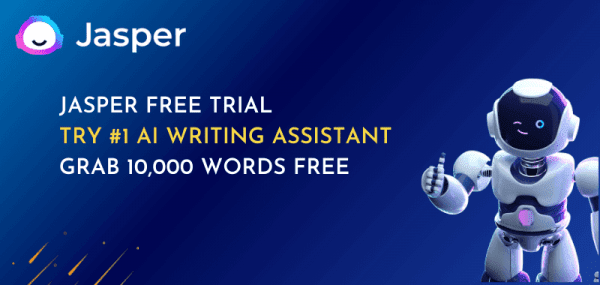
Jasper AI has established itself as a leading force in the AI content generation space. Originally known as Jarvis, the platform has undergone significant development, offering a comprehensive suite of tools designed to streamline the content creation process. Jasper excels at identifying optimal word choices and sentence structures, making it highly efficient and accessible for various writing needs.

Key Features:
- Content Ideation: Generates blog post ideas, outlines, and topic suggestions.
- Copywriting Formulas: Incorporates frameworks like AIDA (Attention, Interest, Desire, Action) and PAS (Problem, Agitate, Solve) for marketing copy.
- Long-Form Content Assistant: Assists in writing blog posts, articles, and even book chapters.
- Plagiarism Checker: Integrates tools to ensure originality of generated content.
- Tone Adjustment: Allows users to specify the desired tone of voice for the content.
Pros:
- User-friendly interface.
- Versatile for various content types.
- Strong community support and educational resources.
- Offers a significant free trial with substantial credits.
Cons:
- Can be more expensive compared to some competitors.
- Occasional need for human editing to refine nuances.
Pricing:
Jasper AI offers several pricing tiers, with its popular "Boss Mode" starting at $99 per month. This tier provides advanced features for longer-form content creation. The platform also frequently offers promotional deals, such as 10,000 free credits for new users signing up through specific affiliate links.
- Copy Ai
Copy.ai is another highly regarded AI content writing tool that empowers users to generate a wide spectrum of marketing copy and creative content. With over 90 templates, it caters to diverse needs, including social media posts, Facebook ads, product descriptions, website copy, and blog post outlines.
Key Features:
- Extensive Template Library: Offers pre-built templates for various marketing and content needs.
- Content Rewriting and Improvement: Assists in rephrasing existing content for better clarity and engagement.
- Brand Voice Customization: Allows users to define and maintain a consistent brand voice.
- Multi-language Support: Generates content in multiple languages.
Pros:
- Intuitive and easy to navigate.
- Excellent for short-form marketing copy.
- Generous free trial offering.
- Competitive pricing for its features.
Cons:
- Long-form content generation might require more extensive editing.
- Limited customization options for highly specialized content.
Pricing:
Copy.ai provides a 7-day free trial with 2,000 words per month. The Pro Plan is priced at $49 per month, with an annual subscription costing $420 ($35 per month). Special offers often include 7,000 free words and significant discounts on paid plans for new users who upgrade within a limited timeframe.
- Frase AI
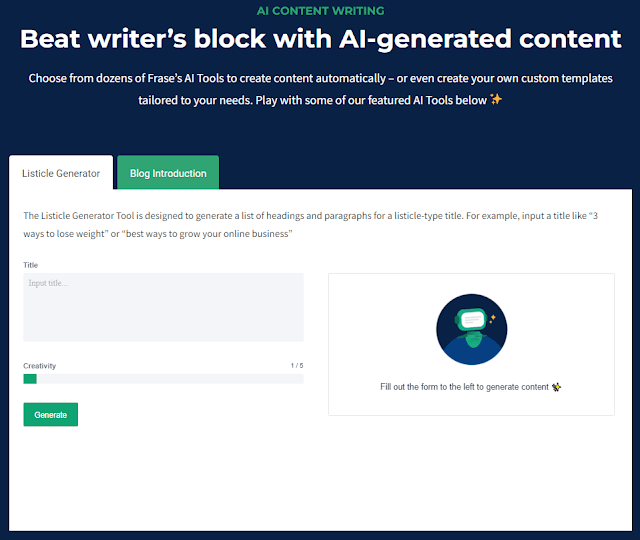
Frase AI positions itself as an all-in-one content optimization platform that integrates AI writing capabilities with SEO research. It assists users in researching, creating, and optimizing content to rank higher in search engine results. Frase focuses on data-driven content creation, analyzing top-performing content to inform its suggestions.
Key Features:
- Content Brief Generation: Automatically creates detailed content briefs based on top search results.
- SEO Optimization: Provides real-time suggestions for keywords, topics, and content structure to improve SEO.
- AI Writing Assistance: Generates content based on research and SEO insights.
- Content Research Tools: Aggregates relevant information from across the web.
Pros:

- Strong emphasis on SEO integration.
- Streamlines the entire content research and creation process.
- Provides actionable insights for content improvement.
Cons:
- The AI writing component might be less advanced than dedicated writing tools.
- Can have a steeper learning curve for beginners.
Pricing:
Frase offers several plans, including:
- Solo Plan: $14.99/month ($12/month billed yearly) for 4 document credits and 1 user seat.
- Basic Plan: $44.99/month ($39.99/month billed yearly) for 30 document credits and 1 user seat.
- Team Plan: $114.99/month ($99.99/month billed yearly) for unlimited document credits and 3 user seats.
Additionally, SEO add-ons are available for $35/month.
- Article Forge
Article Forge distinguishes itself by its ability to generate complete articles from a single keyword input. This approach streamlines the process for users who need to produce a high volume of content quickly. The tool guarantees that all generated content passes Copyscape, addressing concerns about originality.
Key Features:
- Keyword-Based Article Generation: Creates full articles with minimal user input.
- Content Automation: Capable of generating multiple articles simultaneously.
- Copyscape Verified: Ensures that all output is unique.
- Bulk Article Generation: Supports the creation of numerous articles in one go.
Pros:
- Exceptional speed for article generation.
- Cost-effective for bulk content needs.
- Strong guarantee of originality.
Cons:
- Content may require substantial editing for flow and nuance.
- Less control over the narrative and specific messaging.
Pricing:
Article Forge offers a 30-day money-back guarantee. While there is no free plan, it provides a free trial.
- Basic Plan: $27/month, allowing up to 25,000 words per month, suitable for smaller blogs or emerging content creators.
- Standard Plan: $57/month.
- Unlimited Plan: $117/month, offering unlimited word generation.
- Rytr
Rytr.me is an AI content writing assistant that offers a free plan, making it an attractive option for individuals and small businesses on a budget. It is designed for ease of use and can generate SEO-friendly blog posts, articles, and other forms of written content rapidly.
Key Features:
- Versatile Content Types: Generates various content formats, including emails, social media captions, and blog sections.
- Plagiarism Checker: Includes an integrated tool to verify content originality.
- Tone and Language Options: Offers a selection of tones and supports multiple languages.
- User-Friendly Interface: Simple and intuitive for quick content creation.
Pros:
- Generous free plan for basic needs.
- Affordable paid plans.
- Easy to use and quick to generate content.
Cons:
- Limited features on the free plan.
- Longer content pieces may require more editing.
Pricing:

- Free Plan: Offers 5,000 characters generated per month and access to the plagiarism checker.
- Saver Plan: $9/month ($90/year), allowing up to 50,000 characters per month.
- Unlimited Plan: $29/month ($290/year), providing unlimited character generation and all features.
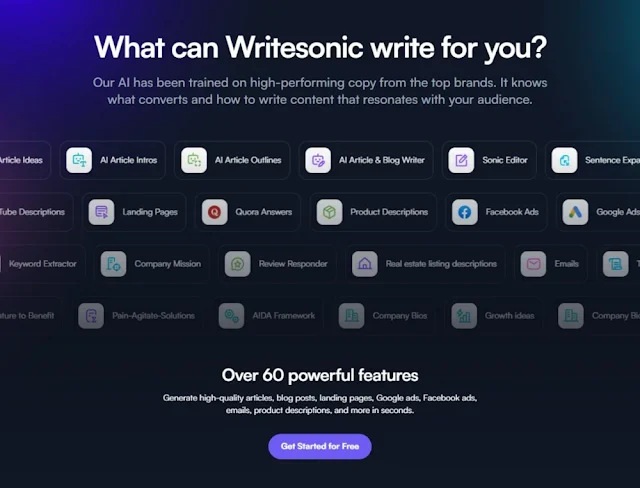
- Writesonic
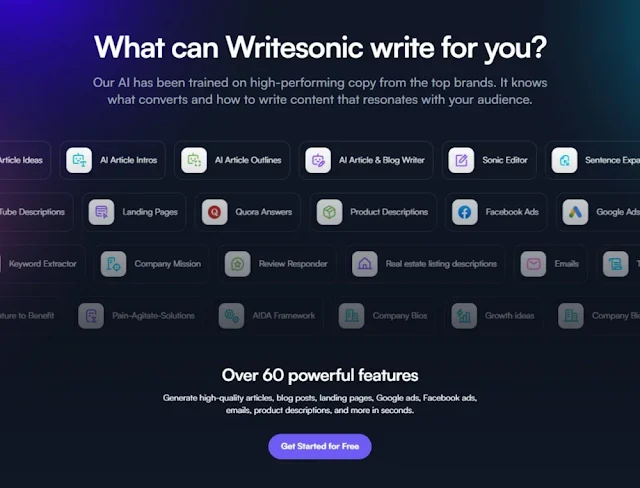
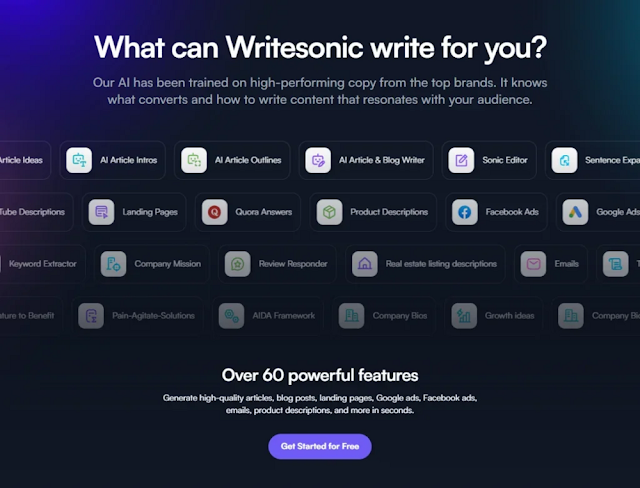
Writesonic is a user-friendly AI content generator praised for its ability to create marketing copy, website content, and blog posts efficiently. It is particularly beneficial for small businesses and solopreneurs seeking cost-effective content solutions. The platform also includes grammar and plagiarism checkers.
Key Features:
- Marketing Copy Generation: Creates ads, product descriptions, and social media content.
- Blog Post and Article Writing: Assists in generating entire blog posts or sections.
- Website Content Creation: Helps in writing landing page copy and other web content.
- Built-in Checkers: Includes grammar and plagiarism detection tools.
Pros:
- Free plan available with limited credits.
- High-quality output for various marketing needs.
- Easy to use and navigate.
Cons:
- Free plan is essentially a trial with limited credits.
- Advanced features are locked behind paid tiers.
Pricing:
Writesonic offers a free plan with 10 credits. Paid plans include:
- Short-form: $15/month, offering more credits for shorter content.
- Long-Form: $19/month, providing higher credit limits for longer articles and blog posts.
- Custom plans are available for enterprise needs.
- CopySmith
CopySmith is an AI content generator designed to produce high-quality content quickly for both personal and professional use. It offers a broad range of features, including the creation of documents, blogs, and presentations, with a library of templates to accelerate the process.

Key Features:
- Document and Presentation Creation: Generates various types of written content.
- Template Library: Provides pre-designed templates for quick start-ups.
- Bulk Content Generation: Supports the creation of multiple pieces of content simultaneously.
- Team Collaboration: Features designed for collaborative content creation.
Pros:
- Fast content generation.
- Good for a variety of content needs.
- Offers a free trial without requiring credit card details.
Cons:
- The AI output may sometimes lack a natural human touch.
- Pricing can be a barrier for very small budgets.
Pricing:
CopySmith provides a free trial. Paid plans include:
- Starter Plan: $19/month, offering a good starting point for individuals and small teams.
- Professional Plan: $59/month, with enhanced features and higher usage limits.
- Enterprise Plan: Custom pricing available upon contact with the sales team.
- Hypotenuse.ai
Hypotenuse.ai is an AI writing software particularly noted for its effectiveness in generating e-commerce product descriptions and marketing content. It offers a user-friendly interface that makes it accessible for beginners looking to leverage AI for content creation, including videos and infographics.
Key Features:
- E-commerce Focus: Specializes in creating compelling product descriptions.
- Content Generation Tools: Assists in writing articles, ad copy, and other marketing materials.
- Video Script Generation: Capable of generating scripts for video content.
- Ease of Use: Designed with a simple and intuitive interface.
Pros:
- Excellent for e-commerce businesses.
- User-friendly for beginners.
- Offers a free trial to test its capabilities.
Cons:
- No free plan available, only a trial.
- May not be as feature-rich for complex long-form content compared to some competitors.
Pricing:
Hypotenuse.ai offers a free trial. Paid plans include:
- Starter Plan: $29/month, suitable for individuals and small businesses.
- Growth Plan: $59/month, with increased usage limits and features.
- Enterprise Plan: Custom pricing for larger organizations.
- Kafkai
Kafkai is recognized as a leading AI writing tool for SEO professionals and marketers. It specializes in producing niche-specific content across a broad spectrum of topics, boasting a user-friendly interface and a high degree of personalization.
Key Features:
- Niche-Specific Content: Tailors content generation to specific industry niches.
- SEO Optimization: Designed to create content that ranks well in search engines.
- Personalization Options: Allows users to customize the AI’s output.
- User-Friendly Interface: Intuitive design for efficient content creation.
Pros:

- Strong focus on SEO and niche content.
- Offers various pricing tiers based on article volume.
- Free trial available to assess its suitability.
Cons:
- Content may require editing for factual accuracy and style.
- The core AI writing engine might not be as advanced as some competitors for creative writing.
Pricing:
Kafkai offers a free trial. Paid plans are structured around article volume:
- Writer Plan: $29/month, allowing up to 100 articles.
- Newsroom Plan: $49/month, for 250 articles.
- Printing Press Plan: $129/month, for up to 1000 articles.
- Industrial Printer Plan: $199/month, for 2500 articles.
- Peppertype.ai
Peppertype.ai is an online AI content generator designed for ease of use, making it an ideal tool for small business owners looking for a powerful way to craft and generate various types of content. Its capabilities extend to creating compelling copy for marketing purposes.
Key Features:
- Content Variety: Generates content for blogs, social media, ads, and more.
- User-Friendly Interface: Simple and intuitive for quick adoption.
- Small Business Focus: Tailored to meet the content needs of smaller enterprises.
- Marketing Copy Generation: Assists in creating persuasive marketing materials.
Pros:
- Easy to use and integrate into workflows.
- Cost-effective for small businesses.
- Good for generating diverse content types.
Cons:

- No free plan, only a free trial.
- May not offer the depth of features for advanced content strategists.
Pricing:
Peppertype.ai offers a free trial. Paid plans include:
- Personal Plan: $35/month, designed for individual users.
- Team Plan: $199/month, for collaborative teams.
- Enterprise Plan: Custom pricing is available upon request.
The implications of AI content generators extend far beyond simply speeding up writing tasks. They are fundamentally reshaping content strategy and marketing. For businesses, these tools offer the potential to:
- Increase Content Output: Maintain a consistent and high volume of content across multiple platforms without proportionally increasing human resources.
- Improve SEO Performance: Generate SEO-optimized content that can improve search engine rankings and drive organic traffic. Data from studies on AI-generated content often shows improvements in keyword density and readability scores, which are crucial for SEO.
- Reduce Costs: Significantly lower the cost of content creation compared to hiring freelance writers or maintaining a large in-house content team.
- Enhance Engagement: Create more targeted and personalized content by leveraging AI’s ability to analyze audience data and preferences.
- Boost Efficiency: Free up human content creators to focus on higher-level strategic tasks, such as content planning, editing, fact-checking, and creative ideation.
The integration of AI into content creation is not without its challenges and considerations. Concerns about the originality, accuracy, and ethical implications of AI-generated content remain. While tools like Article Forge and Writesonic emphasize plagiarism checks, human oversight is still crucial to ensure factual accuracy, ethical considerations, and to inject unique brand voice and personality that AI may not fully replicate. The legal landscape surrounding AI-generated content is also evolving, with questions about copyright and authorship being actively debated.
Furthermore, the effectiveness of AI content generators is highly dependent on the quality of input provided by the user. Crafting clear, specific prompts and providing relevant context are essential for eliciting the desired output. The notion that AI can entirely replace human creativity and critical thinking is a misconception; rather, these tools are best viewed as powerful assistants that augment human capabilities.
Looking ahead, the capabilities of AI content generators are expected to become even more sophisticated. Advancements in natural language understanding, emotional intelligence simulation, and context awareness will likely lead to AI systems that can produce even more nuanced, creative, and contextually appropriate content. The ongoing development in areas like multimodal AI, which can process and generate content across different formats (text, image, audio, video), promises to further revolutionize the content creation ecosystem.
In conclusion, AI content generators have moved from being experimental tools to essential components of modern content strategy. Platforms like Jasper AI, Copy.ai, Frase AI, and others listed provide powerful solutions for businesses and individuals seeking to navigate the demands of the digital age. While human oversight and creative input remain indispensable, these AI tools offer unprecedented efficiency, scalability, and cost-effectiveness, fundamentally transforming how content is conceived, created, and consumed. As AI technology continues to evolve, its role in content creation will undoubtedly expand, making it a critical area of focus for anyone involved in the digital communication space.
About the Author