
The integration of intelligent non-player characters (NPCs) and adversaries that dynamically track and pursue the player character has become a cornerstone feature in the design of many contemporary video games. This fundamental mechanic, crucial for creating immersive environments and challenging gameplay scenarios, is remarkably accessible for developers utilizing modern game engines such as Unreal Engine 5 (UE5). Through its powerful visual scripting system, Blueprints, UE5 enables the swift implementation of sophisticated AI behaviors with minimal coding, democratizing advanced game development techniques. This guide details the straightforward process of enabling AI characters to follow the player within Unreal Engine 5, building upon foundational AI navigation principles.
The Evolution of AI in Interactive Entertainment
The journey of artificial intelligence in video games has seen remarkable advancements, evolving from rudimentary, pre-scripted patterns to complex, reactive systems. Early game AI often relied on simple state machines and basic pathfinding algorithms, leading to predictable enemy behaviors. However, with the advent of more powerful hardware and sophisticated engine tools, AI capabilities have expanded dramatically. Modern engines like Unreal Engine 5 provide robust frameworks, such as the Navigation Mesh (NavMesh) system, which allows AI agents to intelligently traverse complex environments, avoiding obstacles and finding optimal paths. This underlying navigational intelligence is critical for enabling dynamic behaviors like player pursuit, ensuring that AI characters can not only identify their target but also physically reach them within the game world. The ability for AI to intelligently navigate is the bedrock upon which all subsequent movement logic is built, providing the spatial awareness necessary for compelling interactions.
Prerequisites for Intelligent Movement: The NavMesh Foundation

Before any AI character can effectively chase or follow a player, a properly configured Navigation Mesh (NavMesh) is indispensable. As detailed in the preceding guide, "Setting up a NavMesh in Unreal Engine 5," this critical component defines the walkable areas for AI agents within a level. Without a NavMesh, AI characters lack the necessary spatial data to calculate paths, resulting in erratic movement, getting stuck on geometry, or an inability to move at all. The NavMesh acts as a simplified, abstract representation of the environment, allowing pathfinding algorithms to efficiently determine routes from one point to another while respecting environmental constraints. Ensuring the NavMesh is accurately generated and covers all intended walkable surfaces is the first and most crucial step in enabling any intelligent AI locomotion, including dynamic player following.
Transitioning from Random Patrol to Targeted Pursuit
The foundation for AI movement often begins with simple patrolling or random wandering behaviors. In a typical setup, as demonstrated in previous iterations, an AI character might utilize a sequence of Blueprint nodes to move to a randomly determined reachable point within a defined radius. This initial configuration serves as an excellent starting point for understanding basic AI locomotion but requires modification to achieve persistent player pursuit.
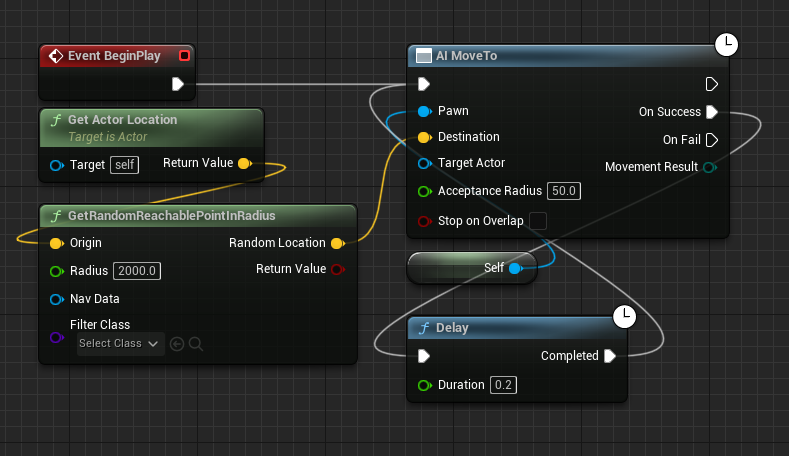
The initial Blueprint graph typically includes nodes such as AI MoveTo, which orchestrates the AI’s movement, Get Actor Location, which retrieves a reference point (often the AI’s own location), and GetRandomReachablePointInRadius, which calculates a random valid destination on the NavMesh around that reference point. These nodes collectively instruct the AI to wander within its vicinity, providing a baseline for movement.
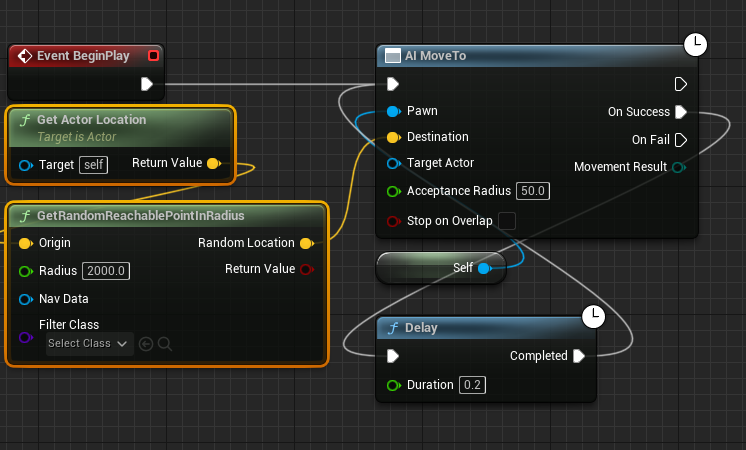
To shift this behavior from aimless wandering to targeted pursuit, the existing destination-finding logic must be updated. The nodes responsible for generating random points—specifically, Get Actor Location (if it was being used as the origin for random point generation) and GetRandomReachablePointInRadius—are no longer relevant for player following. Their purpose is to find an arbitrary location, whereas the objective for player following is a very specific, continuously updated target: the player’s current position. Therefore, these nodes are systematically removed from the Blueprint graph, clearing the way for the new targeting mechanism. This deletion streamlines the logic, ensuring that the AI’s focus can be redirected efficiently towards the player.
Establishing the Player as the Dynamic Target
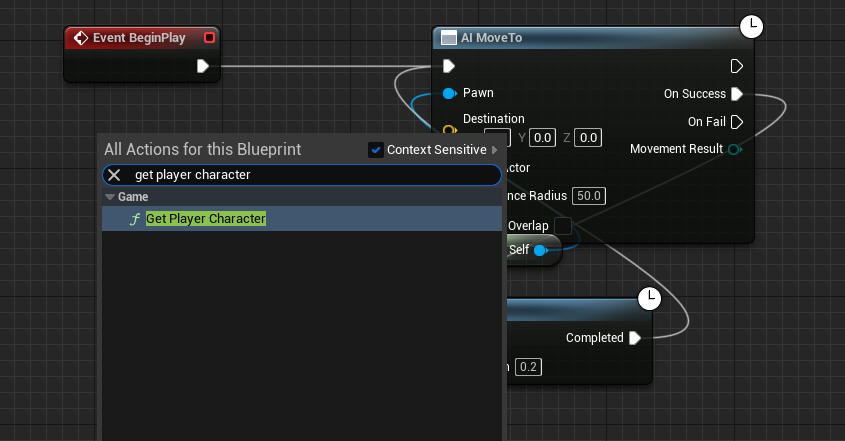
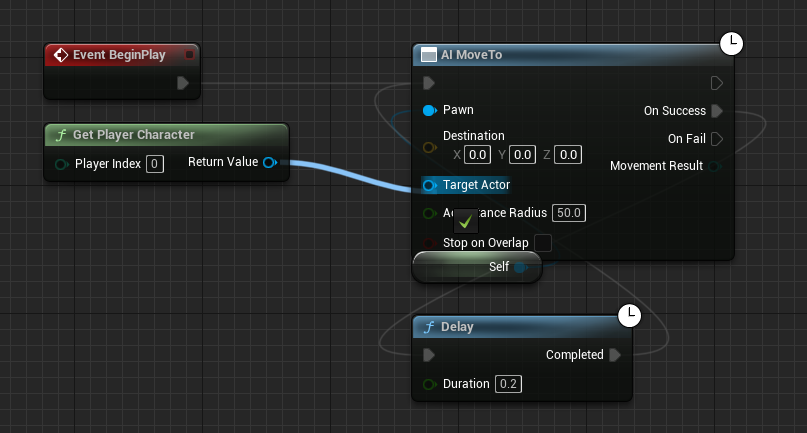
With the previous random targeting nodes removed, the next step involves dynamically identifying the player character as the AI’s new destination. This is achieved by introducing a Get Player Character node into the Blueprint graph. This node serves a crucial function: it returns a reference to the default player character currently controlled by the user. In multiplayer scenarios, this node typically targets the local player, or specific player controllers can be queried for a more generalized approach. For single-player experiences, it reliably points to the primary protagonist.
Once the Get Player Character node is added, its Return Value output pin, which represents the player character actor, is connected to the Target Actor input pin of the AI MoveTo node. This connection is the pivotal modification that transforms the AI’s behavior. Instead of receiving a static coordinate or a randomly generated point, the AI MoveTo node now continuously receives the current location of the player character through the Target Actor reference. This dynamic link ensures that as the player moves, the AI MoveTo command is implicitly updated to guide the AI towards the player’s evolving position, thereby initiating the pursuit behavior. This seemingly simple connection forms the core of the AI’s ability to track and follow.
Ensuring Persistent Pursuit: Handling Movement Failures
A robust AI following system must account for potential failures in movement. In dynamic game environments, AI characters might encounter situations where their intended path to the player becomes temporarily unreachable or invalid. This could occur if the player moves off the NavMesh, navigates into an area that the AI cannot physically access, or if the NavMesh itself is dynamically rebuilt or obstructed. If the AI MoveTo node fails to find a valid path or encounters an issue during execution, the AI could potentially cease movement altogether, breaking the immersion and functionality of the game.
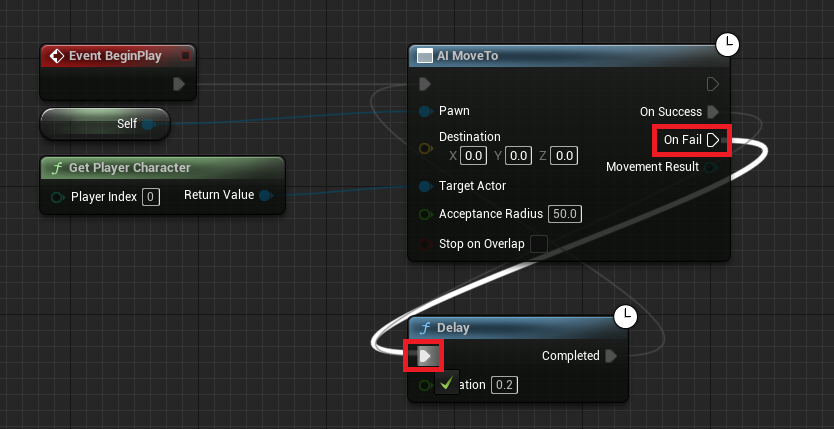
To mitigate this, a critical step involves connecting the On Fail execution pin of the AI MoveTo node to a Delay node, which then loops back to re-trigger the AI MoveTo command after a short interval. The On Fail pin fires whenever the AI fails to reach its target or cannot find a path. By linking it to a Delay node (e.g., with a duration of 0.5 to 1 second), the system introduces a brief pause before attempting the movement again. This prevents the AI from getting stuck in an infinite loop of immediate failed attempts and provides the game engine a moment to potentially recalculate the NavMesh or for the player to move into a reachable area. After the delay, the execution flow returns to the AI MoveTo node, prompting the AI to reassess the player’s current location and attempt to move towards it once more. This robust error-handling mechanism ensures that the AI remains persistently engaged in following the player, regardless of temporary navigational challenges, thereby maintaining continuous pursuit and enhancing gameplay reliability.
Finally, after all modifications have been made to the Blueprint graph, it is imperative to Compile and Save the Blueprint editor. This standard development practice ensures that all changes are processed by the engine and applied to the AI character when the game is played in the editor or packaged for distribution. Failure to compile and save will result in the new AI behaviors not being reflected in the game.
Implications and Diverse Use Cases in Game Design
The implementation of dynamic AI following, despite its apparent simplicity in Unreal Engine 5’s Blueprint system, unlocks a vast array of possibilities for game designers. This core mechanic forms the basis for numerous compelling gameplay elements across various genres:
- Antagonistic Pursuit: The most common application involves enemies or monsters relentlessly chasing the player, generating tension and threat. From the iconic Nemesis in Resident Evil to the terrifying Xenomorph in Alien: Isolation, persistent pursuers create high-stakes encounters and memorable gameplay moments. The AI’s speed, perception, and ability to navigate complex environments can be finely tuned to adjust the level of challenge, offering scalable difficulty that caters to different player skill levels.
- Supportive Companions: Beyond adversaries, this system is equally vital for friendly AI companions, pets, or escort targets. Characters like Dogmeat in Fallout or various party members in RPGs rely on robust following logic to stay with the player, offer assistance, and participate in narrative progression. This enhances immersion by making the game world feel more populated and interactive.
- Dynamic Environments and Narrative: AI following can drive non-combat scenarios, such as tour guides leading players through a level, quest-givers needing to be followed to a new location, or even simulating crowds where individuals follow a leader figure. This contributes to world-building and narrative delivery.
- Puzzle Mechanics: Certain puzzle designs might involve luring AI characters to specific locations, requiring the player to understand and manipulate the AI’s following behavior.
- Stealth and Evasion: In stealth games, AI following is fundamental to guard patrols and enemy detection. The player’s objective often revolves around evading or outsmarting AI that is actively attempting to track their position.
"Game developers across the industry increasingly leverage powerful tools like Unreal Engine 5’s Blueprint system to craft sophisticated AI behaviors with remarkable efficiency," states an industry analyst familiar with current game development trends. "The accessibility of these visual scripting tools means that complex AI interactions, once the domain of expert programmers, can now be prototyped and implemented rapidly by designers, fostering greater creative freedom and faster iteration cycles." A senior technical artist further adds, "The ability to quickly prototype and iterate on core mechanics like AI pursuit is invaluable for streamlining development cycles and focusing on creative design rather than getting bogged down in low-level code."
Advanced Considerations and Future Expansions
While the described Blueprint setup provides a solid foundation for AI following, modern game development often demands more nuanced and intelligent AI behaviors. This basic mechanic serves as a springboard for incorporating advanced systems:
- Perception Systems: Integrating AI perception components (e.g., sight, hearing, damage detection) would allow the AI to conditionally follow the player. Instead of an always-on pursuit, the AI could only chase when the player is seen, heard, or becomes hostile. This adds a layer of realism and tactical depth.
- Behavior Trees and State Machines: For more complex decision-making, the basic
AI MoveToloop can be integrated into larger behavior trees or state machines. This allows the AI to switch between behaviors like patrolling, investigating, attacking, fleeing, or following based on dynamically changing game states and player actions. - Obstacle Avoidance and Local Movement: While NavMesh handles global pathfinding, local avoidance algorithms (like RVO or crowd simulation) can prevent AI characters from colliding with each other or small dynamic obstacles not represented on the NavMesh.
- Formation Following: For groups of AI characters, more advanced logic can be implemented to make them follow the player in specific formations, enhancing military simulations or squad-based gameplay.
- Dynamic Target Acquisition: The
Get Player Characternode assumes a single, primary player. More advanced systems might allow AI to target any actor with a specific tag, the closest hostile entity, or dynamically switch targets based on game logic. - Performance Optimization: For games featuring a large number of AI characters, optimizing the frequency of path recalculations and the complexity of the NavMesh is crucial. Techniques like AI LOD (Level of Detail) or awareness systems (where AI only calculates paths when "aware" of the player) can help manage performance overhead.
These enhancements allow developers to build AI that is not only functional but also believable and engaging, reacting intelligently to the player’s actions and the dynamic game world. The foundational following mechanic, while simple, is often the first step in creating these intricate AI ecosystems.
Conclusion
The ability to implement dynamic AI following mechanics is a fundamental skill in modern game development, and Unreal Engine 5’s Blueprint system makes this powerful feature remarkably accessible. By understanding and manipulating a few core nodes—specifically, replacing random destination logic with a direct reference to the player character and ensuring robust failure handling—developers can quickly establish AI characters that persistently track and pursue their target. This core mechanic forms the backbone for a vast array of gameplay experiences, from terrifying adversaries that stalk the player to loyal companions that aid in adventure. The simplicity and efficiency of this process underscore Unreal Engine 5’s commitment to empowering creators, enabling even those without extensive coding expertise to bring complex and engaging AI behaviors to life within their interactive worlds. As game development continues to evolve, tools like Blueprints will remain instrumental in democratizing advanced features and fostering innovation in interactive entertainment.
About the Author