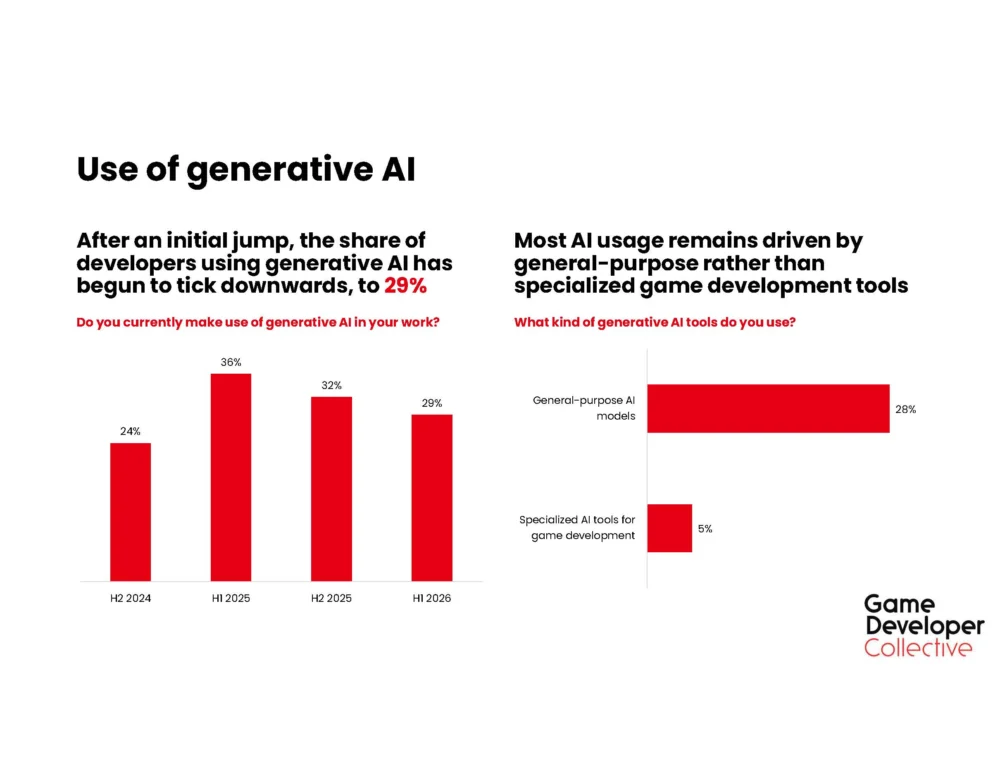
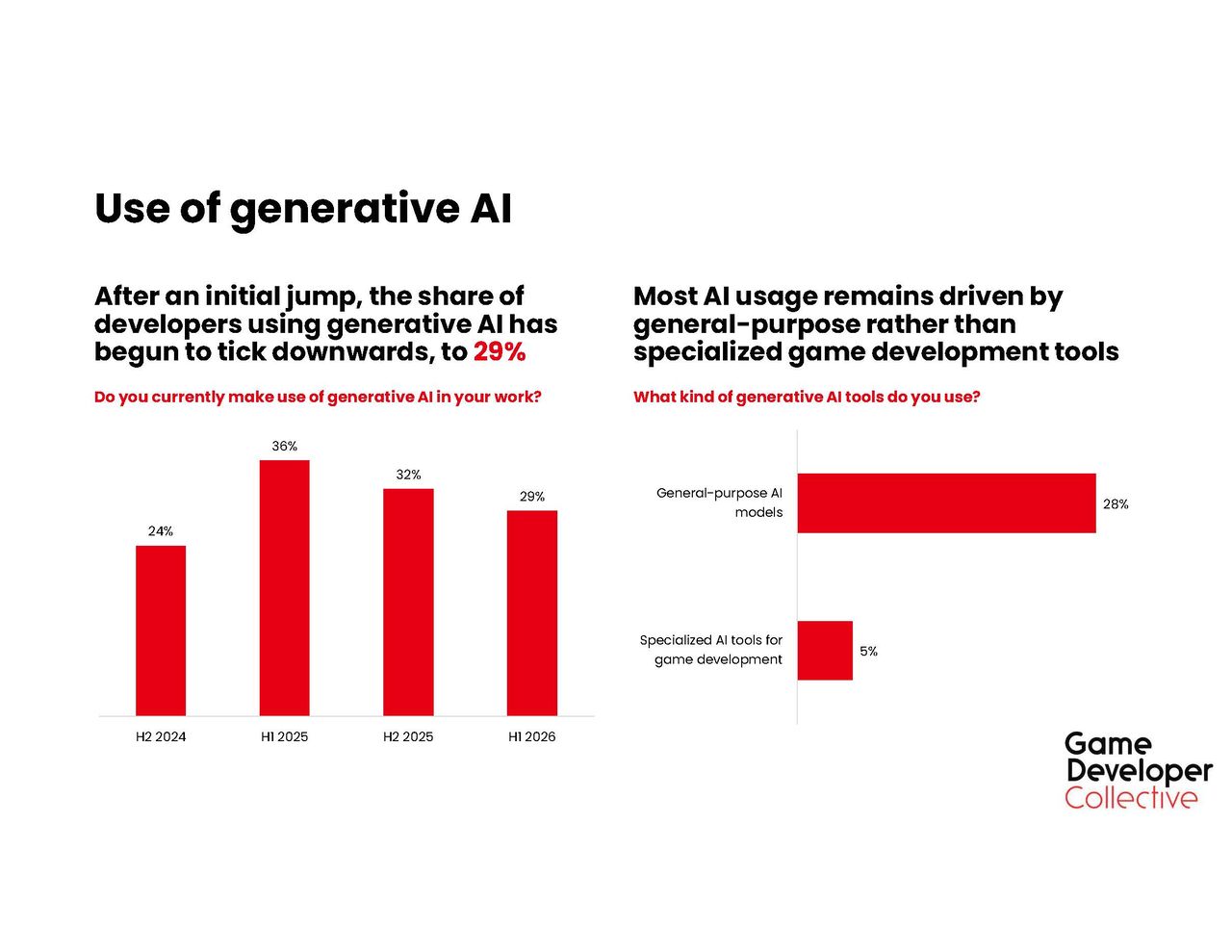
The video game development community’s initial embrace of generative artificial intelligence (AI) tools appears to be cooling, with new data indicating a notable decline in adoption after an early surge of interest. Findings from the Game Developer Collective, a comprehensive survey project conducted in partnership with Omdia, reveal a significant reversal in the trend of AI integration within game studios, accompanied by a growing tide of skepticism regarding the technology’s overall impact. This shift suggests a more cautious and critical stance among developers as the industry grapples with the practicalities, ethical dilemmas, and economic implications of AI.
According to the latest survey, only 29 percent of Game Developer Collective participants reported actively utilizing generative AI tools in the current year. This figure marks a substantial year-over-year decrease from the 36 percent of panelists who indicated using the technology in the corresponding period last year. This downturn represents a significant pivot from the trajectory observed between 2024 and 2025, where generative AI adoption saw a distinct spike. In the latter half of 2024, a mere 24 percent of developers claimed to be using genAI. This number then surged by 12 percent, reaching 36 percent in the first half of 2025, signaling an initial wave of optimism and experimentation. However, the subsequent 7 percent decline indicates that this initial enthusiasm was not sustained, giving way to a more pragmatic, and often critical, evaluation of the technology’s real-world utility and broader implications.
The Shifting Tides of Developer Sentiment
Beyond mere adoption rates, the survey data illuminates a deepening negative sentiment among developers concerning generative AI. As the rate of adoption has receded, an increasing number of professionals within the industry are voicing concerns about the technology’s potential downsides. This mirrors earlier findings and suggests that initial worries have not been assuaged but rather amplified by experience.
Last summer, nearly half (47 percent) of surveyed developers expressed apprehension that generative AI would detrimentally affect the quality of games. In stark contrast, only 11 percent held the belief that AI would positively impact game quality. These figures have largely remained static into the first half of 2026, indicating a persistent and widespread concern about the potential for AI-generated content to dilute creative vision, introduce generic elements, or simply fail to meet the high standards expected by players. This apprehension is particularly salient in an industry where artistic integrity, narrative depth, and innovative gameplay are paramount, and where the human touch is often seen as indispensable for crafting truly compelling experiences.
A more pronounced shift in sentiment has been observed regarding generative AI’s impact on game development costs. In the first half of 2025, 27 percent of panelists were optimistic about genAI’s capacity to reduce expenses. However, this optimism has waned considerably, with only 21 percent echoing that sentiment at the beginning of 2026. Simultaneously, the number of developers who believe that generative AI will increase costs has jumped by 8 percent year-over-year. This reversal suggests that the perceived cost-saving benefits, often touted by AI proponents, have not materialized as anticipated for many studios. Developers may be discovering that while AI can automate certain tasks, the costs associated with licensing sophisticated AI tools, integrating them into complex pipelines, training staff, and crucially, overseeing and refining AI-generated output to meet quality standards, can often outweigh the initial savings. The need for human oversight, quality assurance, and creative direction remains critical, adding layers of complexity and cost that may not have been fully accounted for in early projections.
A Look at the Broader Landscape: Contrasting Survey Results
The Game Developer Collective’s findings offer a crucial snapshot, yet it is important to contextualize this data against other industry surveys to understand the multifaceted perspectives on generative AI. Different methodologies, respondent demographics, and question framings can yield varied results, painting a complex picture of AI’s penetration and perception across the global game development ecosystem.

For instance, the GDC Festival of Gaming, a sibling organization to Game Developer and Omdia under Informa, reported similar adoption rates, finding that approximately one-third of game developers utilize generative AI tools. Crucially, this survey also revealed that half of developers believe the technology is detrimental to the industry as a whole, aligning with the negative sentiment captured by the Collective regarding quality and cost. Both the Game Developer Collective and GDC Festival of Gaming surveys primarily draw their respondents from North America and Europe, suggesting a consistent regional perspective on these issues.
However, geographical differences appear to play a significant role. In Japan, the Computer Entertainment Supplier’s Association (CESA), organizers of the prestigious Tokyo Game Show, reported a much higher adoption rate. According to a report in The Nikkei, 51 percent of Japanese developers are using generative AI. This disparity could be attributed to varying cultural attitudes towards technological adoption, different regulatory environments, or perhaps a stronger emphasis on specific types of automation or content creation workflows within the Japanese game industry.
Perhaps the most divergent data comes from a poll conducted in August 2025 by Google Cloud and The Harris Poll. This survey claimed that a striking 87 percent of developers were using AI agents in their workflows. Furthermore, roughly half of respondents indicated that the technology significantly speeds up tasks such as "playtesting and balancing of mechanics," "localization and translation of game content," and "code generation and scripting support," as reported by GamesIndustry.biz. The substantial difference between this 87 percent figure and the roughly one-third reported by the Game Developer Collective and GDC Festival of Gaming warrants careful consideration. This discrepancy might stem from a broader definition of "AI agents" used by Google Cloud, which could encompass more established, less "generative" forms of AI that have been integrated into development tools for years (e.g., intelligent code completion, automated testing scripts, basic asset optimization). In contrast, the "generative AI tools" specified in the Game Developer Collective survey likely refer to newer, more autonomous systems capable of creating original content, code, or design elements, which are at the heart of the current debate. The Google Cloud survey’s focus on efficiency gains in specific, often technical, tasks also highlights areas where AI’s utility is less contentious, perhaps obscuring the broader creative and ethical concerns associated with generative AI.
Adding another layer of complexity, data from TotallyHuman.io indicates that the number of games released on Steam that disclose the use of generative AI is, in fact, increasing. This trend might seem contradictory to the reported decline in developer adoption. However, it could reflect several factors: the rise of smaller, indie studios leveraging readily available generative AI tools to accelerate asset creation or prototyping; the application of AI in specific, non-core aspects of game development that are easier to integrate; or simply that a smaller percentage of the overall developer population using AI is still translating to a growing number of released products due to market dynamics or specific niches. It’s also possible that larger studios are still exploring AI but on a limited, experimental basis, while smaller teams are deploying it more directly into production.
The Undercurrent of Criticism: Ethical, Economic, and Environmental Concerns
The fluctuating adoption rates and cautious sentiment within the game development community are not occurring in a vacuum. Generative AI, as a technology, has faced a relentless "drumbeat of criticism" on multiple fronts, and these broader societal and industrial concerns undoubtedly contribute to developers’ hesitancy.
One significant area of critique revolves around the harmful environmental impact of generative AI. The training and operation of large language models and image generators require immense computational power, leading to substantial energy consumption and, consequently, a significant carbon footprint. Reports from sources like Reuters have highlighted the insatiable thirst of data centers for water and electricity, raising questions about the sustainability of widespread AI adoption in an era of climate change. For an industry increasingly mindful of its environmental responsibilities, these concerns are not easily dismissed.
Another contentious issue is the potential misappropriation of copyrighted work. Generative AI models are often trained on vast datasets scraped from the internet, which frequently include copyrighted images, texts, and code without explicit permission or compensation to the original creators. This practice has led to numerous lawsuits and ignited fierce debates about intellectual property rights. Within the game industry, where art, music, and narrative are core creative assets, the risk of AI infringing on copyrighted material or devaluing human artistry is a profound concern. Companies like Unity have even had to promise stronger AI copyright guardrails after instances of employees demonstrating AI generating copyrighted characters on stream, underscoring the legal and ethical tightrope the industry walks.
The questionable financials of various AI firms also add a layer of uncertainty. While venture capital has poured billions into AI startups, the long-term profitability and sustainable business models for many generative AI companies remain unproven. Reports from Bloomberg have pointed to circular deals and speculative valuations, raising concerns about the stability and longevity of the AI tools ecosystem. Developers might be wary of investing significant resources into integrating tools from companies whose financial futures are precarious.
Furthermore, the rise of AI has had a tangible impact on the price of PC and console components. The immense demand for high-performance graphics processing units (GPUs) and specialized memory (RAM) for AI training and inference has driven up hardware costs. Reports, including one cited by Game Developer, suggest that this demand is contributing to hardware delays and increased pricing for consumers, potentially affecting the broader gaming market and indirectly the development cost of games.
Finally, concerns about the risk of psychological harm to users have also emerged. The potential for AI to generate misleading information, perpetuate biases, create deepfakes, or even contribute to mental health issues through overly persuasive or manipulative interactions is a growing area of ethical scrutiny. As highlighted by sources like the BBC and The New York Times, issues like AI-induced delusions or psychosis are being discussed, raising a broader societal unease that can spill over into specific industry applications.
The Creative Frontier: Why No Truly "AI-Driven" Games?
Amidst the discussions of adoption rates, costs, and ethical concerns, a fundamental question about generative AI’s impact on game design itself persists. Famed game designer and NYU Game Center founder Frank Lantz recently published a thoughtful analysis titled "Why No AI Games," exploring why, despite the technology’s explosion since 2021, the industry has yet to see a significant emergence of fundamentally new types of AI-driven games.
Lantz’s analysis, and the broader industry discourse, suggests that while generative AI has proven adept at automating existing tasks—generating assets, code snippets, or dialogue—it has largely failed to inspire or enable entirely novel gameplay paradigms. The core experiences offered by games remain largely dictated by human design principles, with AI serving more as an assistive tool rather than a generative core. This indicates a potential gap between the technological capabilities of AI and its creative integration into game design at a conceptual level. Developers may be finding that while AI can create components, the holistic vision, intricate systems, and emotional resonance required for a truly innovative game still necessitate human ingenuity and direction. The challenge lies not just in making content, but in designing meaningful interactions and experiences that AI, at its current stage, struggles to autonomously achieve.
Implications and the Path Forward
The Game Developer Collective’s latest data, coupled with the broader industry sentiment, paints a nuanced and complex picture of generative AI’s role in game development. The initial hype cycle, characterized by a rapid spike in interest and adoption, appears to have given way to a more sober and critical assessment. Developers are increasingly weighing the promised efficiencies against tangible challenges, including quality concerns, unexpected cost increases, and the pervasive ethical and environmental criticisms surrounding the technology.
This cooling period could be interpreted in several ways. It might signify a necessary recalibration, as the industry moves beyond superficial experimentation to understand where generative AI genuinely adds value and where its limitations or risks outweigh its benefits. It could also suggest that for generative AI to achieve widespread, sustainable adoption, its creators and proponents will need to address the fundamental concerns around intellectual property, quality control, ethical governance, and transparent cost structures.
The future of generative AI in game development is far from settled. While its revolutionary potential remains a topic of considerable debate, the current trend indicates a more cautious and selective integration rather than a wholesale embrace. The industry seems to be settling into a phase of careful evaluation, demanding clearer benefits, stronger ethical frameworks, and more robust solutions to the multifaceted challenges before fully committing to this transformative, yet still controversial, technology. The journey from initial fascination to practical, ethical, and economically viable application is proving to be a winding one for generative AI in the dynamic world of game creation.
About the Author