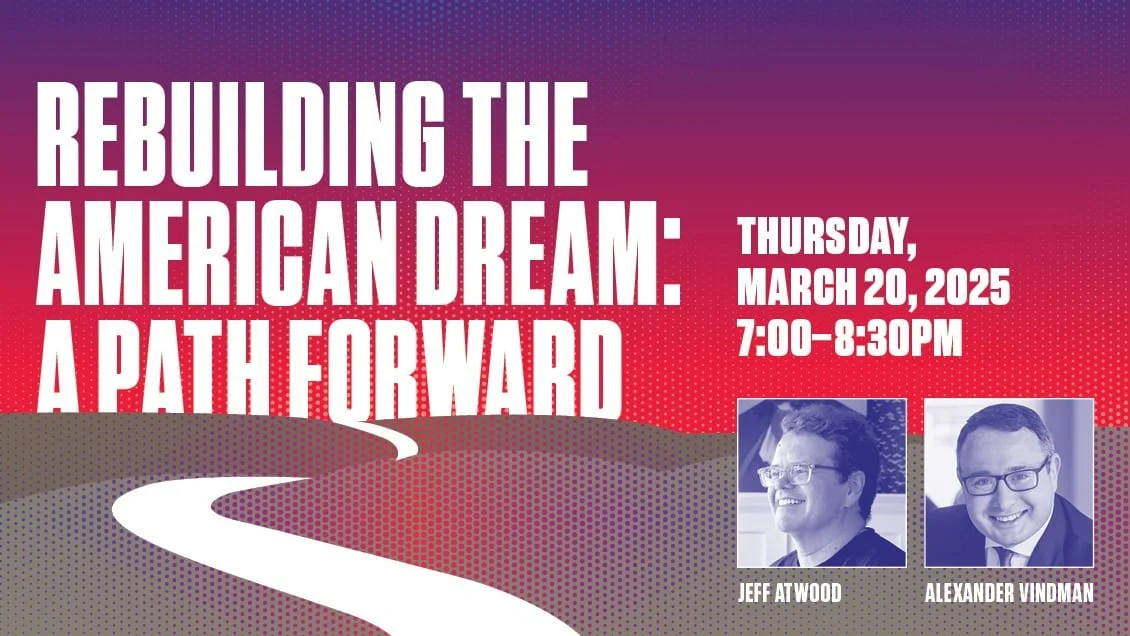
In a pivotal dialogue held on December 19, 2023, at the hallowed Cooper Union Great Hall in New York City, tech entrepreneur Jeff Atwood and retired Lieutenant Colonel Alexander Vindman convened to address the pressing question of how to revitalize the American Dream for the 21st century. The joint talk, titled "Rebuilding The American Dream: A Path Forward," brought together two distinct voices – one from the frontier of digital community building and the other from the battleground of democratic defense – to explore the intricate connections between democracy, community, and economic mobility. Their collective message underscored a vital call to action: moving beyond individual acts of generosity towards implementing systemic changes that foster security, dignity, and possibility for all Americans. The event, livestreamed globally, highlighted the urgent need for active civic engagement and a collaborative spirit to navigate the complex challenges facing the nation.
The Nexus of Ideals and Innovation: A Dialogue on the American Dream
The discussion was framed by Atwood’s earlier concept of "staying gold" – a philosophy advocating for the active preservation of the best aspects of oneself, one’s community, and the foundational ideals of the American Dream. This concept, far from being passive, demands continuous effort, difficult conversations, and a willingness to confront societal realities to forge a better future. The year 2023 presented a critical juncture, with widespread concerns regarding economic disparities, political polarization, and the erosion of trust in institutions. The American Dream, traditionally defined by the promise that hard work and opportunity lead to upward mobility, has increasingly felt like a question rather than an assurance for many. Atwood and Vindman sought to provide a framework for answering this question, emphasizing that while their backgrounds diverged significantly, their shared conviction in the fight for everyone’s American Dream formed the bedrock of their collaboration.
A Historic Venue for Timely Discussions: The Cooper Union Great Hall
The choice of the Cooper Union Great Hall as the venue added profound historical resonance to the discussion. Established in 1859 by industrialist Peter Cooper, the institution was founded on the radical principle of free education, aiming to provide working-class individuals with access to knowledge and opportunity. Its Great Hall quickly became a prominent forum for public discourse, hosting iconic figures who shaped American history. Abraham Lincoln delivered his pivotal "Might Makes Right" speech there in 1860, a speech widely credited with boosting his presidential campaign. Over the decades, figures like Frederick Douglass, Susan B. Anthony, Mark Twain, and multiple U.S. presidents have graced its stage, making it a crucible for national debates on abolition, women’s suffrage, civil rights, and economic justice. By choosing this venue, Atwood and Vindman consciously placed their contemporary discussion within a continuum of vital American dialogues, signaling the enduring importance of public discourse in navigating national challenges and shaping the future. The historical weight of the Great Hall underscored the gravity of their topic: the very fabric of American society and its founding promises.
Profiles in Courage and Community Building
The synergy between the two speakers was central to the event’s unique appeal, bridging the seemingly disparate worlds of military service and tech innovation.
Lt. Col. Alexander Vindman: Upholding Democratic Integrity
Alexander Vindman’s journey is a testament to the American Dream and the sacrifices often required to defend its underlying principles. Born in the Soviet Union, he immigrated to the United States as a child, growing up in Brooklyn. His path led him to enlist in the U.S. Army, where he served with distinction for 21 years, earning a Purple Heart for injuries sustained during his deployment in Iraq. His career culminated in his role as Director for European Affairs on the National Security Council. Vindman gained national prominence during the 2019 impeachment inquiry against then-President Donald Trump, where he testified about concerns regarding presidential conduct. His decision to prioritize his oath of office and the values he swore to protect over personal and professional convenience ultimately cost him his military career. His unwavering commitment to integrity and the rule of law served as a powerful embodiment of civic duty, offering a firsthand perspective on the fragility of democratic institutions and the courage required to safeguard them. Vindman’s insights into the challenges facing American democracy were deeply informed by his experience both as an immigrant from an authoritarian state and as a decorated officer dedicated to constitutional principles.
Jeff Atwood: Architect of Digital Democracies
Jeff Atwood, a prominent figure in the technology world, brought an equally compelling, albeit different, perspective. As the co-founder of highly successful online platforms like Stack Overflow and Discourse, Atwood has spent decades building and observing digital communities. Stack Overflow, a Q&A platform for programmers, exemplifies a self-governing meritocracy where users contribute, moderate, and curate content, leading to a vast repository of public knowledge. Discourse, an open-source discussion platform, is designed to foster constructive dialogue and community engagement. Atwood’s work has provided him with invaluable insights into how people interact online, how communities form, thrive, or fail, and the mechanisms required to create digital spaces that promote fairness, participation, and productive discourse. He argued that the principles necessary for managing successful online communities – clear expectations, fair systems, strong boundaries, and a shared sense of purpose – are surprisingly analogous to the principles required for effective governance in a democratic society. His premise was that understanding how to scale self-governing digital communities offers relevant lessons for the future of democracy itself, particularly in an era increasingly shaped by digital interactions and information flows.
Deconstructing the American Dream in the 21st Century
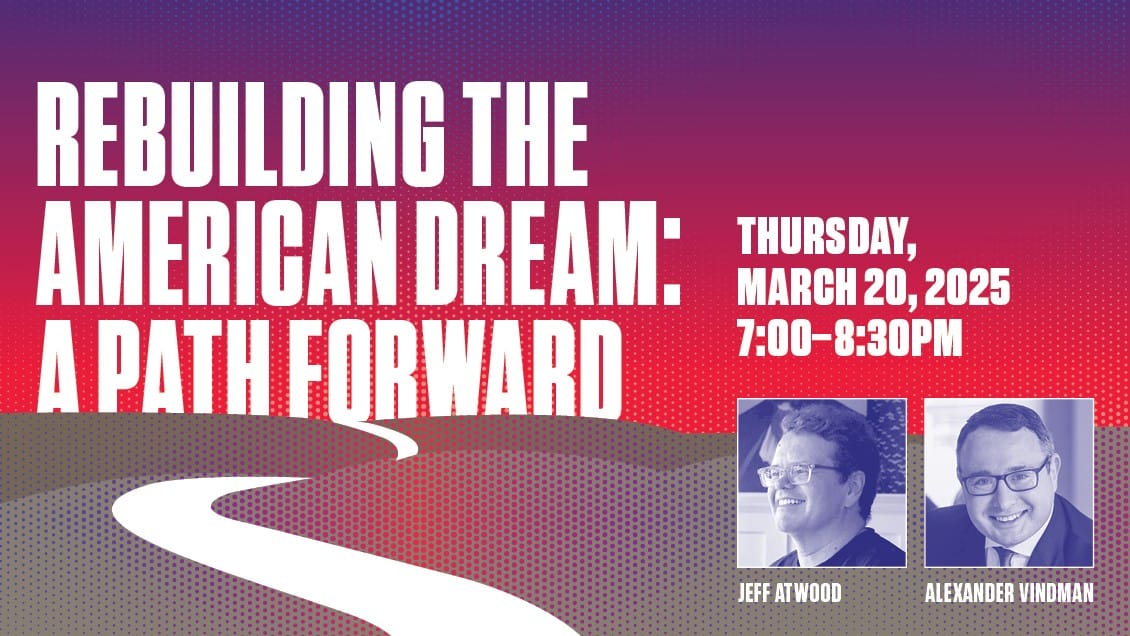
The core of their dialogue centered on dissecting the contemporary challenges to the American Dream and proposing concrete pathways forward.
Economic Mobility and Opportunity
The speakers acknowledged the growing perception that the American Dream is becoming increasingly elusive. Data from various sources underscore these concerns. The Gini coefficient, a measure of income inequality, has steadily risen in the United States over recent decades, indicating a widening gap between the wealthiest and the rest of the population. Studies on intergenerational mobility reveal that it is increasingly difficult for individuals to move up the economic ladder compared to previous generations, with the odds of surpassing one’s parents’ income declining. For instance, research from Stanford University’s Opportunity Atlas shows significant geographical disparities in upward mobility. Furthermore, the rising costs of education, healthcare, and housing have placed immense pressure on middle-class families, often negating the gains from hard work. Atwood and Vindman argued that these trends necessitate a shift from relying on individual generosity – admirable but insufficient – to building robust systems that inherently create broader opportunity and economic security. This involves examining and reforming policies related to education, labor, taxation, and social safety nets to ensure that the promise of a better future is accessible to all, not just a privileged few.
Democracy and Civic Engagement
Concerns about the health of American democracy were also a focal point. Recent years have seen a rise in political polarization, a decline in public trust in governmental institutions, and the proliferation of misinformation. Data from organizations like the Pew Research Center consistently show declining trust in government, media, and even fellow citizens. Voter turnout, while sometimes seeing spikes, often lags behind other developed nations, indicating a potential disconnect between citizens and their electoral processes. Vindman’s experience as a witness to and participant in high-stakes political events provided a somber reminder of the fragility of democratic norms and the importance of institutional checks and balances. He emphasized that defending democracy requires not just vigilance against external threats but also internal fortitude and a commitment to truth and accountability. Atwood, from his vantage point in the digital sphere, highlighted how the architecture of online platforms can either exacerbate division or foster constructive dialogue. He argued that intentional design, clear rules, and robust moderation are essential to cultivate spaces – both digital and physical – where diverse viewpoints can engage productively without devolving into acrimony.
Community and Shared Purpose
The concept of community served as a crucial bridge between economic opportunity and democratic health. Both speakers stressed that a thriving American Dream relies on strong, cohesive communities where individuals feel a sense of belonging and shared purpose. Atwood drew parallels between the need for "artifacts for the common good," like local parks, where everyone can enjoy them together, and the need for digital spaces that similarly serve public interest. He explained how successful online communities define their purpose, establish clear boundaries for behavior, and implement fair systems for participation and conflict resolution. These lessons, he contended, are directly applicable to strengthening local communities and the nation as a whole. Vindman reinforced this by emphasizing that a strong civic fabric is essential for citizens to engage in the hard work of democracy, to hold leaders accountable, and to collectively strive for a more perfect union. Without a shared sense of purpose and mutual respect, the ability to address complex societal problems becomes severely hampered.
The Call to Action: Moving Beyond Generosity to Systemic Change
The most profound takeaway from the Cooper Union event was the urgent call to move beyond an individualistic approach to societal problems. While individual acts of kindness and philanthropy are commendable, they are insufficient to address deeply entrenched systemic issues. The speakers advocated for a paradigm shift: identifying specific, foundational areas where structural change can create lasting security, dignity, and possibility for all citizens. While not offering a detailed policy blueprint, they promised an "honest, unfiltered conversation about how we move forward, with specifics." This implied a need for data-driven policy solutions, institutional reforms, and a renewed commitment to collective action. Vindman’s embodiment of American ideals provided the moral compass, while Atwood’s experience in building scalable, self-governing digital communities offered practical insights into designing systems that encourage participation and fairness. Together, they painted a picture of a future where collaborative effort, informed by both principle and pragmatism, could indeed rebuild the American Dream.
Reactions and Broader Implications
The event garnered significant attention, both from the live audience at Cooper Union and from viewers worldwide via the YouTube livestream. Initial reactions from attendees and online commentators suggested a strong resonance with the speakers’ message, particularly the emphasis on active citizenship and systemic change. Experts in political science and technology policy lauded the interdisciplinary nature of the discussion. Dr. Eleanor Vance, a political sociologist, noted, "Bringing together a defender of democratic institutions with an architect of digital communities offers a refreshing and necessary perspective. The challenges to democracy and economic equity are intertwined, and solutions will require insights from across traditional silos." Technology ethicists highlighted Atwood’s nuanced understanding of how digital platforms can both empower and fragment communities, underscoring the responsibility of tech leaders in shaping civic discourse.
The broader implications of such high-profile dialogues are manifold. Firstly, they contribute to a vital public discourse on the state of the nation, prompting reflection and engagement among citizens. Secondly, by modeling constructive dialogue between individuals from different professional spheres, they can help bridge the growing divides in society. Thirdly, the emphasis on systemic change over individual generosity could influence philanthropic efforts and policy advocacy, steering resources towards more structural solutions. Finally, the event served as a powerful reminder that the American Dream is not a static inheritance but an ongoing project requiring constant vigilance, adaptation, and collaborative effort from all citizens. The partnership between Atwood and Vindman underscored a fundamental truth: imagination, courage, and collective action are indispensable ingredients for securing a future where the promise of America truly works for everyone.
About the Author