The universe, an expanse estimated to be 13.8 billion years old, presents one of humanity’s most profound cosmic riddles: if life is statistically probable and given the vast timescale for evolution, why has Earth not yet encountered any definitive signs of extraterrestrial civilizations? This perplexing question, known as the Fermi Paradox, highlights a stark contradiction between the high probability of alien life’s existence and the complete absence of observable evidence. Our planet has been a cradle of life for billions of years, a mere fraction of the cosmic timeline, yet the silence from the stars is deafening.
The Genesis of a Cosmic Question
The paradox takes its name from Italian-American physicist Enrico Fermi. During an informal lunchtime conversation in 1950 with fellow scientists Edward Teller, Herbert York, and Emil Konopinski at Los Alamos National Laboratory, the discussion turned to a recent cartoon depicting aliens. Fermi abruptly posed the question, "Where is everybody?" Given the estimated age and size of the universe, the number of stars, and the likelihood of planets orbiting them, it seemed improbable that Earth would be the sole abode of intelligent life. If extraterrestrial civilizations were common, even a small percentage of them developing interstellar travel would mean our galaxy, the Milky Way, should have been explored and colonized multiple times over. Fermi’s simple query encapsulated a profound scientific and philosophical dilemma that continues to challenge astronomers, physicists, and philosophers today.
The Drake Equation: Estimating the Unseen
To formalize the probability of extraterrestrial intelligence, astronomer Frank Drake proposed an equation in 1961, known as the Drake Equation. This probabilistic argument estimates the number of communicative extraterrestrial civilizations in the Milky Way galaxy. The equation is expressed as:
N = R* × fp × ne × fl × fi × fc × L
Where:
- N: The number of civilizations in our galaxy with which communication might be possible.
- **R***: The average rate of star formation in our galaxy (estimated at 1.5 to 3 stars per year).
- fp: The fraction of those stars that have planets (current exoplanet discoveries suggest this is very high, possibly close to 1).
- ne: The average number of planets that can potentially support life per star that has planets (estimates vary widely, but the discovery of exoplanets in habitable zones suggests this number is not negligible).
- fl: The fraction of those planets where life actually develops (from simple microbial to complex multicellular).
- fi: The fraction of planets with life where intelligent life emerges.
- fc: The fraction of civilizations that develop a technology that releases detectable signs of their existence into space (e.g., radio signals).
- L: The length of time for which such civilizations release detectable signals into space (this is a critical and highly uncertain variable).
While the first few factors in the Drake Equation have become more constrained by astronomical observations, particularly with the discovery of thousands of exoplanets, the latter biological and sociological factors remain highly speculative. Depending on the values assigned to these variables, N can range from one (us) to many millions. The vast potential implied by even conservative estimates of N makes the cosmic silence even more perplexing, fueling the Fermi Paradox.
The Observable Universe and the Scale of Possibility

To fully appreciate the scope of the paradox, one must grasp the sheer scale of the observable universe. It contains an estimated 2 trillion galaxies, each hosting hundreds of billions of stars. Our own Milky Way galaxy alone is thought to contain between 100 billion and 400 billion stars. Recent data from missions like NASA’s Kepler Space Telescope suggest that planets are ubiquitous, with potentially billions of Earth-like planets residing in the habitable zones of their stars within our galaxy alone. Given that the universe is 13.8 billion years old, and Earth formed relatively late, about 4.5 billion years ago, there have been vast stretches of time and countless opportunities for life to emerge and evolve elsewhere, potentially billions of years before life on Earth even began. This "13 billion year head start" for evolution in the cosmos implies that any advanced civilizations would have had ample time to develop technologies far beyond our current understanding, including interstellar travel or communication methods.
The Great Filter: A Universal Bottleneck?
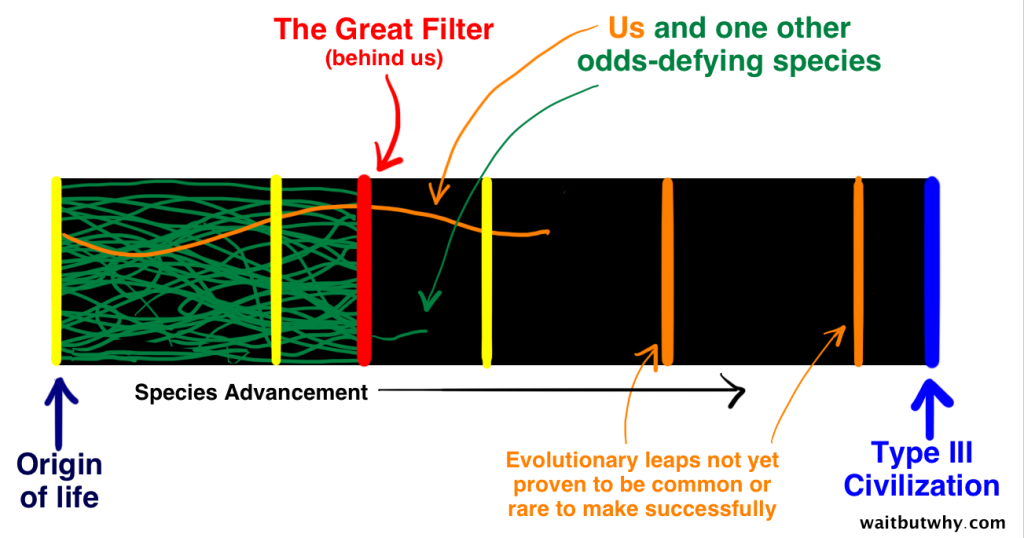
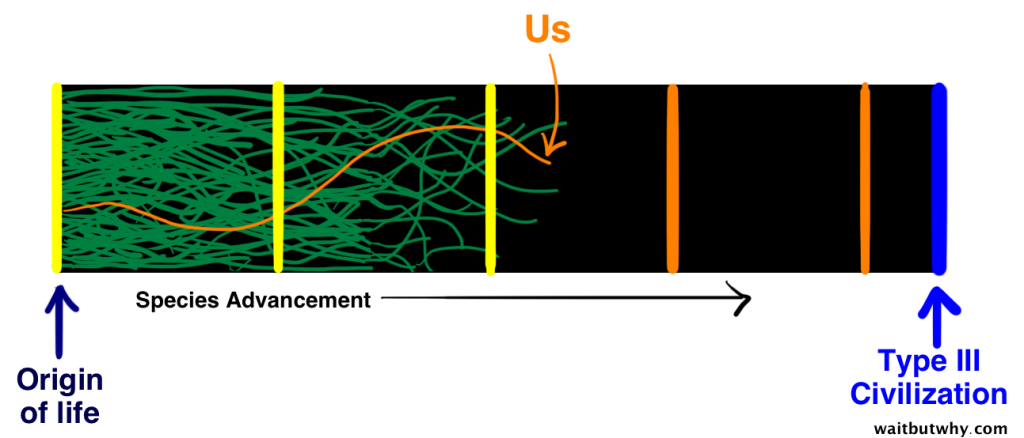
One of the most compelling hypotheses attempting to resolve the Fermi Paradox is the "Great Filter" theory. Proposed by economist Robin Hanson in 1996, this theory suggests that at some point in the long evolutionary path from pre-life to a Type III civilization (a civilization capable of harnessing the energy of an entire galaxy, according to the Kardashev scale), there exists a "wall" or an extremely unlikely, perhaps impossible, step that almost all attempts at life hit. This critical bottleneck, the Great Filter, could be in our past, meaning humanity has already passed it, or it could be in our future, posing an existential threat to our continued existence.
The implications of where the Great Filter lies are profound:
-
The Filter is in Our Past: This scenario suggests that the emergence of complex, intelligent life is extraordinarily rare. Stages like the genesis of life from non-living matter (abiogenesis), the transition from prokaryotic to eukaryotic cells, the development of multicellularity, or the evolution of complex brains and tool-use might be the incredibly improbable hurdles. If this is the case, humanity might be among the first, or perhaps the only, intelligent species to have overcome these initial barriers, making us incredibly fortunate but also profoundly alone. This aligns with the "Rare Earth Hypothesis," which posits that the combination of astrophysical and geological events necessary for complex life (e.g., a stable star, a planet in the habitable zone with a large moon, plate tectonics, a strong magnetic field) is exceedingly rare.
-
The Filter is in Our Future: This is a far more unsettling possibility. It implies that intelligent civilizations typically reach a certain point of technological advancement before encountering an insurmountable challenge that leads to their demise. This could manifest in various forms:
- Self-destruction: Advanced technology might invariably lead to the self-annihilation of a civilization, perhaps through nuclear warfare, unchecked environmental degradation, resource depletion, or uncontrolled artificial intelligence. Our current global challenges, such as climate change and the proliferation of advanced weaponry, can be seen as potential precursors to such a filter.
- Technological Stagnation or Retreat: Civilizations might reach a plateau where they lack the motivation or resources to expand further, or they might deliberately choose to remain isolated and undetectable.
- Cosmic Catastrophes: While less likely to be a universal filter for all civilizations, events like gamma-ray bursts, asteroid impacts, or supervolcanic eruptions could wipe out nascent intelligence on a planetary scale.
-
The Filter is Us (or close to us): This variation suggests that the transition from current human civilization to a truly interstellar or galaxy-spanning civilization is the difficult step. Perhaps the development of highly advanced, detectable technologies is itself the filter, leading to either self-destruction or an evolution beyond such visible forms.
Alternative Explanations for the Silence
Beyond the Great Filter, numerous other hypotheses attempt to explain the cosmic silence:
-
They Are Here, But We Don’t Know It: This "Zoo Hypothesis" suggests that advanced civilizations are aware of our existence but choose not to interfere, observing us as if we were animals in a cosmic zoo. This non-intervention policy might be part of a galactic ethical code. Alternatively, they might be here but in forms we do not recognize or in hidden enclaves, as suggested by Carl Sagan regarding time travelers.
-
They Are Too Far Away: The sheer distances between stars and galaxies, combined with the speed of light limit, mean that even if civilizations exist, their signals might not have reached us yet, or their physical presence is simply too far to detect. The universe is not only vast but also constantly expanding, making travel and communication across immense cosmic distances incredibly challenging.
-
They Evolved Differently: Our search for extraterrestrial intelligence (SETI) is largely based on anthropocentric assumptions – looking for radio signals, Dyson spheres, or other signs of technological activity similar to our own. Alien life and intelligence might operate on entirely different principles, using forms of communication or energy manipulation that are currently beyond our comprehension or detection capabilities.
-
The "Small is Fast" Hypothesis (Technological Transcendence): A compelling argument, articulated by individuals like astronomer Seth Shostak and echoed by Jeff Atwood, posits that advanced intelligent life might trend towards increasingly smaller, faster, and more efficient forms. Just as computers have evolved from room-sized behemoths to minuscule, powerful chips, advanced civilizations might shed their physical forms or large-scale engineering projects. They might move beyond the need for vast energy consumption or planetary manipulation, opting instead for highly efficient, possibly digital or quantum, existence within hyper-compact spaces.
- Seth Shostak elaborated on this, suggesting, "Why build planet-size anything when the real action is in the small things? Small spaces, small units of time, everything gets smaller." This paradigm shift implies that a truly advanced civilization might not leave behind the grand, visible cosmic architecture we currently search for. Instead, they might inhabit "the infinite spaces between," perhaps existing as intricate nanobot swarms, distributed consciousness, or purely informational entities that are inherently difficult, if not impossible, for our current observational technologies to detect. Their "footprint" might be so subtle or so fundamentally different from what we expect that we simply overlook it. This hypothesis aligns with concepts of post-biological intelligence and technological singularity, where intelligence could transcend its biological origins and physical constraints, becoming something entirely new and possibly invisible to us.
-
Short Lifespan of Communicative Civilizations: The "L" variable in the Drake Equation – the lifespan of a communicative civilization – might be inherently short. Perhaps civilizations, once they achieve the ability to send signals across space, do not last long enough for those signals to travel meaningful distances and be received. This could be due to self-destruction, environmental collapse, or even a transition to a non-communicative state.
Current Search Efforts and Future Outlook
Despite the enduring mystery, the search for extraterrestrial intelligence continues. Projects like SETI (Search for Extraterrestrial Intelligence) have been scanning the skies for decades, primarily listening for radio signals, a method chosen because radio waves travel at the speed of light and can penetrate cosmic dust clouds. While no definitive signals have been detected, the efforts continue to evolve, with new approaches exploring optical SETI and other forms of electromagnetic radiation.
The ongoing discovery of exoplanets, particularly those in habitable zones, continues to fuel optimism and refine our understanding of planetary formation and potential abodes for life. Missions like the James Webb Space Telescope are providing unprecedented views of exoplanet atmospheres, potentially allowing us to detect biosignatures or technosignatures in the future.
The Fermi Paradox forces humanity to confront its place in the universe. Are we truly alone, an improbable fluke of cosmic evolution? Or is the universe teeming with life, yet separated from us by vast distances, different evolutionary paths, or an insurmountable filter that awaits us? The answer to "Where is everybody?" remains elusive, but the pursuit of that answer continues to drive scientific inquiry, pushing the boundaries of our knowledge and inspiring a deeper contemplation of life’s origins and destiny in the grand cosmic tapestry. The silence, far from being discouraging, serves as a powerful impetus for exploration, both outward into the cosmos and inward into the very nature of intelligence and civilization.
About the Author