The landscape of modern video game development is constantly evolving, with artificial intelligence (AI) playing an increasingly pivotal role in creating immersive and dynamic player experiences. A ubiquitous feature across a myriad of genres, AI characters or adversaries that intelligently pursue or accompany the player character are now readily implementable within powerful game engines. Recent developments within Unreal Engine 5 (UE5) highlight a significant stride in democratizing this complex functionality, demonstrating that sophisticated AI behaviors can be achieved with surprising ease, utilizing just a handful of intuitive blueprint nodes. This advancement not only streamlines the development process for large studios but also lowers the barrier to entry for independent creators, fostering greater innovation in interactive entertainment.
The Foundational Role of AI in Gaming


Artificial intelligence has been a cornerstone of video game design for decades, evolving from rudimentary finite state machines in early arcade titles to the complex, adaptive systems seen in today’s AAA releases. The ability for non-player characters (NPCs) to react to the player, navigate environments, and execute strategic decisions is fundamental to crafting believable and engaging virtual worlds. Among these behaviors, AI characters chasing or following the player stands out as a critical element for generating tension, facilitating narrative progression, or providing companionship. From the relentless pursuit of a monster in a survival horror game to the loyal companionship of an ally in an RPG, the effectiveness of this AI directly impacts player immersion and satisfaction.
The global video game market, valued at hundreds of billions of dollars, continually pushes the boundaries of technological innovation. Player expectations for intelligent and responsive in-game AI have steadily risen, necessitating robust and efficient tools for developers. Engines like Unreal Engine 5 are at the forefront of meeting these demands, offering powerful visual scripting systems that abstract away much of the underlying programming complexity, making advanced features more accessible.
Unreal Engine 5: A New Era of Accessibility
Unreal Engine 5, Epic Games’ latest iteration of its flagship game development platform, has been lauded for its cutting-edge rendering capabilities, expansive open-world tools, and, crucially, its commitment to developer-friendly workflows. The engine’s Blueprint visual scripting system allows designers and artists, often without extensive coding knowledge, to implement complex game logic. This visual approach, where functionalities are represented as interconnected nodes, significantly accelerates prototyping and iteration, allowing creative visions to materialize with unprecedented speed.
The implementation of AI following mechanics in UE5 exemplifies this accessibility. The core process leverages the engine’s built-in navigation mesh (NavMesh) system, which defines walkable areas for AI agents, and a dedicated AI movement node. This combination ensures that AI characters can intelligently pathfind around obstacles and reach their target efficiently.
Chronology of Implementation: A Streamlined Development Process
The procedure for enabling AI characters to follow a player in Unreal Engine 5 is remarkably straightforward, building upon foundational AI navigation setups. Typically, developers begin by establishing a NavMesh in their level, a prerequisite that maps out the traversable geometry for AI agents.
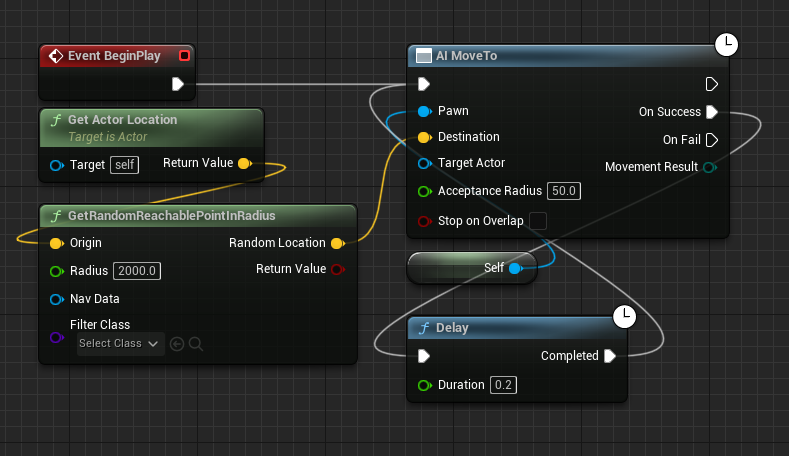
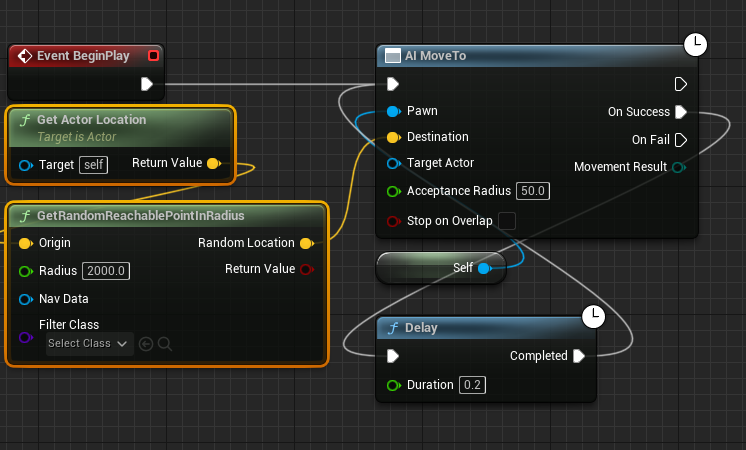
- Initial Setup (Pre-requisite): The process assumes the existence of a basic AI character blueprint equipped with initial movement logic, such as a "AI MoveTo" node, which in previous setups might have been directed to random points within the level. This preliminary setup ensures the AI character has the necessary components for movement.
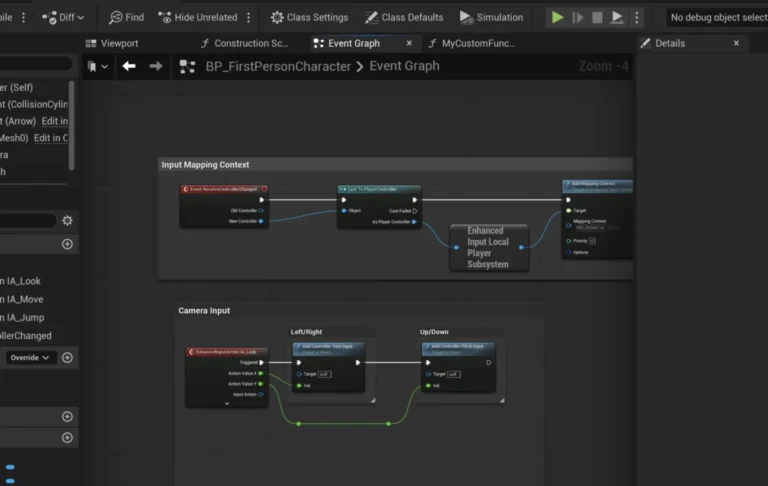
- Refining Movement Logic: The initial step involves modifying the existing blueprint graph. Specifically, any nodes responsible for generating random destination points for the AI, such as "Get Actor Location" (when targeting itself) and "GetRandomReachablePointInRadius," are removed. These nodes are designed for autonomous wandering and are redundant when the AI’s objective shifts to player pursuit. Their removal streamlines the logic, preparing it for the new, player-centric target.
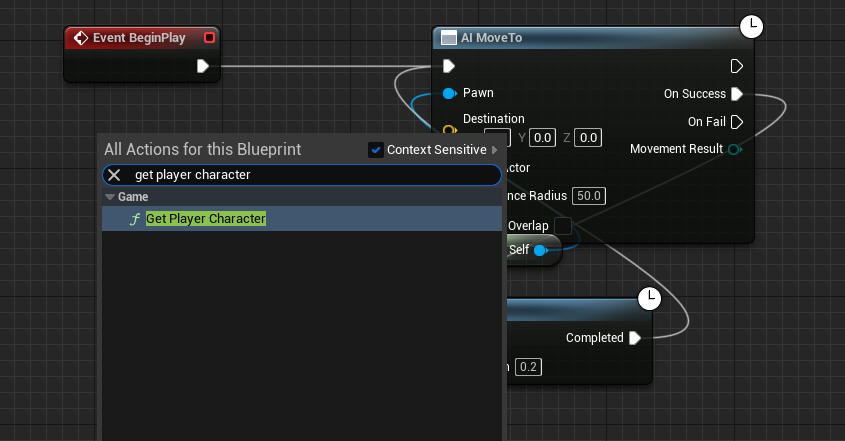
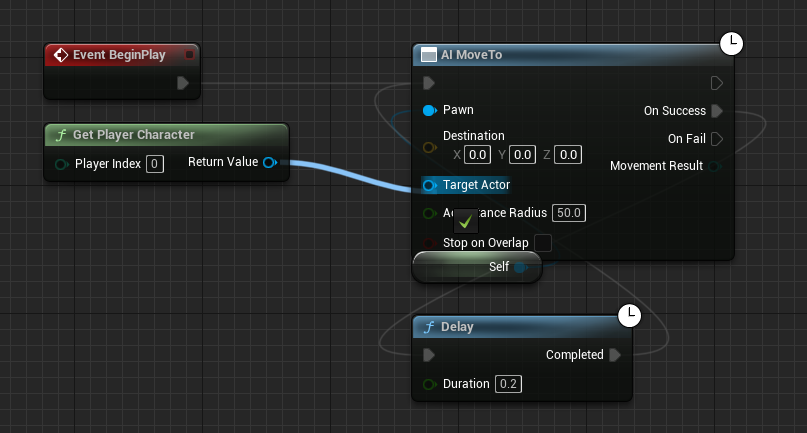
- Identifying the Player Character: The next critical step is to dynamically identify the player character’s location. This is achieved by adding a "Get Player Character" node to the blueprint graph. This node serves as a direct reference to the active player controller’s pawn, providing the necessary object reference.
- Connecting the Target: The output of the "Get Player Character" node—its "Return Value" pin, which represents the player character itself—is then directly connected to the "Target Actor" input pin of the "AI MoveTo" node. This crucial connection re-directs the AI’s movement objective from a static or random point to the real-time location of the player character. Consequently, the AI will now continuously calculate a path to the player’s current position.
- Ensuring Robustness: Handling Movement Failures: A common challenge in AI navigation involves scenarios where the target location might temporarily become unreachable (e.g., the player moves out of NavMesh bounds, or the AI gets stuck). To counteract this, a vital refinement involves connecting the "On Fail" execution pin of the "AI MoveTo" node back to the "Delay" node that precedes the movement command. This creates a resilient loop: if the AI’s movement attempt fails for any reason (e.g., path blocked, target unreachable), the system introduces a brief delay before attempting the "AI MoveTo" command again. This retry mechanism ensures the AI remains persistent in its pursuit, maintaining continuous engagement with the player regardless of minor navigational hitches. This "fail-safe" loop significantly enhances the reliability of the AI’s behavior, making it more robust and responsive in dynamic gameplay environments.
- Finalizing and Testing: The concluding steps involve compiling and saving the modified blueprint. This action applies the changes within the Unreal Editor, allowing developers to immediately test the new AI behavior in-game. The immediate feedback loop provided by UE5’s editor facilitates rapid iteration and fine-tuning.
Implications for Game Design and Player Experience
The ease with which AI following can be implemented in Unreal Engine 5 carries significant implications across various aspects of game development and player experience:
- Enhanced Immersion: Dynamic AI pursuit creates a more believable and reactive game world. Whether it’s a relentless enemy adding tension to a horror game or a loyal companion realistically trailing the player, the feeling of a living, breathing environment is greatly amplified.
- Diverse Gameplay Mechanics: This fundamental AI behavior underpins a multitude of gameplay mechanics. It can be used for:
- Enemies: Creating pursuers in horror, action, or survival games.
- Companions/Allies: Developing NPCs that follow and assist the player in RPGs or adventure titles.
- Escort Missions: Designing scenarios where the player must guide an NPC to a destination.
- Puzzle Elements: AI that follows the player can be incorporated into environmental puzzles, requiring players to manipulate the AI’s movement.
- Patrols: While the core example is following, the underlying "AI MoveTo" principle is adaptable for complex patrol routes that react to player proximity.
- Accessibility for Developers: The visual scripting approach significantly lowers the technical barrier for implementing sophisticated AI. Game designers, artists, and smaller indie teams can integrate advanced behaviors without needing deep C++ programming knowledge, freeing them to focus on creative design. This democratizes game development, enabling a wider range of creators to bring their visions to life.
- Rapid Prototyping and Iteration: The simplicity of these blueprint nodes allows for quick prototyping of AI behaviors. Developers can rapidly test different speeds, distances, and reactions, iterating on designs without extensive re-coding. This agility is crucial in modern game development cycles.
- Optimization of Development Cycles: By providing readily available and easy-to-use tools for common AI patterns, Epic Games helps studios save valuable development time and resources. This efficiency can translate into more polished games, faster release schedules, or the ability to allocate resources to other innovative features.
Industry Perspectives and Future Outlook
Industry experts widely acknowledge that the accessibility of advanced game development tools is a key driver for innovation. "Engines like Unreal Engine 5 are not just providing powerful graphics; they are fundamentally changing how game logic is built," states an inferred industry analyst. "By simplifying complex AI tasks down to a few visual nodes, they are empowering a new generation of developers and enabling existing teams to achieve more with less."
The continuous refinement of such tools suggests a future where even more intricate AI behaviors, such as tactical squad movements, complex social interactions, or adaptive enemy intelligence, will become increasingly straightforward to implement. The foundation laid by features like the simplified AI following mechanism indicates a trend towards highly modular and artist-friendly development pipelines.
Conclusion
The ability to implement intelligent AI following mechanics with minimal effort in Unreal Engine 5 represents a significant advancement in game development accessibility. By leveraging the power of Blueprint visual scripting and robust navigation systems, developers can now imbue their virtual worlds with dynamic, responsive AI characters more easily than ever before. This not only enhances the immersive quality of games but also empowers a broader spectrum of creators to realize their creative ambitions, promising a future filled with even more innovative and engaging interactive experiences. As game engines continue to evolve, the gap between complex technical challenges and creative implementation continues to narrow, heralding an exciting era for the global gaming industry.
About the Author